




Mahogany Fauteuil Chairs
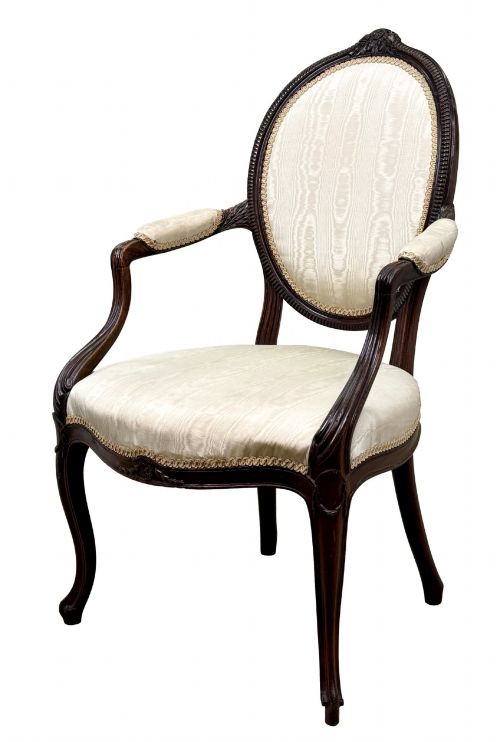
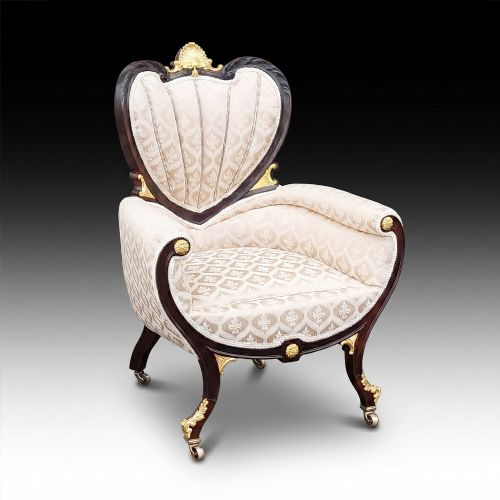
These mahogany fauteuil chairs bring French and English formal seating into a room, offering carved wooden frames and open arms.
Mahogany Fauteuil Chairs
When searching for mahogany fauteuil chairs, buyers look at open armchairs originating primarily from nineteenth-century France and England, alongside revival styles. The pieces combine structural wooden frames with upholstered seats and backrests designed for formal salons, libraries, and studies.
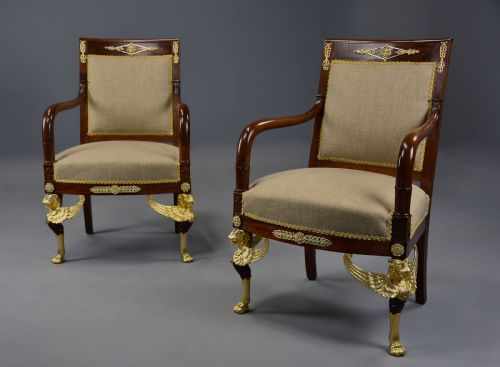
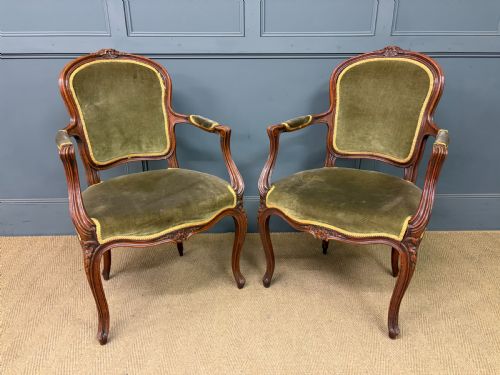
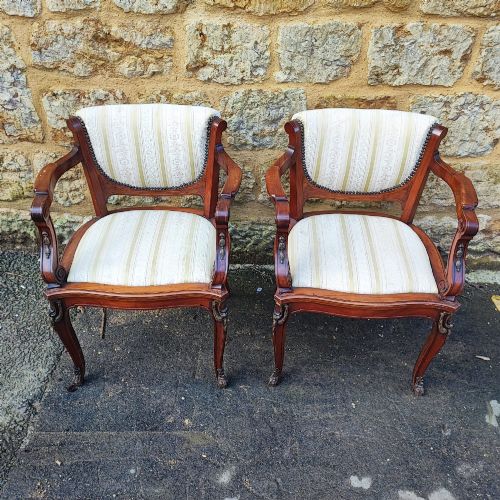
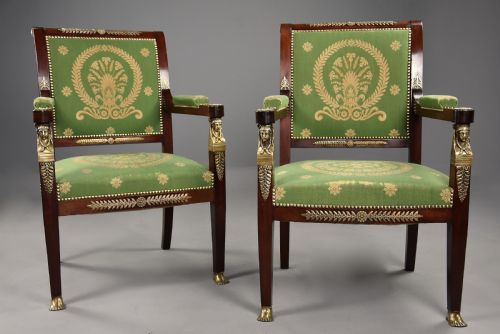
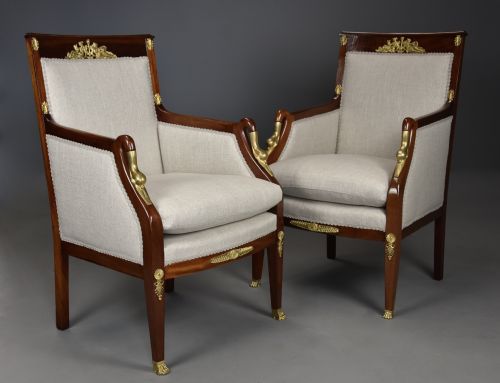
The version met most frequently on this page is the nineteenth-century French armchair adhering to Empire or Louis XV revival aesthetics. These chairs frequently appear in pairs or matched sets, featuring carved wooden armrests and frames constructed from solid mahogany.
Construction and Materials
Frames are constructed from solid mahogany, selected for its stability and deep grain, often shaped through detailed carving and joinery. Artisans applied bronze mounts, ormolu, and brass details directly onto the mahogany woodwork to accent the structural lines of Empire and revival designs.
Upholstery relies on textiles such as leather, linen, velvet, and fabric fixed across sprung or padded seats and backs. These materials are secured to the wooden frames using traditional webbing and stuffing techniques typical of nineteenth-century seating workshops.
Several armchairs arrive with desk adaptations, proving that nineteenth-century scholars also enjoyed deep mahogany cushioning while working.
Evaluating Quality
Quality rests upon the crispness of the carved wooden decoration and the structural integrity of the mahogany frame. Pieces with deeply sculpted foliage or figures demonstrate superior hand-carving skill compared to softly moulded examples.
The integration of metal mounts distinguishes finer pieces. Cast bronze or ormolu elements fitted tightly to the mahogany show higher craftsmanship than cast pieces with loose alignment or simple brass plating.
The Mahogany Fauteuil Chairs Glossary
- Fauteuil
- An open-arm armchair with upholstered back and seat, originating in France. The wooden frame is exposed around the padding.
- Ormolu
- Gilded bronze used for decorative mounts on furniture. It is applied to highlight corners and structural joints.
- Empire
- A neoclassical design style spanning the late eighteenth and nineteenth centuries. It draws inspiration from ancient Roman and Greek motifs.
- Hepplewhite
- An eighteenth-century English furniture style known for light frames and shield-shaped chair backs. Pieces often utilise mahogany.
- Salon suite
- A matching set of seating furniture designed for a formal drawing room. It typically includes armchairs and larger central sofas.
Mahogany Fauteuil Chairs: Frequently Asked Questions
What is a fauteuil chair?
A fauteuil is an upholstered armchair featuring open wooden arms. The structural frame remains visible around the padded back and seat.
These chairs were designed for formal sitting rooms and parlours during the eighteenth and nineteenth centuries.
How do I identify French Empire style?
French Empire pieces display classical motifs derived from ancient Rome and Egypt. They utilise dark mahogany contrasted with gilt bronze or brass mounts.
Armrests often terminate in carved animal forms or swans, establishing a formal and monumental silhouette.
Are these chairs suitable for daily use?
Most antique open armchairs function well for everyday seating when the internal webbing and padding remain sound. Modern placement often involves studies, libraries, or drawing rooms.
Care should be taken to protect the nineteenth-century mahogany frames and original upholstery fabrics from heavy wear.
What is the difference between Empire and Louis XV revival?
Empire pieces feature straight structural lines, symmetry, and classical bronze or ormolu mounts. They project an austere and monumental character.
Louis XV revival pieces display asymmetrical curves, cabriole legs, and flowing carved floral decorations on the mahogany frame.