
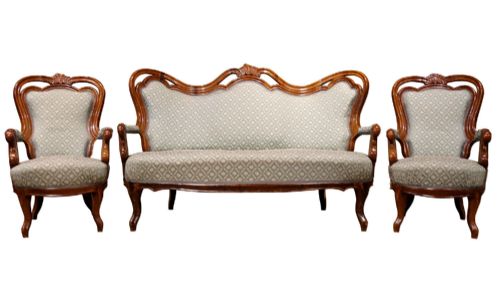
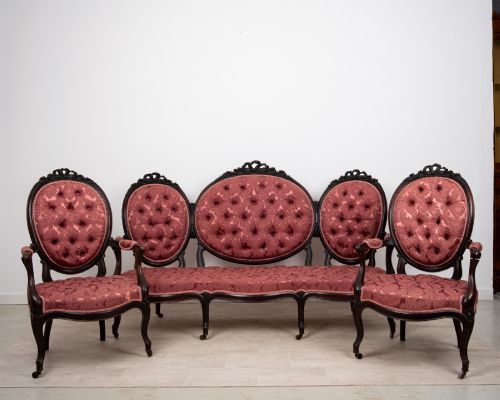


Antique French Parlour Suite
An antique french parlour suite brings formal reception rooms alive with period character, offering matching seats crafted for graceful entertaining.
Antique French Parlour Suite
An antique french parlour suite comprises matching sets of seating furniture designed for formal reception rooms, typically featuring a settee alongside matching armchairs. The pieces span periods such as the nineteenth century, eighteen-eighty, and the early twentieth century, reflecting enduring stylistic choices.
The versions most commonly met on this page include walnut and mahogany constructions embodying rococo revival, french empire, and louis xvi revival aesthetics. Buyers encounter configurations ranging from three-piece settings to larger seven-piece arrangements.
Makers and craftsmen of these suites drew on classical and continental design traditions to create cohesive groupings for domestic display. Each configuration demonstrates how formal seating evolved across different decades while maintaining a unified visual language.
Materials and construction
Craftsmen utilised robust hardwoods such as walnut and mahogany to form the structural frames of each salon suite. These timbers provided the necessary strength for intricate carved details and weight-bearing elements.
Surface enrichment often included giltwood applications and marquetry inlay work to enhance the visual appeal of the frames. Deep buttoned upholstery and damask fabric completed the seating, providing texture and comfort.
Some suites travelled from continental workshops to British parlours, bringing a touch of Parisian drawing room elegance across the Channel.
Distinctions in quality
Quality in an antique french parlour suite rests upon the crispness of the carved ornamentation and the integrity of the timber frame. Superior examples display deeply sculpted woodwork that retains sharp definition across every component.
The sophistication of the upholstery technique and the selection of textile materials also mark out finer pieces. Suites retaining their original or appropriately matched damask fabric demonstrate a higher level of historical preservation.
The Antique French Parlour Suite Glossary
- Rococo Revival
- A nineteenth-century design movement favouring exuberant, asymmetrical scrollwork and naturalistic floral motifs. This style draws inspiration from earlier eighteenth-century French decoration.
- Giltwood
- Timber coated with a thin layer of gold leaf or metallic paint. This treatment creates a brilliant reflective surface on decorative furniture frames.
- Marquetry
- The art of applying decorative veneer pieces to a structure to form geometric or pictorial designs. Craftsmen use contrasting woods to achieve tonal variation.
- Damask
- A reversible figured fabric woven on a jacquard loom with patterns formed by contrasting warp and weft threads. It frequently appears as upholstery on formal seating.
- Canape
- An upholstered settee or sofa designed for multiple occupants within a formal parlour setting. It matches the accompanying armchairs in style and material.
Antique French Parlour Suite: Frequently Asked Questions
What pieces comprise a standard suite?
A standard suite typically includes a settee or canape paired with matching armchairs to create a unified seating arrangement for a parlour or salon.
Larger configurations extend to seven pieces, incorporating additional chairs designed in the same stylistic idiom.
How do revival styles differ?
Revival styles draw upon distinct historical periods, such as the curved exuberance of rococo or the classical symmetry of the French Empire aesthetic.
Each movement reinterprets earlier design vocabulary through the craftsmanship methods of its own contemporary era.
Where were these suites used?
These matching groupings furnished formal reception rooms and parlours where hosts received guests and gathered for social conversation.
Their cohesive design ensured the interior presented a polished and harmonious appearance.
What timber types are typical?
Walnut and mahogany serve as the primary woods utilised for the structural frameworks of these suites.
Selected for their durability and grain, these hardwoods supported detailed carving and marquetry embellishment.