



Empire Style Console
An empire style console brings architectural presence to a hallway or drawing room through monumental proportion and classical ornament.
Empire Style Console
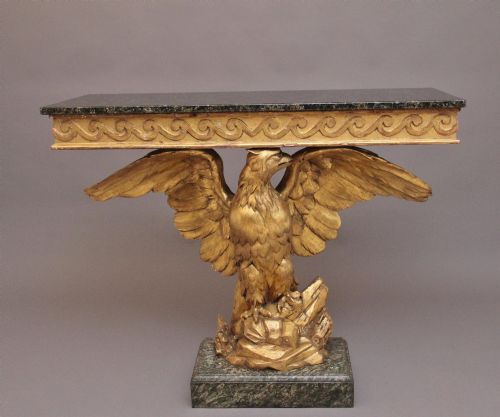
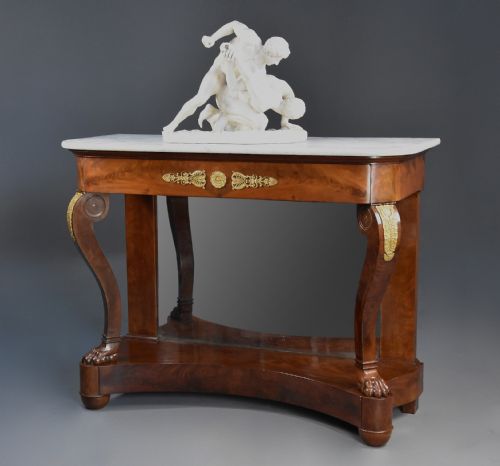
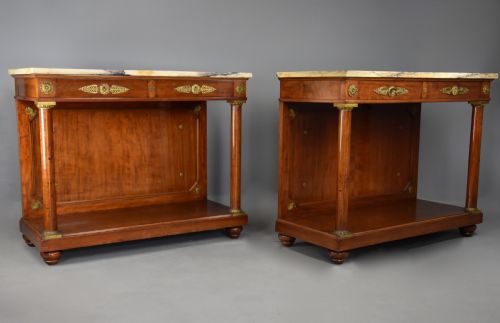
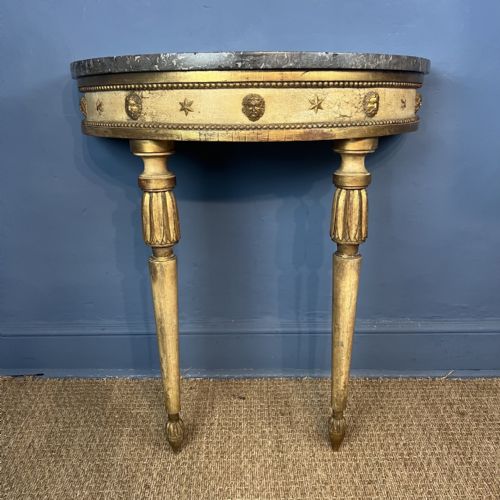
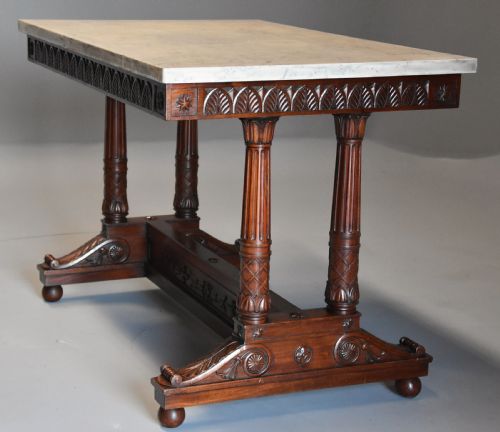
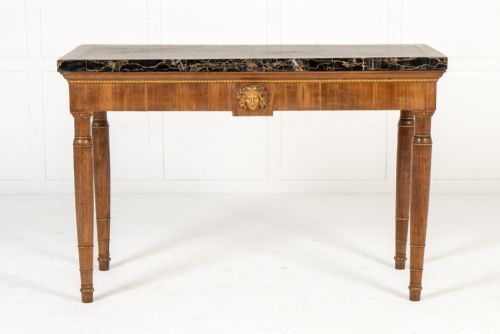
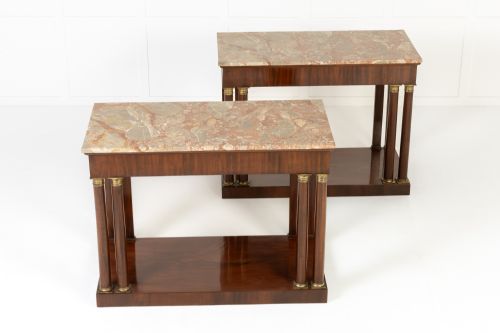
An empire style console primarily takes the form of a console table designed to stand against a wall, frequently accompanied by a matching pier mirror or constructed with a heavy marble top. The pieces appearing here span from the early nineteenth century through to later revival periods, encompassing French Empire, Italian Neoclassical, Regency, and Biedermeier interpretations.
Materials and Construction
Cabinetmakers utilised dense timbers such as mahogany, walnut, burr birch, and ebonised wood as the structural foundation, often pairing them with contrasting veneers like Karelian birch and satinwood. Tops were predominantly surfaced with heavy marble slabs in white or coloured varieties, providing a cool, resilient contrast to the polished timber bodies.
Giltwood, ormolu, and cast brass mounts provide the characteristic classical hardware and decorative details, such as classical motifs, swans, and gilt accents. Painted and parcel-gilt finishes also appear, particularly on Italian and French regional pieces, adding brightness to the carved wooden surfaces.
Carved wooden swans occasionally support the tabletops, bringing a distinct avian geometry to the rigid neoclassical lines.
Distinctions in Execution
The distinction between ordinary and superior pieces rests on the crispness of the carving, the weight and fire-gilding of the ormolu mounts, and the choice of timber figurations. Top-tier examples exhibit tightly fitted marble tops and finely cast bronze hardware that integrates seamlessly into the architectural form.
Simpler provincial variants rely on painted surfaces or simpler mahogany veneers with minimal brass mounts, offering a more restrained aesthetic. The integrity of the foundational timber and the precision of the joinery ultimately determine the standing of each piece.
Krieger Paris·JACOB
The Empire Style Console Glossary
- Console table
- A table designed to stand against a wall, frequently supported by front legs or brackets while relying on wall fixings for stability. These tables often feature heavy marble tops suited for display.
- Ormolu
- Gilded bronze mounts applied to furniture for decorative effect. The technique involves applying a mercury and gold amalgam to cast bronze before heating.
- Pier mirror
- A tall mirror designed to hang on the wall space between windows, frequently paired with a matching console table placed directly beneath it.
- Biedermeier
- A Central European style of furniture dating from the early nineteenth century. It prioritises clean lines and domestic utility over heavy classical ornamentation.
- Parcel gilt
- A surface treatment where only specific carved details, mouldings, or motifs receive a thin application of gold leaf while the surrounding wood remains exposed.
Empire Style Console: Frequently Asked Questions
Where should an empire style console be placed?
These tables suit hallways, reception rooms, and drawing rooms where their architectural presence can be appreciated against a blank wall. Pairing them with a tall pier mirror enhances the vertical scale of the room.
Ensure the floor is level, as heavy marble tops require stable foundations to prevent stress on the wooden frame.
How do I care for the marble top?
Clean the marble surface using a soft, damp cloth and neutral soap, avoiding acidic cleaning products that can etch the polished stone. Wipe up spills promptly to prevent staining.
Waxing the wooden base periodically will maintain the sheen of mahogany, walnut, or ebonised surfaces without affecting the stone.
How do I distinguish an original nineteenth-century piece from a later revival?
Examine the timber construction, secondary woods used in the interior framing, and the wear patterns on the feet and joints. Nineteenth-century examples often show hand-cut joinery and period-specific framing methods.
Revival pieces from the early twentieth century typically employ more uniform machine-sawn elements and different secondary wood species beneath the primary veneers.
What is the difference between a console table and a centre table?
A console table is specifically shaped to stand flush against a wall, often featuring a finished front and sides with a flat or unworked back. Centre tables are freestanding objects designed to be viewed from all four sides in the middle of a room.
While both share materials like mahogany and marble tops, their framing and placement differ fundamentally.