
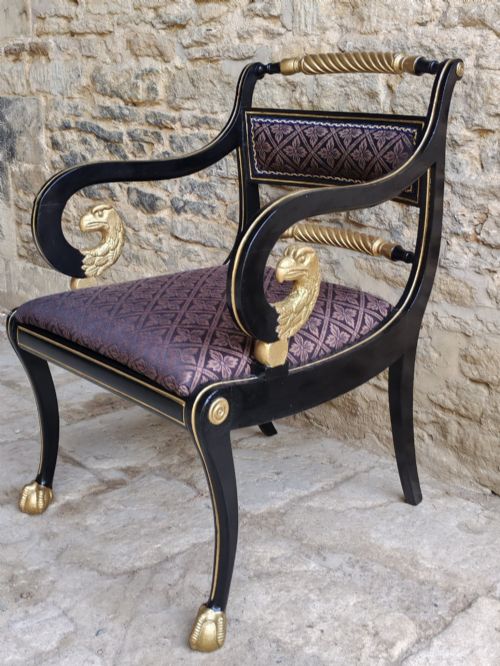
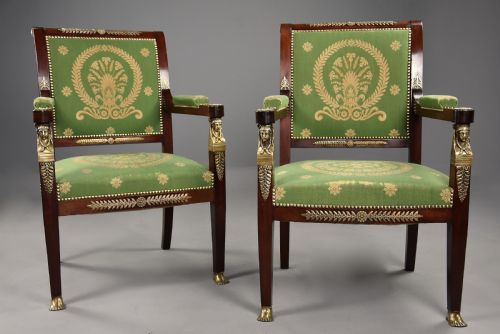
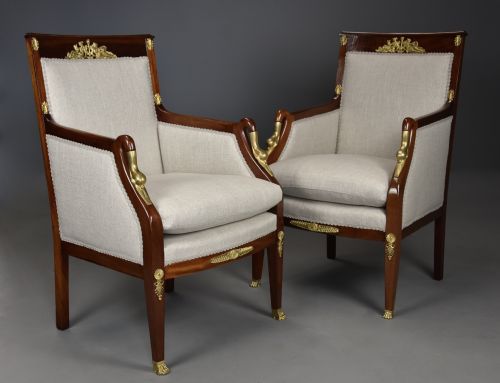


Empire Revival Armchair
An empire revival armchair brings classical symmetry and bold presence to a room, built for dramatic silhouettes.
Empire Revival Armchair
An empire revival armchair draws on neoclassical design vocabulary, channeling the grand proportions and architectural dignity of earlier periods into later seating forms. When you search for an empire revival armchair, you encounter nineteenth-century and early twentieth-century interpretations that echo French and Swedish models.
The pieces on this page appear as single open armchairs, matched pairs, and larger parlour or lounge suites. Many feature open arms, sometimes shaped as swan necks, alongside substantial frames designed for formal reception rooms.
Materials and construction
Cabinetmakers constructed these frames primarily in mahogany and walnut, using dense hardwoods capable of supporting strong structural lines. Wood surfaces often received rich polish to highlight the grain.
Mounts in ormolu and brass provide metallic contrast against the dark timber, applied as decorative classical motifs. Upholstery utilises traditional fabrics, textiles, and leather to pad the seats and backs.
Listings span from eighteen-seventy to nineteen-twenty, featuring mahogany, walnut, ormolu, and brass across single chairs and suites.
Judging quality and craftsmanship
The refinement of the ormolu mounts separates standard examples from exceptional ones, with finely chased bronze details showing superior craftsmanship. Crisp carving on the wooden frames and swan neck supports similarly indicates higher workshop standards.
The choice of primary timber density and the integrity of the joinery dictate the longevity of the armchair. Heavier mahogany and walnut selections generally correlate with more robust construction.
The Empire Revival Armchair Glossary
- Ormolu
- Gilt bronze applied to furniture mounts. This technique involves gilding a mercury-bronze amalgam to create a durable metallic decoration.
- Fauteuil
- An open-armed upholstered armchair with exposed wooden sides. Originating in France, it differs from enclosed upholstered seating by displaying its structural frame.
- Neoclassical
- A style reviving classical antiquity in architecture and decorative arts. It emphasises straight lines, symmetry, and motifs drawn from Greek and Roman precedents.
- Tub armchair
- A seating form with a continuous curved back and armrest structure. This design wraps around the sitter to provide enclosed support.
Empire Revival Armchair: Frequently Asked Questions
How do I date an empire revival armchair?
Dating relies on examining the timber preparation, secondary woods, and the casting quality of any metal mounts. Earlier nineteenth-century examples often display denser primary mahogany and hand-chased ormolu.
Later twentieth-century revivals tend to show machine-tooled elements and different upholstery foundations. Comparing the construction methods to known period benchmarks clarifies the decade of manufacture.
Are these armchairs comfortable for daily use?
These chairs were built for formal reception spaces rather than slouching, offering upright and structured support. The padded seats and arms provide firm comfort suitable for a library or parlour.
Modern users often pair them with an ottoman or position them as accent seating rather than primary lounge chairs.
How do I maintain ormolu mounts?
Ormolu mounts require gentle dusting with a dry, soft cloth to prevent the accumulation of grit in the recesses. Avoid abrasive metal cleaners that can strip the delicate gilding from the bronze.
Professional conservation is recommended if the gilding shows wear or if the mounts become loose from the wooden frame.
What is the difference between French and Swedish styles?
French empire revival pieces lean towards dramatic, heavy ormolu applications and deep mahogany tones. The ornamentation frequently references Napoleonic grandeur and military motifs.
Swedish interpretations often present a slightly lighter palette with restrained detailing and painted or gilded surfaces. They reflect a Scandinavian adaptation of continental neoclassical trends.