


Edwardian Wooden Settee
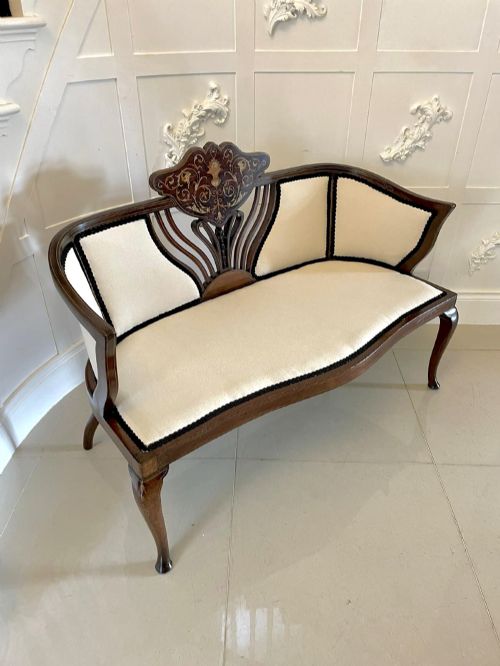
An Edwardian wooden settee brings lightness and refined marquetry into a room, offering comfortable seating shaped by decades of revival design.
Edwardian Wooden Settee
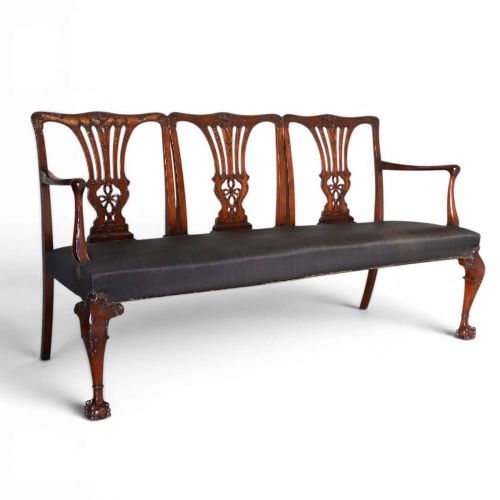
An edwardian wooden settee brings together the refined joinery of the late nineteenth and early twentieth centuries, drawing heavily on Sheraton revival forms and classical proportions. Buyers searching for an edwardian wooden settee typically encounter mahogany frames enriched with satinwood inlay, alongside painted finishes and caned panels.
The selection ranges from intimate two-seater salon settees and window seats to larger country house sofas and expansive parlour suites. While Edwardian pieces dominate, related examples stretch back into the Victorian era and forward to the nineteen-twenties.
Makers adapted historical motifs, producing chairs with Chippendale-style carved backs, Louis XVI fluted legs, and Art Nouveau curves. These seats served formal entertaining spaces and withdrawing rooms, balancing decorative impact with domestic utility.
Materials and construction methods
Makers relied primarily on solid mahogany and walnut for structural stability, frequently applying contrasting satinwood inlay to define panels and borders. Beech and painted timbers appear in lighter salon pieces and decorative window seats.
Upholstery methods varied from traditional webbed and sprung foundations covered in velvet or patterned fabric to woven cane panels set within bentwood or hardwood frames. Brass elements provided subtle hardware accents and castors on heavier frames.
Listings span the years from eighteen-seventy through nineteen-twenty, encompassing late Victorian, Edwardian, and Art Nouveau aesthetic movements.
Distinctions in quality and execution
The distinction between standard production and top-tier workshop output lies in the crispness of the timber carving and the precision of the marquetry work. Finer examples display meticulous satinwood stringing and balanced proportions that maintain structural integrity without excessive weight.
The choice of secondary woods and the retention of original canework or decorative painted surfaces further separate utilitarian seating from high-status salon furniture. Superior upholstery foundations demonstrate careful edge-rolling and durable stuffing that preserves the intended silhouette.
Thonet
The Edwardian Wooden Settee Glossary
- Satinwood inlay
- A decorative technique where contrasting light-coloured exotic timber is fitted into recesses in a darker primary wood, commonly mahogany. This creates delicate geometric borders and floral motifs across the backrest and rails.
- Canework
- A woven grid of split rattan used to form breathable panels for seats and backrests. This technique lightened the visual weight of the frame and appeared frequently on lighter salon couches.
- Sheraton revival
- A design movement inspired by late eighteenth-century neoclassical furniture forms. Pieces in this style utilise tapered legs, straight lines, and symmetrical marquetry patterns.
- Bentwood
- Timber softened by steam and bent into curved structural components. This method allowed manufacturers to form continuous arches for backs and arms without traditional joints.
- Parlour suite
- A coordinated set of seating furniture designed for a formal reception room, typically comprising a matching settee and armchairs sharing identical wood finishes and upholstery.
Edwardian Wooden Settee: Frequently Asked Questions
What is an edwardian wooden settee?
An edwardian wooden settee is a upholstered or caned small sofa produced during the early twentieth century, characterised by mahogany frames and classical inlay.
These pieces were designed for formal reception rooms and bedrooms, functioning as both decorative focal points and functional seating.
Were these settees used in parlours?
Parlour settees served as principal seating in formal entertaining spaces, often accompanied by matching armchairs to form a complete suite.
Their open backs and compact dimensions allowed them to sit comfortably against walls or beneath bay windows.
Can I reupholster an antique settee?
Reupholstering is a common practice for salon settees, particularly when the existing fabric shows wear or does not match modern interiors.
Retaining the original webbing and spring foundations during restoration preserves the historic profile of the frame.