
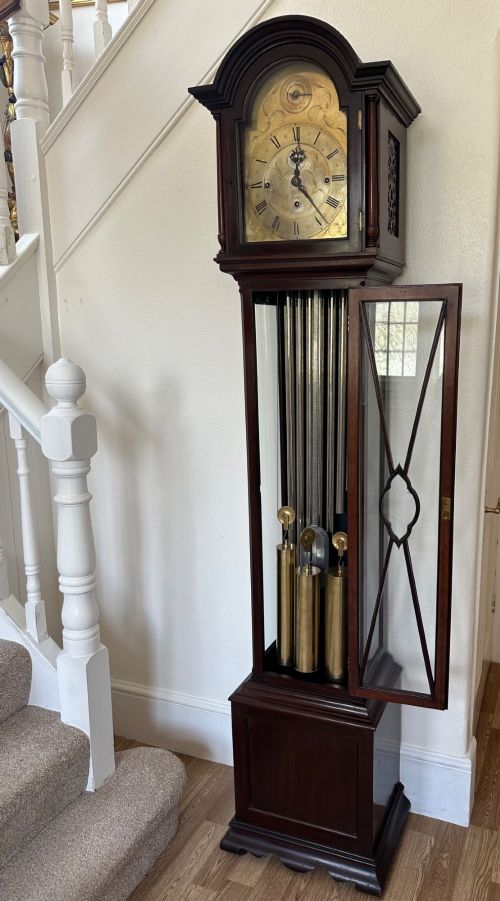


Edwardian Westminster Chime Clock
These edwardian westminster chime clock pieces offer a distinct acoustic presence, bringing period bell movements and traditional cabinetwork into your home.

Edwardian Westminster Chime Clock
When you search for an edwardian westminster chime clock, you encounter tall floor-standing longcase examples, more compact grandmother clocks, and smaller bracket or mantel formats. The selection spans the Edwardian era alongside pieces from the Victorian period, 1900, 1910, 1920, and 1930.
The floor-standing variations include long case clock formats and musical grandmother clocks housed in wood cases. Meanwhile, the shelf-bound versions appear as bracket clocks and mantel clocks suited to smaller spaces.
Stylistic influences range from traditional British and Georgian styles to Gothic Revival and Chinoiserie. These diverse forms reflect the varied domestic interiors of their original period.
Materials and construction
Cases utilise woods such as mahogany and oak, alongside lacquer finishes for specific decorative styles like Chinoiserie. Glass panels protect the dial faces, while brass components form the structural clock movements and internal bells or tubular chime assemblies.
The mechanical workings incorporate quarter chiming mechanisms, hour strikes, and musical tune movements. These complex assemblies demand precise engineering to coordinate both timekeeping and acoustic chimes.
Listings feature mahogany, oak, brass, and glass across Edwardian, Victorian, and later 1920 and 1930 periods.
Distinctions in quality
Quality separates through the acoustic clarity of the bell or tubular chime movement and the acoustic resonance of the wooden case. Substantial boardroom bracket clocks or substantial longcase examples demonstrate heavier timber construction and more complex musical barrels.
The refinement of the cabinetwork itself differentiates standard production from superior pieces. Finely finished mahogany or oak cases with detailed lacquer work contrast with simpler utilitarian housings.
Camerer Cuss & Co
The Edwardian Westminster Chime Clock Glossary
- Grandmother clock
- A smaller, more slender version of the traditional longcase or grandfather clock. It occupies less floor space while retaining a weight-driven or spring-driven movement.
- Bracket clock
- A portable clock originally designed to sit upon a wall bracket. These pieces typically feature a carrying handle and rest on small feet for table or mantel placement.
- Tubular bell movement
- A chime mechanism utilising hanging metal tubes instead of traditional gongs or bells. It produces a deep, cathedral-like chime sound.
- Quarter chiming
- A movement capability that sounds a musical phrase every fifteen minutes. It builds up to the full melody prior to the hourly strike.
- Chinoiserie
- A decorative style employing European interpretations of Chinese artistic motifs. This finish often appears on lacquer clock cases.
Edwardian Westminster Chime Clock: Frequently Asked Questions
How do I wind the clock?
Winding requires inserting the key into the specific winding holes on the dial face and turning it gently until resistance is felt.
Overwinding can damage the internal springs, so care must be taken not to force the mechanism past its natural stop.
Where should I place a bracket clock?
Bracket clocks suit sturdy pieces of furniture such as sideboards, mantelpieces, or dedicated wall shelves. They need a stable, level surface to keep the pendulum or balance wheel beating evenly.
Keep them away from direct sunlight and draughts to protect the wooden case and internal lubricants.
What is the difference between a grandfather and grandmother clock?
A grandfather clock is a full-sized floor-standing longcase clock, usually over six feet tall. A grandmother clock is a scaled-down version designed to fit into smaller domestic spaces.
Both utilise similar weight or spring-driven movements and chime mechanisms.