


Edwardian Walnut Davenport
Edwardian walnut davenport desks combine compact writing surfaces with stationery storage, offering a neat workstation for a study or drawing room.
Edwardian Walnut Davenport
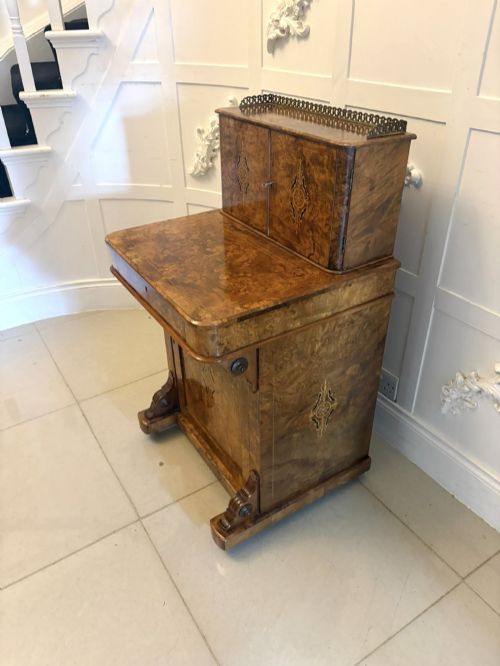
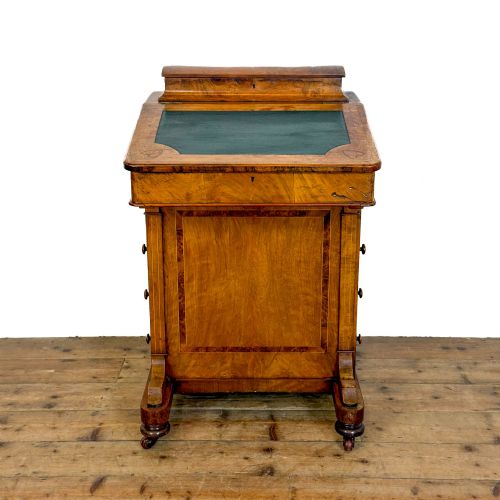
When searching for an edwardian walnut davenport, collectors encounter compact writing desks originating from the early period around 1890 alongside numerous Victorian antecedents spanning 1850 to 1880. These pieces typically combine a sloping writing lid with internal drawers or compartments, supported by a pedestal base containing cupboards or side drawers.
The material palette of these desks relies heavily on walnut and burr walnut veneers, often enhanced with boxwood inlay, marquetry, and brass hardware. While the search phrase specifies the Edwardian era, the surviving record shows a strong presence of mid-to-late Victorian pieces, including specialised forms such as pop-up, piano top, tilt-top, and kidney-shaped writing tables.
How they were made
Cabinet makers constructed these desks using solid wood carcases surfaced with figured burr walnut veneers to create rich grain patterns across the sloping lids and drawer fronts. Boxwood inlay and marquetry techniques added contrasting decorative borders and floral motifs into the timber surfaces.
Writing slopes were typically inset with tooled leather panels to provide a durable surface for handwriting. Brass fittings, including gallery rails, castors, and drawer pulls, completed the construction and added mobility to the freestanding pedestals.
Some models feature a hidden pop-up compartment for secret letters.
What varies in quality
The quality of an edwardian walnut davenport depends heavily on the selection and matching of the burr walnut veneer across the primary surfaces. Superior examples display symmetrical grain patterns and precise boxwood inlay rather than plain timber or simplified banding.
Internal engineering also differentiates the tier of manufacture, particularly in mechanical variants such as pop-up stationery compartments and piano top actions. Desks retaining original brass hardware, fitted interiors, and stable pedestals demonstrate higher workshop standards.
Gillows Designed·James Winter and Son
The Edwardian Walnut Davenport Glossary
- Davenport
- A small compact writing desk featuring a sloping top and a pedestal base containing drawers or a cupboard. This form became popular during the nineteenth century for use in reception rooms and boudoirs.
- Burr walnut
- Timber taken from a tree growth or burl, yielding intricate and swirling grain patterns. Cabinet makers prized this wood for veneering the most visible surfaces of fine desks.
- Pop-up davenport
- A desk incorporating a spring-loaded or mechanical superstructure that rises from the back of the desk to reveal stationery compartments. This mechanism allowed papers to be concealed when not in use.
- Marquetry
- The art of applying small pieces of veneer to a structure to form decorative patterns and pictures. Craftsmen utilised contrasting woods like boxwood to create geometric or floral designs on the desk lid.
- Secretaire
- A desk containing a drawer or compartment that pulls down to reveal a writing surface and small pigeonholes. These fitted interiors often conceal hidden compartments or additional small drawers.
Edwardian Walnut Davenport: Frequently Asked Questions
What is an edwardian walnut davenport?
An edwardian walnut davenport is a compact writing desk featuring a sloping, leather-inset lid above a pedestal base fitted with drawers or a cupboard. These pieces were designed to occupy minimal floor space while offering secure storage for writing materials.
The form developed from earlier Victorian writing cabinets, retaining the characteristic combination of a sloped writing surface and side drawers accessed from a seated position.
How do you use a davenport desk?
A davenport is used by sitting beside the pedestal and writing upon the inclined lid, which typically lifts to access internal storage for paper and correspondence. The side drawers or cupboard store additional stationery and writing accessories.
The upper gallery or pop-up superstructure provides supplementary space for letters and inkwells, keeping the main writing slope clear for daily use.
How do you tell Edwardian from Victorian davenports?
Edwardian davenports generally date from around 1890 onwards and often exhibit lighter timbers, simpler inlaid decoration, and three-drawer arrangements in the pedestal. Victorian examples span from 1850 to 1880 and frequently feature heavier proportions, darker walnut tones, and complex mechanical variants.
Construction details such as the style of boxwood inlay, secondary woods inside the drawers, and the complexity of the internal mechanism help distinguish between the periods.
Where should you place a davenport in a room?
Because many davenports feature finished backs and freestanding pedestals, they can sit out in the middle of a room rather than flat against a wall. This positioning displays the craftsmanship of the rear panels and allows comfortable access to the side drawers.
Placing the desk near a natural light source helps illuminate the sloping leather writing surface, making the desk practical for everyday correspondence.