
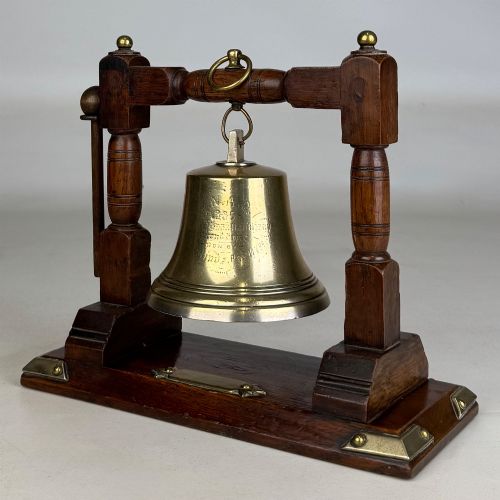
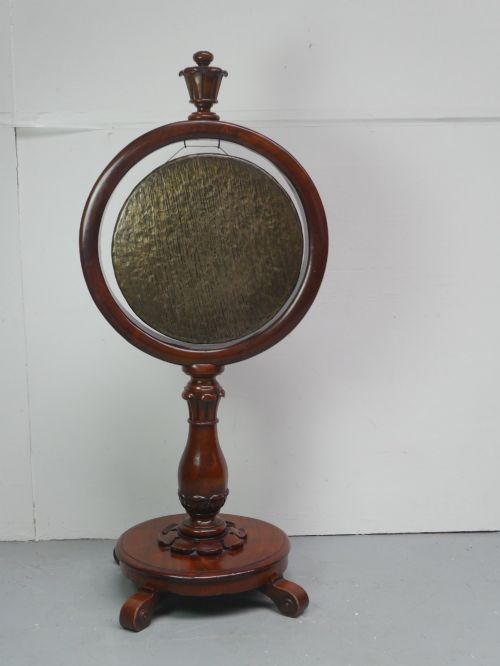

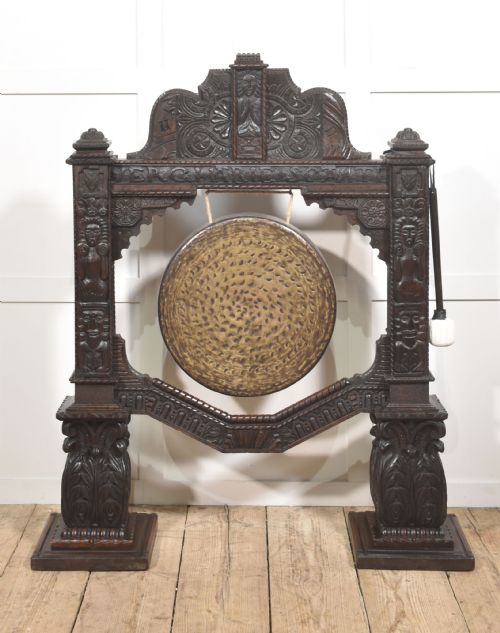


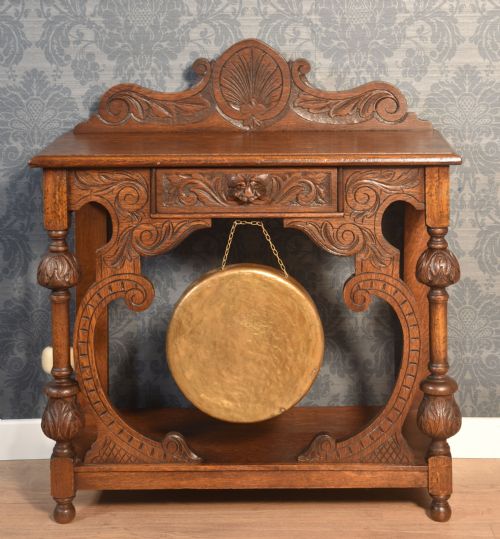
Edwardian Standing Dinner Gong
An Edwardian standing dinner gong brings theatre to the hallway, calling household and guests to table with a resonant chime.
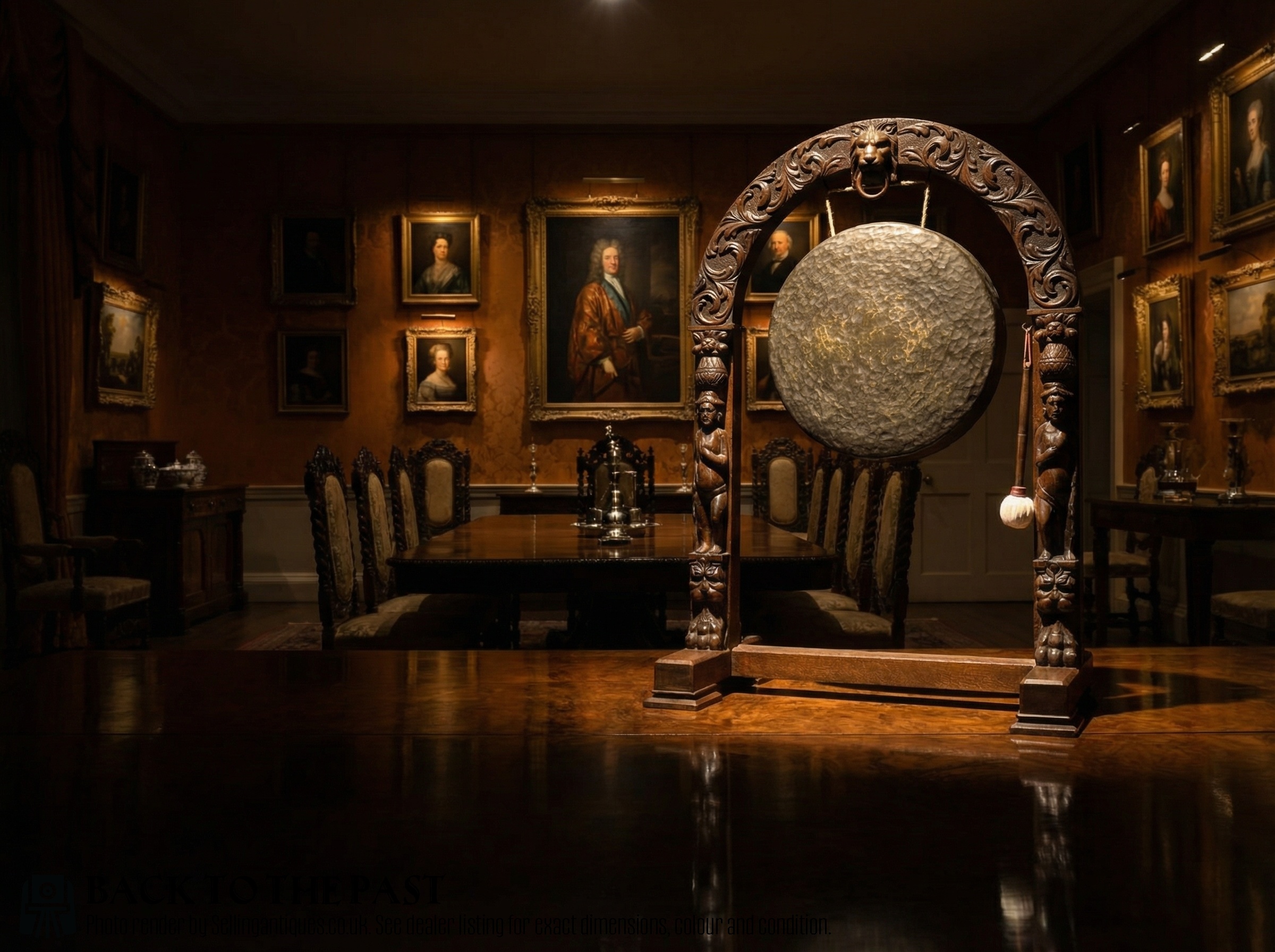
Edwardian Standing Dinner Gong
An edwardian standing dinner gong is a striking domestic appliance designed to summon residents to meals from across the house. These pieces combine a resonant metal disk or bell suspended within a wooden or iron support structure.
The versions most commonly met on this page span the late nineteenth century and the early twentieth century, taking the form of floor-standing or table-top frames. They frequently utilise robust timbers paired with polished brass elements to create an imposing visual presence.
How they were made
Makers constructed the supporting frames predominantly from solid oak, mahogany, and walnut, often employing carved detailing characteristic of the gothic revival and arts and crafts movements. Wrought iron and cast iron also appear as structural materials for frames, offering industrial strength and sinuous art nouveau lines.
The gongs themselves consist of cast brass or bronze disks and bells suspended by cord, rope, or metal hooks. These metallic elements produce the deep, carrying tone required to project sound through substantial period properties.
Listings demonstrate a strong preference for oak frames paired with brass gongs, spanning the nineteenth and twentieth centuries.
What varies in quality
Quality rests primarily on the ambition of the joinery and the purity of the metal casting. Superior examples feature deeply carved wooden stands with balanced proportions, whereas simpler iterations rely on plain, unadorned timber beams.
The acoustic properties of the metal disk separate standard items from finer works. A well-cast brass gong yields a sustained, clear tone that lingers in the air, while lesser metals produce a dull, flat thud.
The Edwardian Standing Dinner Gong Glossary
- Gong
- A percussion instrument consisting of a flat or curved metal disk that is struck with a mallet. In domestic settings, it serves as a signal device.
- Gothic revival
- An architectural and decorative style drawing inspiration from medieval forms. Pieces often display pointed arches and heavy carving.
- Arts and crafts
- A design movement valuing traditional craftsmanship and visible construction methods. Furniture from this tradition uses honest materials without excessive veneer.
- Art nouveau
- A style characterised by flowing, organic lines and floral motifs. Iron frames often curve into whip-like tendrils in this manner.
Edwardian Standing Dinner Gong: Frequently Asked Questions
How do you clean the brass gong?
Dust the surface regularly with a soft dry cloth to prevent the accumulation of grime. Avoid aggressive metal polishes that strip away the aged patina built up over decades.
Test any cleaning solution on a small hidden area first. Preserve the dark, mellow finish rather than striving for a bright, mirror-like shine.
Where should a dinner gong be placed?
Position the piece in a hallway or landing where the sound can travel freely into surrounding rooms. These locations mirror their original domestic placement for maximum acoustic reach.
Ensure the frame stands on a stable surface away from heavy foot traffic to prevent accidental tipping. The mallet should rest conveniently nearby for easy access.
What wood types are most common?
Oak forms the majority of the supporting frames found in this category, often paired with brass fittings. Mahogany and walnut appear in slightly more refined designs.
Rarely, wrought iron or cast iron provides the structural skeleton. Each timber reflects the prevailing cabinet-making fashions of its decade of production.
How do you date an edwardian gong?
Examine the decorative motifs on the wooden frame for clues regarding its period of origin. Art nouveau curves and specific arts and crafts joinery point toward the early twentieth century.
Heavier gothic revival elements suggest a late nineteenth-century Victorian origin. The fixings and screws used in construction also offer helpful indicators of manufacturing age.