
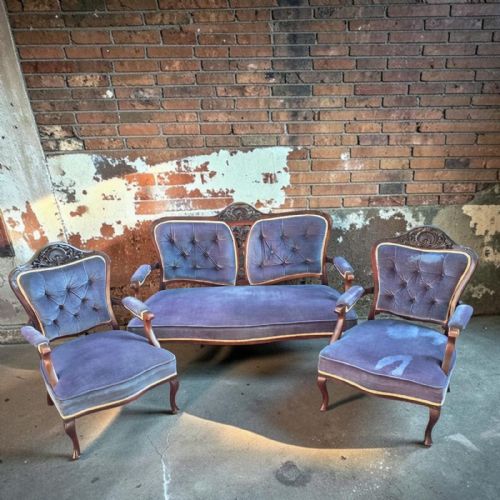
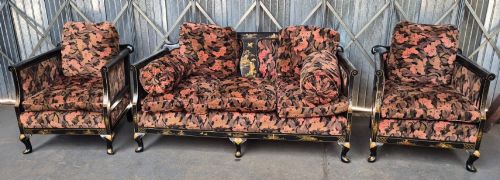


Edwardian Sofa Suite
An edwardian sofa suite brings together matching seating crafted for formal entertaining, offering coordinated elegance for a drawing room or salon.
Edwardian Sofa Suite
When you search for an edwardian sofa suite, you encounter matched seating arrangements designed for turn-of-the-century reception rooms. These groupings typically comprise a settee paired with matching armchairs, creating a unified arrangement for formal sitting spaces.
The versions most frequently met on this page span the late nineteenth and early twentieth centuries, drawing heavily upon Edwardian, Victorian, and transitional design idioms. Makers produced these sets in various configurations, ranging from compact three-piece arrangements to expansive salon suites.
Beyond standard parlour seating, the evidence records specialised forms such as boudoir suites, conservatory sets, and deep-seated club chairs paired with sofas. These groupings reflect the varied social spaces of the period, from light-filled garden rooms to private drawing rooms.
Materials and Construction
Carved and inlaid timber forms the structural backbone of these suites, with mahogany, walnut, rosewood, and beech providing sturdy frames for elaborate decoration. Cabinet makers utilised contrasting wood veneers and delicate stringing to create floral and geometric inlay patterns across the crest rails and arm supports.
Upholstery materials define the character and comfort of the seating, employing tactile fabrics such as velvet, damask, leather, and woven textiles. Caned panels also appear frequently on lighter wooden frameworks, particularly within bergere suites designed for conservatory or parlour use.
Brass fittings, carved wooden details such as lion hands or ball and claw feet, and traditional buttonback padding provide the finishing touches. These construction methods ensure that surviving frames maintain their structural integrity after a century or more of domestic use.
The listings here demonstrate that mahogany is the predominant timber used for Edwardian sofa suites, frequently complemented by inlaid marquetry and cane panels.
Assessing Quality and Craftsmanship
The distinction between ordinary and exceptional suites lies in the crispness of the timber carving and the precision of the marquetry inlay. Superior pieces exhibit deeply carved woodwork and meticulously fitted veneers that remain flush with the surrounding surface.
Frame stability and wood selection also dictate the upper tier of the range, distinguishing solid hardwood structures from simpler constructions. Suites produced by notable makers often display superior joinery, balanced proportions, and well-executed stylistic revivals such as Chippendale or Art Nouveau motifs.
Howard and Sons·James Shoolbred·J. S. Kinsey
The Edwardian Sofa Suite Glossary
- Bergere suite
- A matching set of seating featuring woven cane panels set into wooden frames. These lighter pieces were popular for sunrooms and informal reception spaces.
- Chinoiserie
- A decorative style reflecting European interpretations of Chinese art and motifs. It appears on painted or inlaid furniture frames from the period.
- Marquetry
- The art of applying pieces of veneer to a structure to form decorative patterns. Craftsmen used various tinted woods to create intricate pictorial designs on tabletops and chair backs.
- Salon suite
- A matched group of seating designed for formal entertaining in a drawing room. These sets usually consist of a settee and several armchairs sharing identical upholstery and woodwork.
- Tub chair
- An armchair featuring a rounded, enclosed back that curves continuously into the armrests. This enclosed shape provided draught-free comfort in domestic interiors.
Edwardian Sofa Suite: Frequently Asked Questions
What is an edwardian sofa suite?
An edwardian sofa suite is a matched set of upholstered seating comprising a settee and one or more matching armchairs. These groupings were designed to create a unified decorative scheme in period reception rooms.
They reflect the formal entertaining habits of the early twentieth century, providing comfortable and coordinated seating for guests.
How do I identify an edwardian suite?
You can identify an edwardian suite by its characteristic timber frames, often made of mahogany or walnut with inlaid stringing or marquetry. Stylistic details often include tapered legs, delicate carvings, and period upholstery fabrics.
Many pieces also bear the stylistic influence of earlier revivals like Chippendale or the emerging curves of Art Nouveau.
Where were these suites used?
These suites were primarily placed in formal reception rooms, drawing rooms, and parlours where hosts received visitors. Lighter caned variants were frequently positioned in conservatories and sunrooms.
Their coordinated design ensured that the principal entertaining spaces of a large Edwardian home presented a polished appearance.
Can these suites be re-upholstered?
Many surviving suites are suitable for re-upholstering, and listings occasionally offer frames specifically for this purpose. Updating the fabric allows modern buyers to adapt the seating to contemporary interiors while preserving the antique frame.
Traditional webbing and spring techniques should be maintained during restoration to ensure correct support and authenticity.