
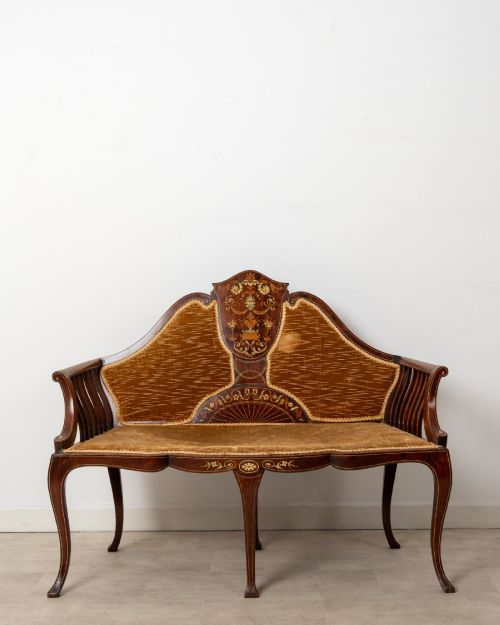
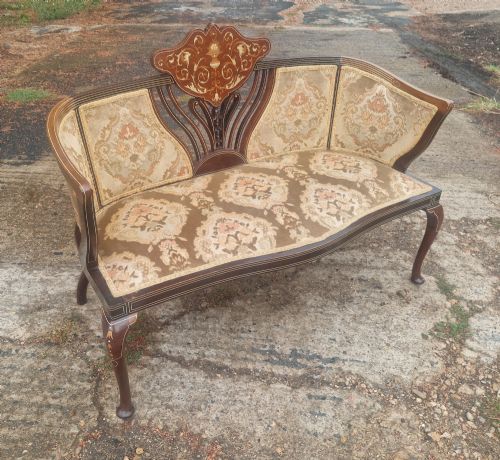
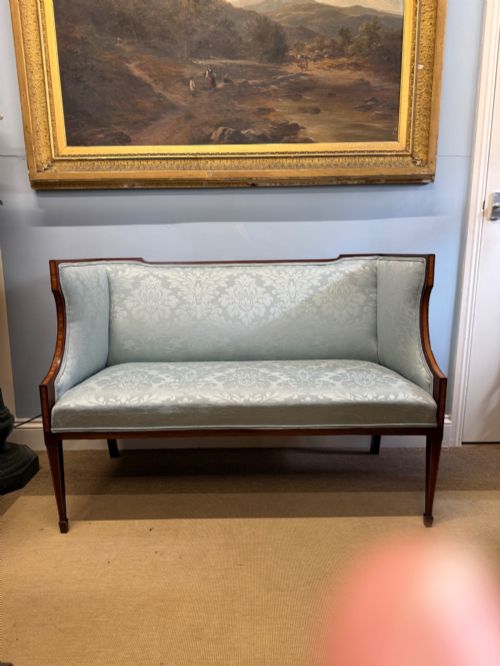


Mahogany Inlaid Settee
A mahogany inlaid settee brings tactile warmth and refined line to a room, combining rich timber with delicate contrast ornament.
Identifying your mahogany inlaid settee
A mahogany inlaid settee is primarily a product of the Edwardian era and the late Victorian period, though earlier examples appear. These seating pieces were built for salons and bedrooms, often functioning as end of bed sofas or compact two seater love seats.
The prevailing aesthetic draws heavily on Sheraton revival design, favouring graceful proportions and lighter frames than earlier heavy Victorian furniture. You will frequently encounter satinwood inlay, marquetry, and occasionally bone details enriching the primary mahogany structure.

Construction and materials
The foundational frame relies on solid mahogany, shaped and joined to support upholstered seats upholstered in fabric or velvet. Cabinetmakers integrated contrasting veneers like satinwood directly into the timber surfaces to form decorative motifs.
Inlay techniques included precise stringing and complex marquetry, sometimes augmented with small bone elements to increase tonal contrast. Upholstery methods ranged from simple pad seats to sprung multi-person arrangements finished with traditional textiles.
Retail Price Guide 2026
Typical UK retail prices for mahogany inlaid settee, calculated from the Sellingantiques database of over a million retail prices indexed since 2003. This retail price guide relies exclusively on Sellingantiques data; no external sources or auction records are used, so the figures do not describe the wider market.
Listings for this phrase predominantly span the Edwardian period and late Victorian era, featuring mahogany paired with satinwood inlay and velvet upholstery.
Distinctions in craftsmanship
Quality rests heavily on the crispness of the timber preparation and the precision of the inlay work. Finer pieces display sharp, clean joins in the satinwood stringing and well-chosen mahogany grain that complements rather than competes with the ornamentation.
Structural integrity also defines the tier of a piece, separating standard production salon furniture from examples with finer carved details or sophisticated Edwardian Art Nouveau influences.
The Mahogany Inlaid Settee Glossary
- Satinwood inlay
- A contrasting light-coloured wood inserted into recesses within the darker mahogany surface to create geometric or floral patterns. This decorative method defines the visual character of Edwardian seating.
- Marquetry
- Elaborate pictorial inlay assembled from various wood veneers to form decorative panels. Artisans used this technique on back panels and friezes.
- Sheraton revival
- A late nineteenth and early twentieth century design movement that reinterpreted the lighter, neoclassical forms associated with eighteenth century cabinetmaker Thomas Sheraton. These pieces feature slender legs and restrained ornament.
- End of bed sofa
- A compact seating form designed to sit at the foot of a bedroom suite. These narrow settees provide functional seating without overwhelming private sleeping quarters.
- Bone inlay
- Small sections of bone inserted alongside wood veneers to provide bright, opaque white highlights. This material adds delicate detail to floral and stringing motifs.
Frequently Asked Questions
Where should I place a mahogany inlaid settee?
These compact settees suit bedrooms as end of bed seating or smaller reception spaces like hallways and dressing rooms.
Their shallow depth allows them to sit comfortably against walls without dominating the floor plan.
How do I care for the upholstery?
Protect the fabric or velvet upholstery from direct sunlight to prevent fading and preserve the original textile.
Vacuum the surfaces gently with a soft brush attachment to remove dust without stressing the antique fibres.
What is the difference between Victorian and Edwardian examples?
Late Victorian pieces often present heavier proportions and darker, denser frames with traditional upholstered backs.
Edwardian and Sheraton revival examples tend towards lighter timber tones, slender tapered legs, and airier open frames.
How do I maintain the mahogany and inlay?
Feed the mahogany timber occasionally with a suitable wax polish to maintain the natural lustre of the wood.
Avoid excessive moisture and modern chemical sprays that can loosen delicate satinwood or bone inlay over time.