


Edwardian Shipping Watercolour
These edwardian shipping watercolour works capture maritime life and bustling ports through delicate washes on paper, offering a direct window into early twentieth-century naval history.
Edwardian Shipping Watercolour
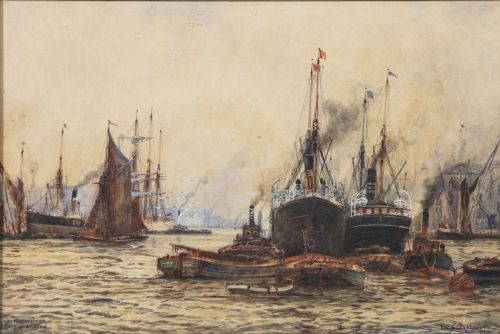
An edwardian shipping watercolour depicts maritime scenes, coastal ports, and naval vessels originating from the early twentieth century. These works frequently record specific vessels, docks, and river pools, capturing the working life of British and French waters.
The pieces present on this page span the Edwardian era through to the early nineteen-twenties, incorporating styles such as British Impressionism and maritime art. Buyers encounter both framed art and fine art paintings executed on paper support.
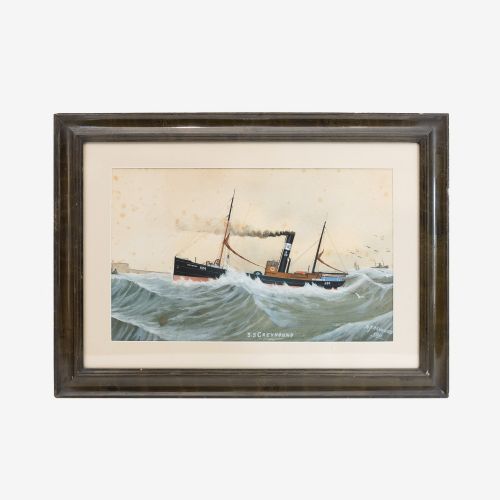
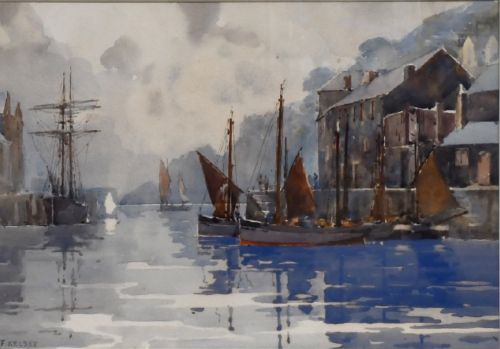
Subjects range from the Pool of London and Cornish harbours to ironclad battleships and tall masted ships in choppy waters. Works are often inscribed with specific locations or ship names by the artists who painted them.
Materials and execution
Makers utilised watercolour pigment and gouache applied to paper supports, sometimes combining both media to achieve opaque highlights on turbulent water or metallic hull surfaces. The application involves fluid washes alongside controlled brushwork to delineate rigging and architecture.
Framing typically incorporates wood and glass to protect the paper surface from environmental degradation. Gilt details on frames complement the warm tones often found within the pigment mixtures.
Current listings feature watercolours and gouaches executed on paper, framed in wood and glass, dating from nineteen hundred to nineteen twenty.
Assessing quality in maritime painting
Superior examples demonstrate confident handling of light upon water and precise draughtsmanship in the rigging of ships and industrial dockside architecture. The skill of the hand shows in how atmospheric haze over a port is rendered without muddying the paper.
Condition and provenance elevate individual works, particularly when titles, dates, and signatures are clearly documented by the artist. Intact historical framing under glass also preserves the integrity of the watercolour pigment over time.
Frank William Scarbrough·Alexander Harwood·Frank Kelsey·Rowland Henry Hill·Frank Wood·Harold E Frecker·William Boyce·Alfred Leyman
The Edwardian Shipping Watercolour Glossary
- Watercolour
- A paint consisting of a pigment suspended in a water-based solution. It relies on the white of the paper to provide luminosity through translucent washes.
- Gouache
- An opaque watercolour paint containing a white pigment added to the mixture to create heavier, solid highlights.
- Edwardian
- Pertaining to the reign of King Edward VII, spanning from nineteen hundred to nineteen ten, noted in these works for specific maritime subjects.
- Ironclad
- A steam-propelled warship protected by iron or steel armour plates, frequently depicted in naval art of this period.
- Maritime
- Relating to the sea, shipping, and navigation, forming the primary subject category for these painted works.
Edwardian Shipping Watercolour: Frequently Asked Questions
What subjects appear in edwardian shipping watercolour works?
These paintings depict steamships, tall masted sailing vessels, naval battleships, and bustling commercial docks along rivers like the Thames. Coastal towns and maritime ports also feature prominently in the compositions.
Artists recorded specific vessels, such as the S.S. Greyhound or various ironclads, alongside recognisable locations ranging from London to Cornish harbours.
How should I display watercolour paintings safely?
Watercolour works on paper require protection from direct sunlight to prevent the pigments from fading over time. Framing behind glass with proper matting ensures the paper does not touch the glazing directly.
Keeping the pieces in rooms with stable humidity levels helps preserve both the paper support and any wooden or gilt framing.
How do I date an edwardian shipping watercolour?
Dating relies upon artist signatures, period inscriptions on the reverse or front, and stylistic markers typical of the early twentieth century. Ship types and naval architecture depicted in the painting also offer reliable clues to the era.
Many works include explicit dates or reflect the specific commissioning practices of naval officers and maritime enthusiasts of the time.
What is the difference between watercolour and gouache?
Traditional watercolour uses transparent washes that allow the underlying paper to show through and create luminosity. Gouache incorporates added white pigment, making the paint opaque and suitable for solid highlights.
Artists frequently combined both mediums within a single maritime painting to contrast translucent water with solid elements like ship hulls or billowing smoke.