
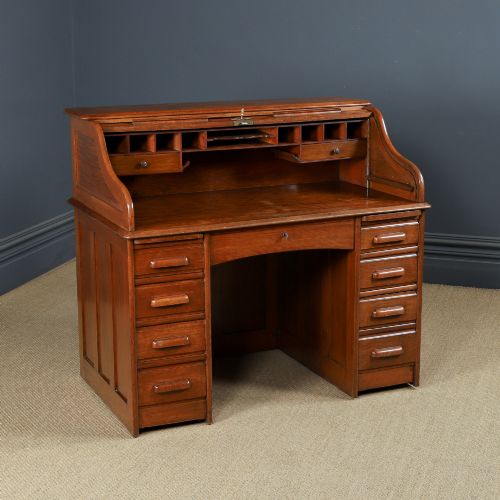
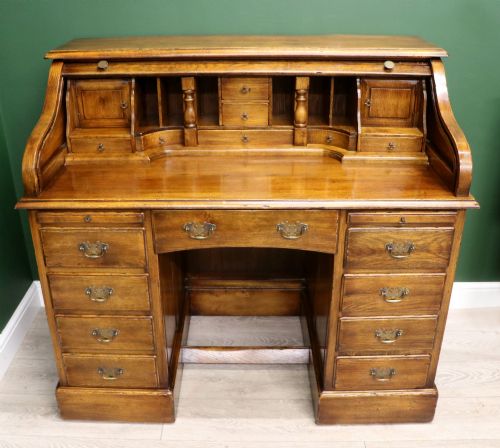
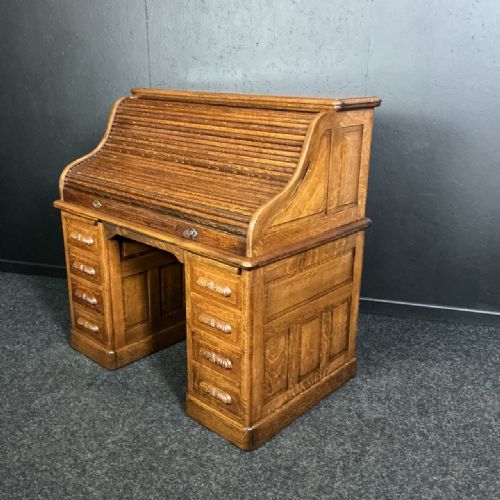


Edwardian Oak Rolltop Desk
These edwardian oak rolltop desk pieces are practical workspaces offering clever compartmentalised storage, perfect for keeping a modern study organised.
Edwardian Oak Rolltop Desk
An edwardian oak rolltop desk is a substantial workspace designed primarily for office or study use, featuring a slatted tambour closure that pulls down to secure the interior. The version you are most likely to meet on this page is the pedestal desk, which includes banks of small drawers and pigeonholes beneath the main writing surface. Bureau bookcases and cylinder desks also appear, offering alternative storage configurations within the same domestic and commercial traditions.
Most examples originate from the Edwardian period or the early decades of the twentieth century, with occasional Victorian precedents and interwar interpretations. The timber used is predominantly solid oak, sometimes combined with brass hardware, leather writing surfaces, or glass panels in bookcase upper sections. These items served as functional administrative hubs in period offices and homes, built to accommodate paperwork and correspondence securely.
How they were made
Construction relies on solid oak timbers, chosen for strength and durability in heavy office furniture. Makers utilised panelled construction techniques for the sides and pedestals to prevent warping over time.
The characteristic tambour top consists of narrow wooden slats glued to a canvas or fabric backing, allowing the flexible shutter to slide smoothly along curved grooves. Brass and metal fittings were incorporated into drawer pulls and locking mechanisms to ensure daily mechanical reliability.
Listings feature oak as the primary timber, complemented by brass, glass, leather, and canvas materials across Edwardian and Victorian periods.
What varies in quality
Quality in an edwardian oak rolltop desk is determined by the weight of the timber and the precision of the joinery within the internal pigeonholes and small drawers. Superior examples feature seamless tambour action where the slatted shutter glides effortlessly without binding in its tracks.
The organisation of the interior fittings and the presence of maker signatures or retail stamps distinguish standard commercial office furniture from finer workshop output. Robust pedestal construction and well-fitted panelled backs indicate higher standards of period cabinet making.
Maples of London and Paris·Globe Wernicke
The Edwardian Oak Rolltop Desk Glossary
- Tambour top
- A flexible shutter made of narrow wooden slats affixed to canvas, sliding in curved tracks to conceal the desk interior. This mechanism allows the workspace to be locked quickly.
- Pedestal desk
- A heavy freestanding desk supported by two vertical columns of drawers with a central opening for the user. This form provides substantial storage beneath the writing surface.
- Bureau bookcase
- A writing desk with a sloping or tambour enclosure combined with upper shelving enclosed by glass or wooden doors. These dual-purpose pieces hold both stationery and reference volumes.
- Cylinder desk
- A workspace featuring a smooth, curved solid wooden cylinder that rolls back to reveal the writing surface. This differs from the slatted tambour construction.
Edwardian Oak Rolltop Desk: Frequently Asked Questions
How do I maintain the tambour mechanism?
Keep the wooden tracks clean and free from dust so the slatted shutter moves freely along the curve. Applying a light, appropriate furniture wax occasionally helps maintain smooth operation.
Avoid using heavy oils or moisture near the canvas backing attached to the slats. Regular gentle use prevents the mechanism from stiffening over time.
Can I fit a modern computer on these desks?
Many edwardian oak rolltop desks provide a deep writing surface suitable for laptops and contemporary office equipment. However, the internal pigeonholes and stationary drawers are scaled for historical paperwork rather than modern technology.
Check the internal width and depth dimensions of the main writing area before placing large screens inside. The tambour shutter must be able to close fully without obstruction.
How do I distinguish Edwardian from Victorian examples?
Edwardian oak rolltop desks generally exhibit lighter honey tones and simpler linear detailing compared to earlier Victorian furniture. Victorian versions often lean towards darker finishes and heavier proportions.
Hardware styles and construction methods also offer clues, with Edwardian pieces reflecting early twentieth-century office standardisation. Examining the drawer linings and secondary timbers helps confirm the manufacturing era.
Are the tambour slats fragile?
The individual wooden slats are secured to a flexible canvas backing designed to withstand regular opening and closing. While durable, excessive force can damage the alignment within the curved side grooves.
Operate the rolltop gently from the central handle rather than pushing from one side. This ensures the tambour moves evenly along the tracks.