
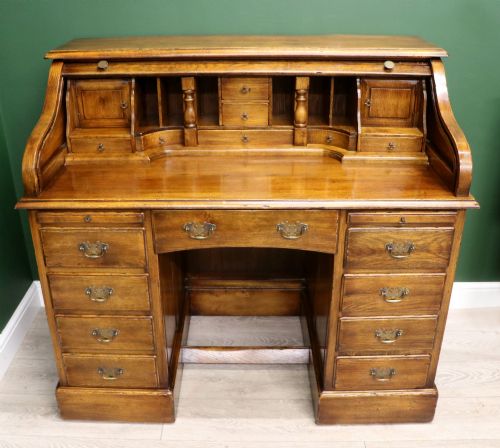


S Roll Desk
When you search for an s roll desk, you enter a world of clever joinery and enclosed writing spaces designed to hide private correspondence.
S Roll Desk
An s roll desk brings together several forms designed for storage and privacy, appearing most frequently in the listings as oak or mahogany pedestal pieces from the Victorian and Edwardian eras. These items span various designations including cylinder desks, bureau bookcases, and tambour fronts where flexible wooden slats slide along a track.
The selection ranges from large freestanding office furniture to smaller satinwood or walnut ladies' desks. Pieces bridge domestic studies and commercial premises, showing adaptations from Georgian writing slides to early twentieth century filing cabinets.
What varies in quality
The distinction between ordinary utility items and exceptional pieces rests on timber selection and the precision of the rolling mechanism. Superior examples display figured mahogany or quarter-sawn oak with seamless movement in the slatted tambour shutter and internal fittings that operate without binding.
Hand-cut dovetailing, substantial secondary woods, and sophisticated marquetry or ormolu mounts elevate the status of a piece. Lesser examples rely on stamped hardware and simpler pine secondary framing behind standard veneered surfaces.
Listings feature periods spanning from the eighteenth century through the Edwardian era, constructed in mahogany, oak, walnut, and satinwood.
Maple and Co London·Tudor and Burrey Shrewsbury·Edwards and Roberts
The S Roll Desk Glossary
- Tambour
- A flexible shutter formed of narrow strips of wood glued to canvas, allowing the surface to slide around a curved track. This mechanism conceals the pigeonholes and writing surface when closed.
- Cylinder desk
- A writing table featuring a quarter-circle rotating solid or veneered cylinder that drops down to cover the desk top. It differs from a tambour by using a rigid curved panel rather than individual slats.
- Marquetry
- The art of forming decorative patterns by fitting together thin slices of various coloured woods, ivory, and shell. It appears frequently on the fall fronts and drawer faces of eighteenth and nineteenth-century pieces.
- Pedestal desk
- A heavy freestanding writing table supported by two separate stacks of drawers or filing compartments. The central section provides legroom beneath the main writing surface.
- Bureau bookcase
- A combined piece of furniture featuring a sloping writing flap or cylinder desk at the base with a glazed or paneled shelving unit positioned above. These towers provide extensive storage for books and documents.
S Roll Desk: Frequently Asked Questions
How do tambour desks work?
The writing surface is concealed by a shutter made of thin wooden slats glued to a flexible fabric backing. This curtain travels along a grooved track cut into the sides of the desk body.
Pulling the handle guides the flexible wood upward into the upper housing of the cabinet, revealing the pigeonholes and drawers beneath.
Where were these desks used?
These pieces served primarily in private studies, libraries, and commercial offices for managing correspondence and ledger books. Larger pedestal versions furnished professional workspaces, while lighter satinwood and mahogany variants suited domestic drawing rooms.
The lockable rolling covers ensured that private letters and financial accounts remained secure from prying eyes when the owner stepped away.
How do I date an oak roll top?
Dating relies on examining the timber preparation, secondary woods inside the drawers, and the style of the hardware. Pieces from the Edwardian period often feature golden oak finishes and simpler structural lines compared to heavier Victorian office models.
Earlier nineteenth-century iterations generally employ solid mahogany or walnut with hand-cut dovetails, while late nineteenth and twentieth-century examples frequently use mass-produced metal tracks and commercial oak.
How do I care for the leather?
The writing surface inset requires occasional cleaning with a slightly damp cloth and treatment with a neutral leather balm to prevent drying and cracking. Avoid abrasive chemical cleaners or excessive moisture that might stain the surrounding wood veneer.
Keeping the desk out of direct sunlight preserves both the leather hide and the polished mahogany or oak surrounds from fading.