
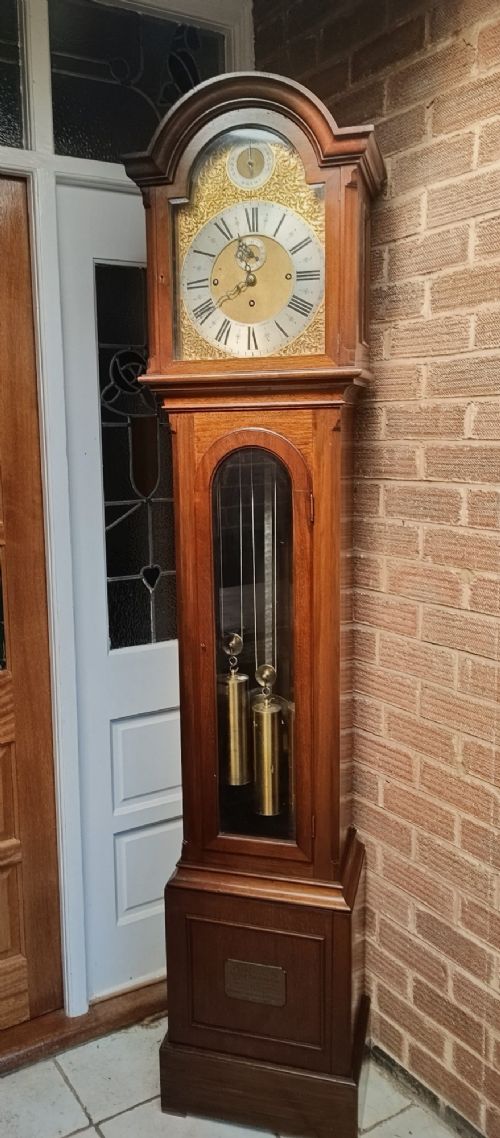
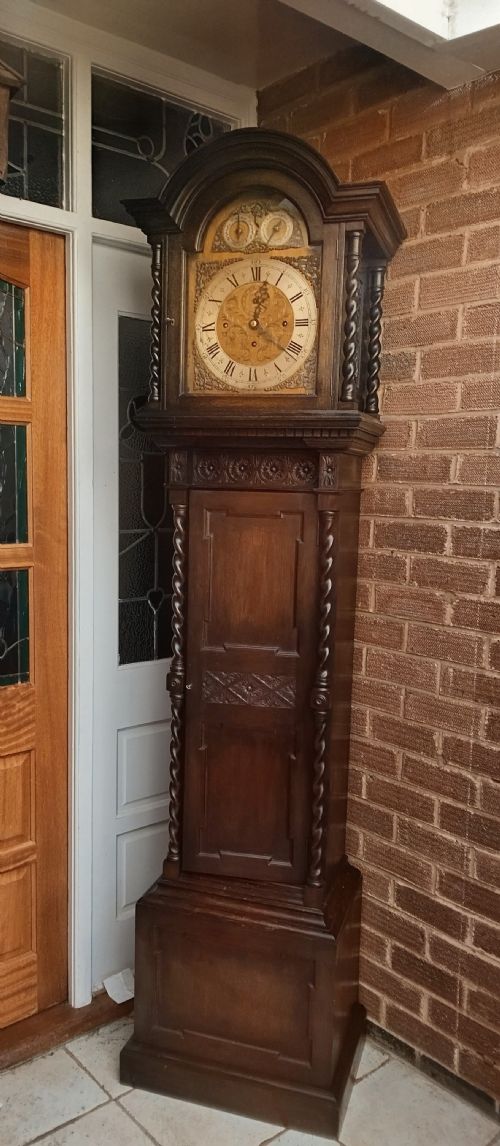


Edwardian Oak Grandfather Clock
These edwardian oak grandfather clock pieces are tall, chiming timepieces crafted from timber, bringing traditional presence and music into a room.
Edwardian Oak Grandfather Clock
An edwardian oak grandfather clock stands as a traditional timepiece, combining architectural timber cases with intricate clockwork mechanisms. Most examples encountered here date from the Edwardian period or the early twentieth century, though related longcase and grandmother clocks span from the nineteenth century into the nineteen-thirties.
The forms vary in height and scale, encompassing large grandfather clocks alongside smaller grandmother and granddaughter variants. Cases predominantly employ oak, often featuring glass-fronted doors and barley twist hood columns that reflect revival styles like Jacobean and Gothic.
How they were made
Cabinetmakers constructed the tall cases chiefly from oak, occasionally incorporating mahogany or burr mahogany for specific sections. Woodwork often included turned barley twist columns on the hood and detailed mouldings around the glass-fronted dial doors.
Clockmakers fitted brass dials, bezels, and complex movements capable of chiming quarters, playing multiple tunes, or operating on triple weight systems. The integration of tubular bells or musical regulators required precise alignment within the timber trunk.
The listings here feature oak and mahogany materials alongside brass and glass components, spanning Edwardian, Georgian, and Victorian periods.
What varies in quality
The distinction between tiers rests upon the sophistication of the movement, ranging from standard eight-day striking mechanisms to elaborate triple train musical systems with numerous bells. Cabinetwork also separates standard production from finer creations through timber selection, such as figured oak or burr mahogany, and the crispness of carved details.
Proportion and scale influence desirability, where smaller grandmother clocks with balanced proportions achieve notable elegance. The reputation of retailers or makers, including names like Mappin and Webb or Harrods, adds distinction to the provenance of the piece.
Elliott·Mappin and Webb·Harrods
The Edwardian Oak Grandfather Clock Glossary
- Longcase clock
- A tall freestanding pendulum clock enclosed in a wooden case, commonly known as a grandfather clock.
- Grandmother clock
- A smaller, more slender version of the traditional longcase clock, usually standing under six feet tall.
- Barley twist
- A decorative turning technique resembling a spiral rope, frequently seen on the hood columns of these timber cases.
- Train
- A series of gears and wheels within a clock movement that controls timekeeping, striking, or chiming functions.
- Regulator
- A precision pendulum clock designed for high accuracy, often featuring specialised dials and musical capabilities.
Edwardian Oak Grandfather Clock: Frequently Asked Questions
How tall is a typical grandmother clock?
These smaller longcase timepieces generally stand shorter than standard grandfather clocks, often measuring under six feet in height.
This reduced scale allows them to fit comfortably into modern rooms while retaining traditional proportions and chiming movements.
What is a triple weight clock?
A triple weight system powers three separate trains within the movement, typically handling timekeeping, hour strikes, and musical chimes.
Weights descend inside the trunk over a period of eight days, requiring periodic winding using a specialised key.
How do I care for an oak longcase clock?
Place the timepiece away from direct heat sources and damp environments to protect the wooden case and internal brass components.
Ensure the case stands level on the floor so the pendulum swings evenly and the clock keeps accurate time.