
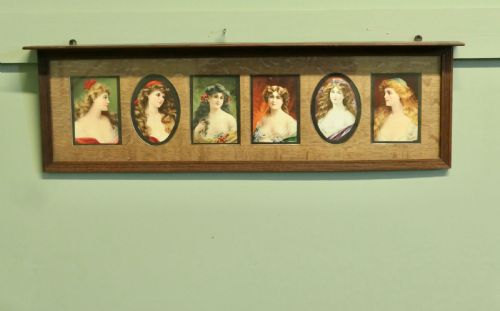


Edwardian Oak Framed Portraits
Edwardian oak framed portraits capture the character of the early twentieth century through solemn faces, military figures, and sporting teams held in sturdy timber mouldings.
Edwardian Oak Framed Portraits
When you search for edwardian oak framed portraits, you encounter framed representations of people, ranging from oil paintings on board and canvas to photographs on card, photogravures, and miniature watercolours.
The selections span the Edwardian era alongside nineteenth-century pieces and interwar works, bringing together family silhouettes, soldiers, sailors, and royalty bound within wood frames.
Many examples utilise simple oak surrounds, while others incorporate stepped profiles or mounted shelves, connecting individual likenesses to the broader material culture of the period.
How they were made
The makers of these items utilised solid oak timber to construct heavy frames, frequently left with a natural grain or darkened finish to complement the artwork within.
Visual surfaces comprise diverse mediums including oil paint applied to canvas or board, ink, and photographic prints on paper or card protected beneath glass.
Backings often consist of wooden boards or card secured with traditional fixings, housing annotations, signatures, and paper labels detailing the subjects.
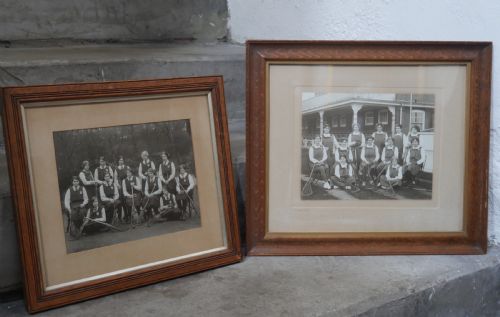
A Scottish lacrosse team from 1914 stares out from one frame, ready to take the field a century ago.
What varies in quality
Quality rests upon the skill evident in the portrait itself, distinguishing finely rendered oil paintings and signed drypoint etchings from standard photographic prints.
The construction of the oak frame contributes significantly, with stepped mouldings, original plaques, and heavy timber housings showing superior craftsmanship compared to plain surrounds.
Condition remains paramount, particularly the preservation of the paper, canvas, or glass, and whether the frame retains its original surface without modern alterations.
The Edwardian Oak Framed Portraits Glossary
- Photogravure
- A photographic printing process that produces an image from an engraved copper plate. This technique yields deep tonal gradations and a rich finish resembling an etching.
- Drypoint etching
- A printmaking method where an image is scratched directly onto a metal plate with a sharp needle. The resulting burr holds ink to create velvety lines.
- Silhouette
- A portrait represented as a solid shape, usually black on a light background, focusing purely on profile outlines. These were popular for domestic likenesses before widespread photography.
- Card mount
- A thick piece of card used to frame or support a photograph or painting within the main border. It separates the image surface from the protective glass.
Edwardian Oak Framed Portraits: Frequently Asked Questions
How do I date an oak frame?
Dating relies on examining the timber grain, joint construction, and backboards. Earlier frames often show hand-planed marks and dense oak, whereas later iterations utilise standardised machine-cut timber.
Associated labels, exhibition notes, or handwritten annotations on the rear provide further chronological clues to pin down the decade of framing.
Are these portraits always original?
The inventory contains original oil paintings, period photographs, and hand-signed prints created during the eras listed. Each medium carries distinct physical markers of its production period.
Surfaces should be examined under magnification to confirm whether a work is a genuine period creation or a later reproduction.
How should I hang heavy oak frames?
Due to the density of solid oak timber, these frames require sturdy picture hooks screwed directly into wall studs or heavy-duty masonry fixings. Wire or cord on the reverse must be checked for strength.
Positioning them away from direct sunlight protects both the wooden surround and vulnerable mediums like watercolour, oil, and photographic paper.
What subjects appear most frequently?
Portraits depict a cross-section of society, including military personnel from the First World War, sailors, royalty, sports teams, and unidentified family members. Canine subjects also feature alongside human likenesses.
These varied subjects reflect the documentary impulse of the late nineteenth and early twentieth centuries.