




Edwardian Mahogany Wall Cabinet
These edwardian mahogany wall cabinet pieces offer compact timber storage and display, designed to mount securely and save floor space.
Edwardian Mahogany Wall Cabinet
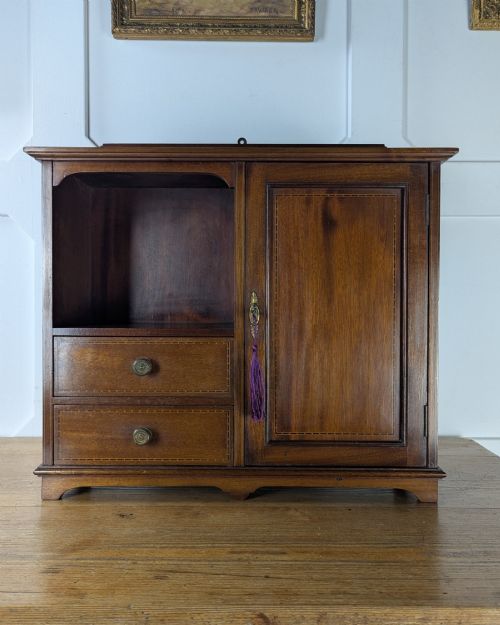
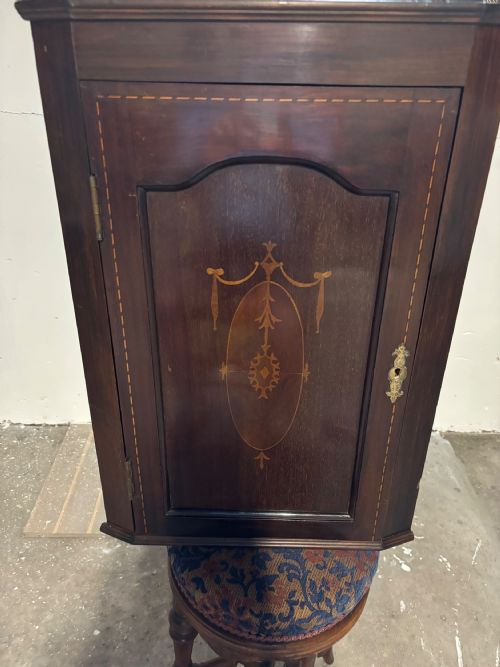
An edwardian mahogany wall cabinet takes several practical forms, most commonly appearing as corner cupboards, flat wall-hung display units, and small cupboards fitted with glass or solid doors.
While many examples originate from the Edwardian period and the surrounding decades of the early twentieth century, the selection also includes earlier Georgian and Victorian iterations sharing the same wall-mounted format.
Buyers look for these items to utilise vertical wall space in compact rooms while displaying china, books, or small collectables behind glazed or panelled doors.
Materials and Construction
Makers built these pieces primarily from mahogany timber, frequently incorporating satinwood inlay, boxwood stringing, and brass hardware such as hinges and key escutcheons.
Glazing is common in the doors to showcase contents, while certain variants integrate mirrored interiors, open wall shelves, or descending drawers beneath the main cupboard compartment.
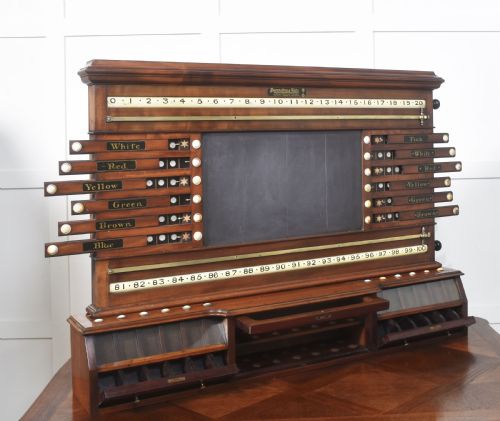
Object forms span corner cabinets, flat wall display units, shaving mirrors, and specialised billiard scoreboards.
Craftsmanship and Detail
Quality rests in the precision of the cabinetmaking, seen in tight dovetail joints, carefully matched timber grain, and crisp execution of inlaid satinwood or boxwood decoration.
Finer pieces display well-proportioned cornices, original brass fittings, and balanced astragal glazing bars rather than plain or later replacement components.
The Edwardian Mahogany Wall Cabinet Glossary
- Astragal glazing
- Timber bars dividing panes of glass in a cabinet door. They create decorative geometric patterns across the front.
- Bowfront
- A convex, outwardly curved cabinet front. This shape softens the room's angles.
- Stringing
- Thin lines of contrasting wood inlay used for decoration. It frames drawer fronts and cabinet doors.
- Corner cupboard
- A triangular cabinet designed to fit directly into a room angle. It makes use of otherwise neglected space.
Edwardian Mahogany Wall Cabinet: Frequently Asked Questions
How do I hang a wall cabinet safely?
These cabinets attach to walls using internal screw fixings or secure hanging brackets mounted directly to the rear timber frame.
Ensure the fixings anchor firmly into wall studs or use appropriate heavy-duty wall plugs to support the weight of the timber and its contents.
Were these cabinets made for specific rooms?
Makers designed these units for various domestic spaces, including hallways for key storage, bathrooms for shaving mirrors, and reception rooms for displaying china.
Corner versions suited parlours and dining rooms where floor space was limited.
How can I tell Edwardian pieces from Georgian ones?
Edwardian examples often feature lighter satinwood inlay, machine-sawn elements, and softer polished finishes typical of the early twentieth century.
Georgian pieces display heavier construction, hand-cut dovetails, and deeper, darker timber patination acquired over a longer lifespan.
Do glass doors indicate a display purpose?
Glazed doors show that the cabinet was intended for viewing contents like ceramics, glassware, or books while protecting them from dust.
Solid panelled doors provided private storage for items owners preferred to keep concealed.