
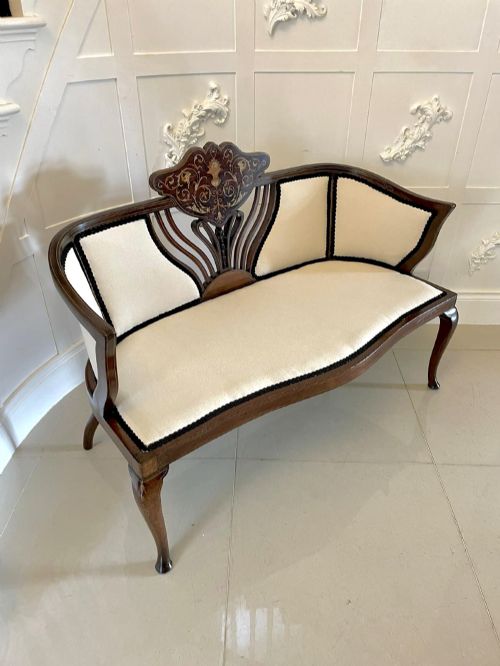
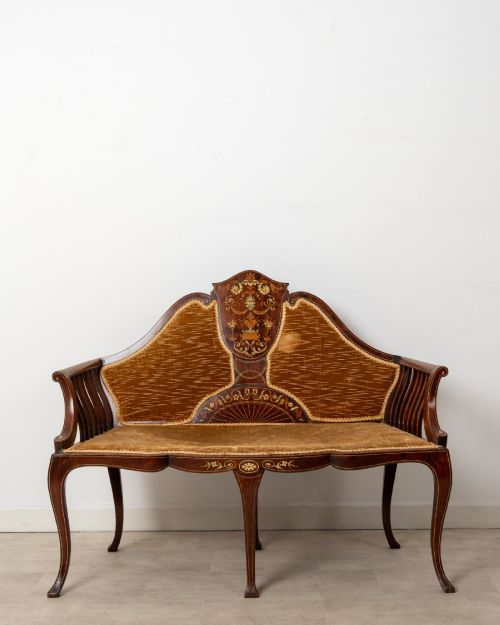
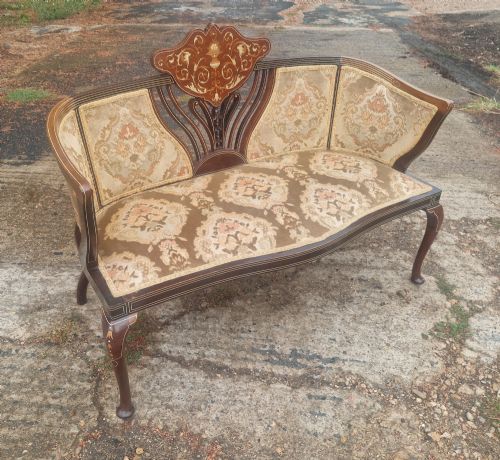
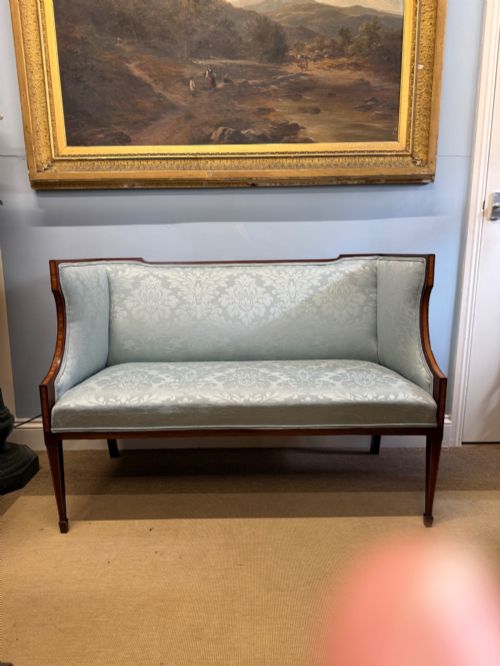


Edwardian Mahogany Loveseat
An edwardian mahogany loveseat brings compact seating to a room, offering warm timber frames and refined inlay work.
Edwardian Mahogany Loveseat
When you search for an edwardian mahogany loveseat, you are looking at small two-seater settees and salon sofas created around the turn of the twentieth century. These pieces combine rich mahogany timbers with slender proportions suited for intimate seating spaces rather than grand drawing rooms.
You will most frequently meet examples dating from the Edwardian era and the late Victorian period, often featuring delicate stringing or contrasting wood details. They appear in forms ranging from salon settees intended for re-upholstery to end-of-bed sofas designed for domestic comfort.
Materials and Construction
The framework of these seats relies primarily on solid mahogany, valued for its strength and deep reddish-brown grain. Workshops frequently enhanced the timber surfaces with satinwood and boxwood inlay, creating crisp geometric patterns or botanical motifs along the crest rails and legs.
Decoration often includes marquetry inlay alongside turned wooden supports, while upholstery incorporates fabric coverings and occasionally brass castors on the feet. Many pieces utilise traditional joinery methods to support the two-seater frame without bulk.
Materials documented across the inventory include mahogany, satinwood, boxwood, fabric, and brass.
Assessing Quality and Craftsmanship
The standard of an edwardian mahogany loveseat rests largely on the precision of its inlay and the crispness of its carved or turned woodwork. Finer examples display meticulous satinwood and boxwood details integrated seamlessly into the mahogany structure, whereas simpler pieces rely solely on plain timber surfaces.
Proportion and integrity of the frame also distinguish the better items from standard production. Well-preserved pieces retain their original structural firmness and balanced proportions, offering a clear view of the cabinetmaker's skill in handling compact seating.
The Edwardian Mahogany Loveseat Glossary
- Edwardian
- Pertaining to the reign of King Edward VII, spanning the early years of the twentieth century until nineteen hundred and ten. This period favoured lighter furniture forms and delicate decorative inlays.
- Mahogany
- A durable tropical hardwood known for its reddish-brown colour and fine grain. It served as the primary structural material for quality seating throughout the nineteenth and early twentieth centuries.
- Satinwood
- A pale, lustrous timber utilised extensively for contrasting inlays and decorative banding on darker woods. It creates bright visual highlights against rich mahogany frames.
- Marquetry
- The art of applying small pieces of veneer to a structure to form decorative patterns. Craftsmen used this technique to ornament the backs and rails of salon settees.
- Salon settee
- A small, elegant sofa designed for entertaining guests in a reception room. These pieces prioritise graceful proportions and decorative detail over deep lounging comfort.
Edwardian Mahogany Loveseat: Frequently Asked Questions
What is an Edwardian mahogany loveseat?
An Edwardian mahogany loveseat is a compact two-seater sofa constructed primarily from mahogany timber during the early twentieth century or late Victorian era. These pieces often feature decorative inlay work and slender proportions.
They were built to provide comfortable seating in smaller domestic spaces, drawing rooms, or bedrooms without dominating the room layout.
How do I date an antique loveseat?
Dating relies on examining the timber, construction methods, and decorative styles present in the piece. Pieces from the Edwardian period typically display lighter frames and refined satinwood inlay compared to earlier Victorian versions.
Looking at the turning on the legs and the style of upholstery framing also helps determine whether the settee originates from the late nineteenth century or nineteen hundred.
Where should I place a small sofa?
These compact settees suit intimate seating areas, hallways, or large bedrooms where full-sized sofas prove too bulky. Placing one at the foot of a bed or in a quiet reading corner makes practical use of their narrow footprint.
Ensure the room has sufficient clearance around the turned wooden legs to appreciate the inlaid details fully.
What maintenance do these wooden seats need?
Maintenance involves keeping the mahogany timber clean with a soft, dry cloth and avoiding placement near direct heat sources or strong sunlight. Regular dusting protects the delicate satinwood and boxwood inlay from drying out.
Upholstered sections benefit from gentle vacuuming, while the wooden frame requires only occasional polishing with appropriate wax to maintain its finish.