
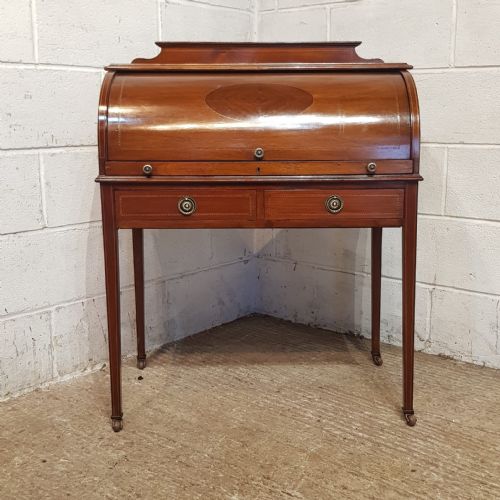
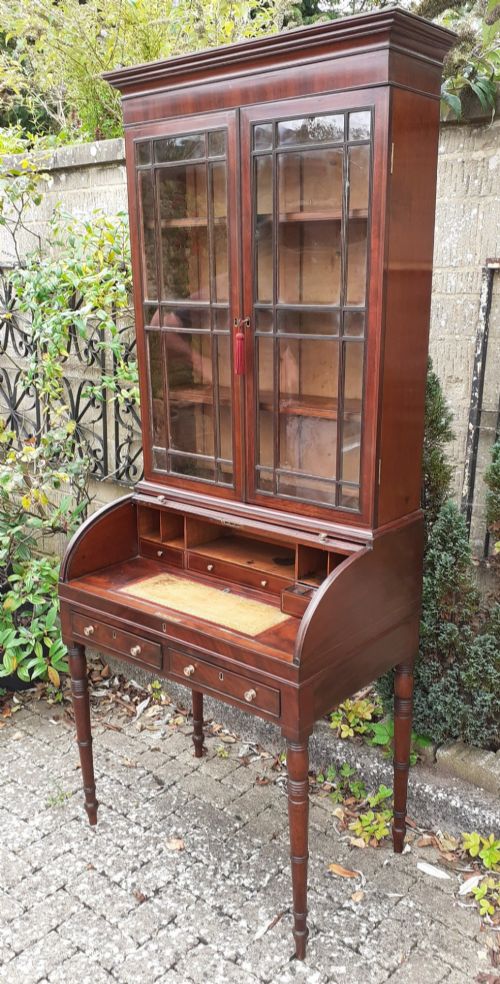
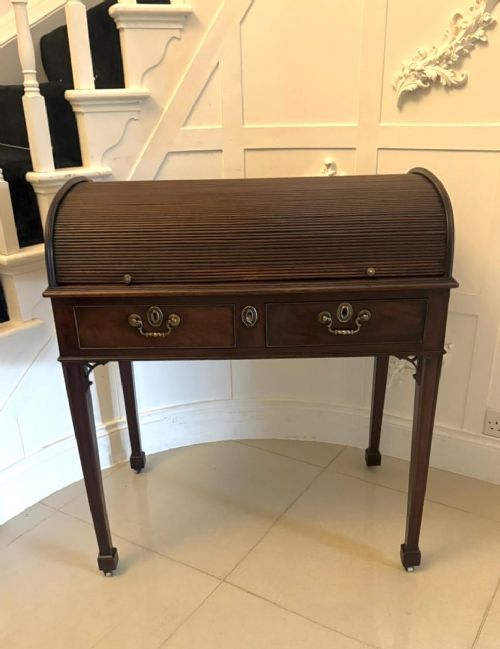
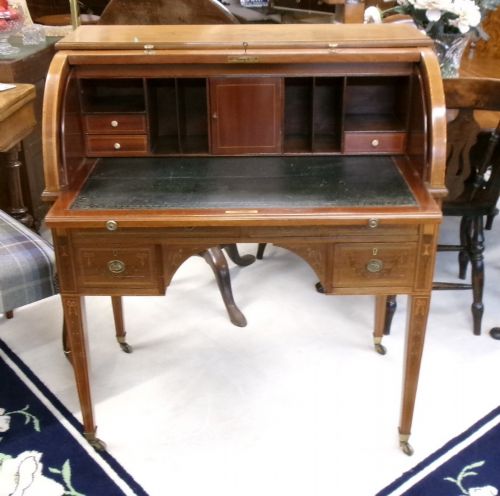


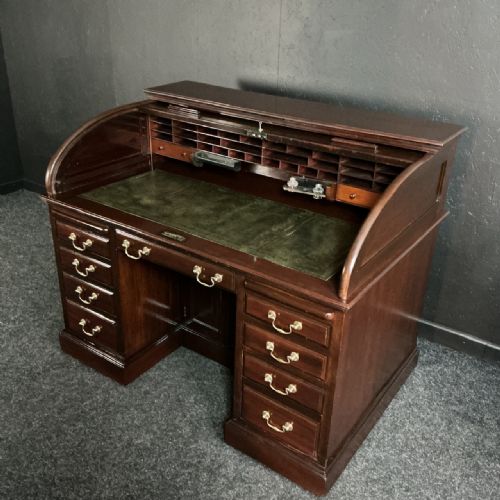


Edwardian Mahogany Cylinder Desk
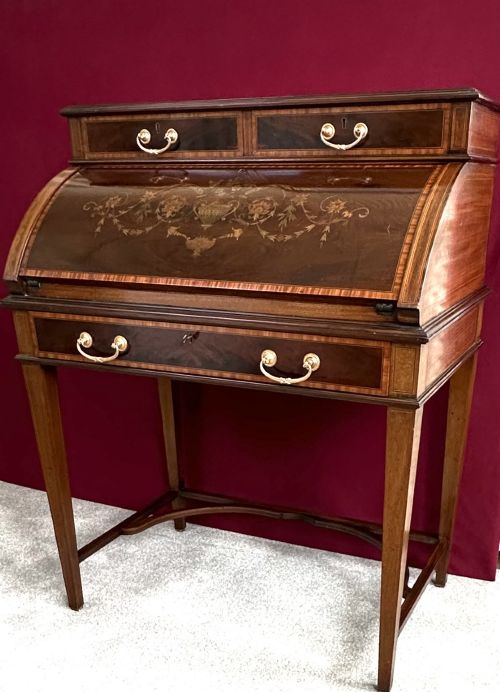
An edwardian mahogany cylinder desk conceals private correspondence beneath a curved wooden shell that rolls smoothly out of sight.
Edwardian Mahogany Cylinder Desk
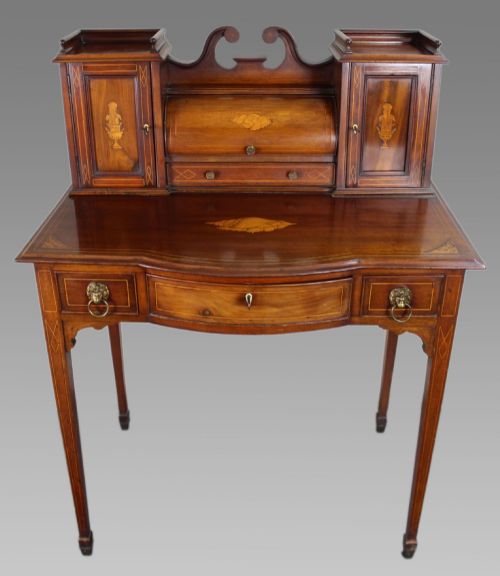
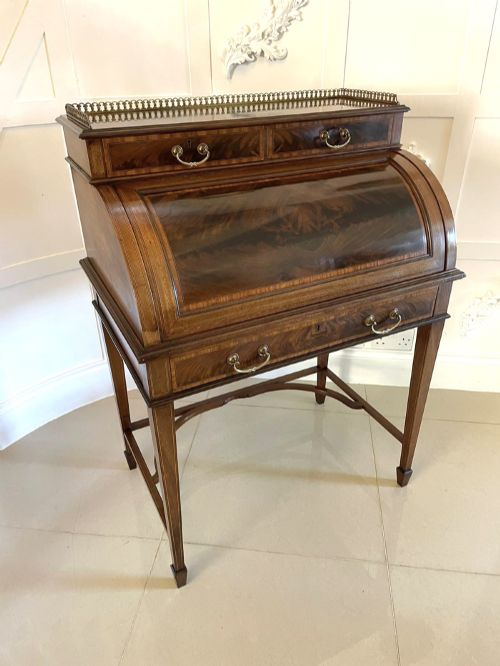
The edwardian mahogany cylinder desk combines a traditional writing cabinet with a concealed rolling shutter, emerging most frequently from the Edwardian period with inlaid satinwood details and compact proportions suited to domestic studies.
Makers of the period drew heavily on Sheraton Revival motifs, pairing rich mahogany surfaces with delicate boxwood and ebony stringing.
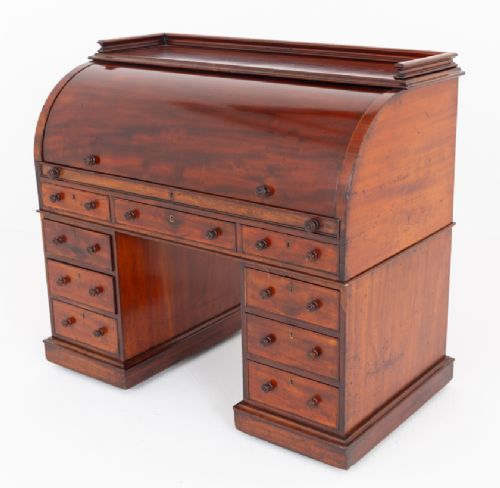
Surviving examples span smaller ladies writing desks designed for light correspondence to larger freestanding pedestal forms equipped with interior pigeonholes and leather-lined pull-out slides.
Materials and construction
Cabinetmakers constructed these pieces primarily from solid and veneered mahogany, often selecting flame-figured timbers for the curved cylinder shutter and exterior panels.
Contrasting veneers such as satinwood, alongside stringing in ebony and boxwood, created crisp geometric borders and decorative floral marquetry.
Functional hardware relied on brass ring handles and fitted interior compartments lined with leather writing surfaces.
Listings feature Edwardian and Victorian periods alongside earlier Georgian and Regency roots, constructed primarily from mahogany with satinwood and brass details.
Distinctions in craftsmanship
Superior examples reveal themselves in the precision of the rolling cylinder mechanism, which glides smoothly within its tracks without binding or catching along the internal curves.
The refinement of the timber selection and the crispness of the hand-cut marquetry and cross-banding separate standard utility pieces from workshop productions bearing maker signatures.
Maple & Co London·Tudor & Burrey Shrewsbury
The Edwardian Mahogany Cylinder Desk Glossary
- Cylinder desk
- A writing desk featuring a quarter-circle wooden shutter that rolls back to reveal a fitted interior of pigeonholes and small drawers.
- Tambour
- A flexible shutter made from narrow strips of wood glued to a canvas backing, allowing the cover to follow a curved track.
- Satinwood
- A lustrous, yellowish timber utilised for contrasting inlay work and decorative banding on darker cabinet woods.
- Marquetry
- Elaborate decorative veneer work assembled from various tinted woods to form pictorial or symmetrical patterns.
Edwardian Mahogany Cylinder Desk: Frequently Asked Questions
How do I operate the cylinder mechanism?
The curved wooden shutter slides along a concealed track inside the carcass, usually linked to the writing slide so that pulling the desk surface forward automatically retracts the top.
Ensuring the internal runners remain clean and lightly waxed prevents the mechanism from sticking during daily operation.
Were these desks used in offices or homes?
While larger pedestal variants served administrative spaces, many Edwardian examples were built as refined ladies writing tables or smaller home office desks designed for domestic sitting rooms.
Their enclosed shutters allowed owners to leave correspondence concealed and secure without locking the main cabinet doors.
How do I distinguish Edwardian pieces from Victorian ones?
Edwardian examples tend to display lighter proportions, delicate satinwood inlay, and Sheraton Revival influences, reflecting a shift away from heavy, dark Victorian forms.
Victorian counterparts often utilise denser flame mahogany with bolder mouldings and less reliance on contrasting stringing.
What is the best way to care for the leather writing surface?
Keeping the leather clean requires dusting with a dry cloth and avoiding harsh chemical cleaners that can dry out the hide.
Applying a specialist leather balm periodically helps preserve the original suppleness and colour of the writing panel.