



Edwardian Jacobean Oak Bureau
These edwardian jacobean oak bureau examples bring sturdy regional revival writing furniture into modern rooms.
Edwardian Jacobean Oak Bureau
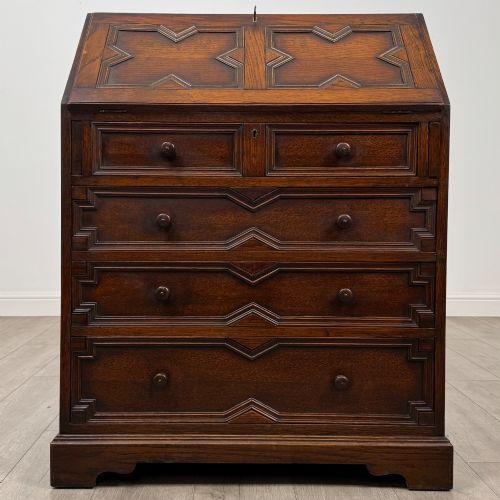
When you search for an edwardian jacobean oak bureau, you are looking at practical writing furniture drawing on earlier seventeenth-century design traditions. Most pieces on this page originate from the Edwardian era through the nineteen-thirties, reflecting a sustained domestic demand for solid timber workstations.
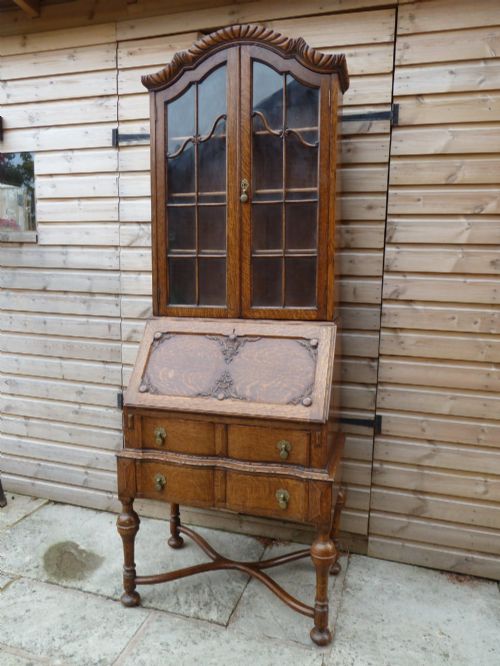
The standard form combines a sloping fall-front desk with interior compartments above drawer storage or cupboard space. You will also encounter taller bureau bookcases and presentation desks equipped with fitted writing surfaces.
How They Were Made
Cabinet makers relied principally on solid oak, utilising its natural grain and durability for heavy case construction. Brass hardware provides functional hinges and drop handles, whilst occasional glass panels feature in upper bookcase sections.
Surfaces frequently display carved decoration executed in a Jacobean revival style, complementing the heavy timber frames. Moving interiors incorporate small drawers and pigeon holes constructed with traditional joinery.
Some models hide moving interiors that slide forward like secret compartments to surprise letter writers.
What Varies in Quality
Superior quality pieces demonstrate crisp, deep carving and heavier solid oak construction rather than thin veneers. The refinement of the internal writing compartment and the smoothness of the moving mechanism distinguish finer examples from standard production.
Proportion and overall timber selection set the better bureaux apart, with well-figured grain patterns elevating the visual impact of the piece. Superior items often feature integrated bookcase superstructures that balance the lower desk mass.
The Edwardian Jacobean Oak Bureau Glossary
- Bureau
- A writing desk featuring a sloping hinged lid that opens to reveal fitted compartments. It often sits above multiple drawers for storage.
- Fall-front
- The inclined writing flap of a bureau that lowers to horizontal for use and folds vertical to enclose the desk interior. This surface bears the brunt of daily writing tasks.
- Jacobean Revival
- A nineteenth and twentieth-century design style mimicking seventeenth-century English decoration. It relies heavily on geometric mouldings and strapwork carving.
- Bureau Bookcase
- A tall combination piece pairing a lower writing bureau with an upper shelved cabinet enclosed by doors. These units maximise storage in smaller rooms.
Edwardian Jacobean Oak Bureau: Frequently Asked Questions
How do I use a bureau desk daily?
Lower the sloping front panel to create a stable writing platform above the fitted interior pigeon holes. Store papers and stationery within the internal compartments when the lid is closed.
Ensure the fall-front stays supported by its internal lopers or side arms while you write.
Where should I place this bureau?
Position the piece against a flat wall in a study, living room, or hallway where natural light reaches the writing surface. Keep it away from direct heat sources to protect the solid oak timber.
Allow enough clearance in front of the unit to pull out a chair and lower the writing flap.
How do I identify the period?
Examine the construction methods, secondary timbers, and hardware style to distinguish Edwardian pieces from later twentieth-century productions. Look at the depth of the carving and the joinery inside the drawers.
Dating clues often appear on presentation plaques or written inscriptions found within the interior compartments.