




Edwardian Demi Lune Cabinet
These edwardian demi lune cabinet pieces offer curved front profiles and refined wood inlay, bringing a classic neoclassical silhouette to reception rooms.
Edwardian Demi Lune Cabinet
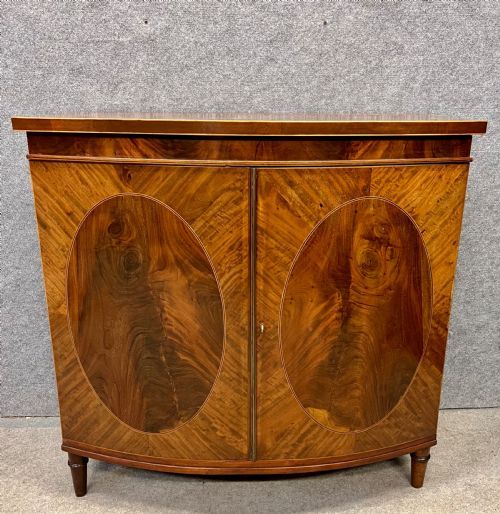
An edwardian demi lune cabinet provides a semicircular footprint designed to sit flush against a wall in a hallway or drawing room. You will most frequently encounter satinwood and mahogany versions across this selection, often decorated with delicate classical panels and boxwood stringing.
The form developed during earlier centuries before experiencing a strong revival in the Edwardian era and around nineteen hundred. Pieces from this later period frequently adopt Sheraton revival and neoclassical styles, combining practical storage with ornamental painted surfaces.
Materials and construction
Cabinet makers utilised fine timbers such as satinwood and mahogany as the primary foundation for these curved carcases. Timber veneers were carefully applied to create smooth semi-circular fronts, supported by solid wood frames and slender tapered legs.
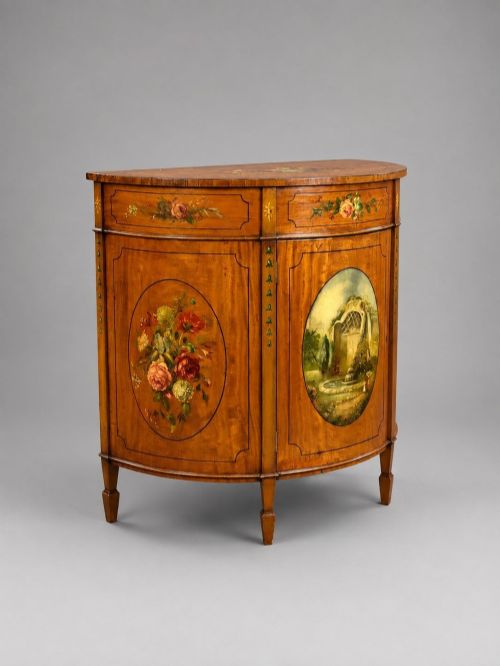
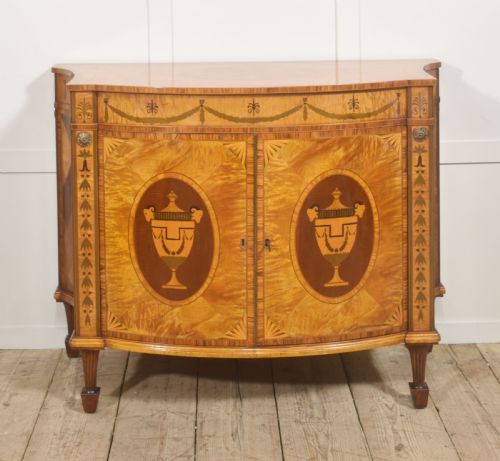
Decoration relied heavily on intricate wood inlay and hand-painted classical panels. Craftsmen incorporated contrasting materials like boxwood and brass details to accentuate the curved outlines and door borders.
Listings feature woods such as satinwood, mahogany, burr elm, and burr yew, alongside painted panels and glass display doors.
Elements of quality
The sophistication of the painted panels and the precision of the wood inlay largely determine the standard of an edwardian demi lune cabinet. Finer examples display meticulous hand-painted classical motifs and tightly fitted marquetry rather than simpler stencilled designs.
The choice of primary timber and secondary framing woods also creates distinction across the range. Superior pieces employ heavily figured satinwood or rich flame mahogany combined with substantial brass hardware and sound structural joinery.
The Edwardian Demi Lune Cabinet Glossary
- Demi-lune
- A half-moon shape describing furniture with a semicircular front and a flat back designed to stand against a wall.
- Satinwood
- A lustrous yellow-brown timber prized by cabinet makers for its fine grain and reflective surface quality.
- Marquetry
- Decorative veneer work arranged in pictorial or geometric patterns using various coloured woods.
- Sheraton Revival
- A late nineteenth and early twentieth century design movement inspired by the neoclassical furniture of Thomas Sheraton.
- Stringing
- Thin strips of contrasting wood inlaid into channels cut into the surface of the furniture to form borders.
Edwardian Demi Lune Cabinet: Frequently Asked Questions
Where should I place an edwardian demi lune cabinet?
These cabinets work well in narrow hallways, landings, or living rooms where a traditional rectangular piece might obstruct movement. Their curved profiles allow them to fit neatly against flat walls while softening room angles.
Because they frequently incorporate display shelving or enclosed cupboards, they serve as both decorative console surfaces and practical storage units for smaller items.
How do I care for satinwood surfaces?
Protect the polished timber surfaces by keeping the cabinet away from direct sunlight and steady heat sources, which can cause the veneer to dry out. Regular dusting with a soft, dry cloth maintains the finish without needing heavy polishes.
Avoid placing damp items or unsealed ceramics directly on the wood to prevent marking the delicate painted panels and polished finish.
How can I identify the Edwardian period?
Edwardian furniture typically dates from the early twentieth century, reflecting lighter proportions and a revival of eighteenth-century neoclassical styles. Look for characteristic satinwood finishes combined with painted floral swags and classical urn motifs.
Construction methods inside the drawers and cabinet backs, along with the specific style of brass hardware, help confirm the manufacturing era.