


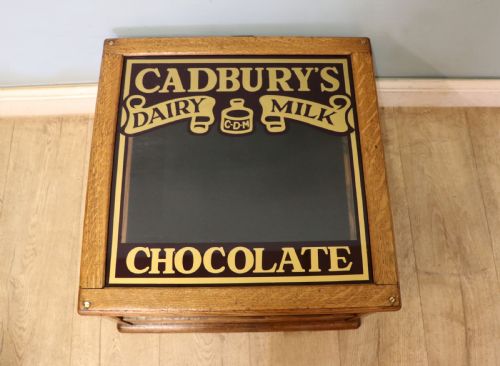

Edwardian Countertop Display Case
An Edwardian countertop display case places retail history directly on your furniture, combining clear glass panels with sturdy timber frames.
Edwardian Countertop Display Case
An edwardian countertop display case is a glazed vessel designed to sit upon shop counters to showcase goods to prospective customers. You will frequently encounter forms originating from the Edwardian period and early twentieth century alongside Victorian and later commercial examples.
The primary forms on this page include display cabinets and showcases built for commercial environments such as sweet shops and apothecary shops. These pieces range from simple oak or mahogany boxes to specialised units bearing sign-written chocolate or cocoa advertisements.
Makers and brands appear on specific units, referencing commercial names like Rowntree's, Fry's, and Cadbury alongside maker details such as F. Sage & Co. London. The overarching style spans Edwardian design, Victorian commercial utilitarianism, and early twentieth-century industrial commercial aesthetics.
How they were made
Construction relies upon timber frames joined to glazed panels, utilising hardwoods like mahogany and oak alongside general wood and metal elements. Internal surfaces often incorporate felt linings to cushion the merchandise displayed within.
Hardware details typically involve brass components for hinges, handles, and catches, securing the glazed doors or access points. Structural integrity is maintained through durable wood joinery suited to daily retail handling.
Listings feature items built from oak, mahogany, and hardwood, paired with glass and brass across Edwardian, Victorian, and 1920s commercial styles.
What varies in quality
Quality separates standard utilitarian shop fittings from finer display pieces through the choice of timber, such as selected oak or rich mahogany over plain hardwood. Finer examples display precise joinery and sophisticated proportioning suited to prominent retail settings.
The presence of original commercial lettering, manufacturer plaques like F. Sage & Co. London, or authentic brand advertising significantly elevates the historical interest of a piece. Later sign-written decoration represents a different tier of finish compared to factory-original branding.
F. Sage & Co. London·Cadburys
The Edwardian Countertop Display Case Glossary
- Edwardian
- A period spanning the reign of King Edward VII, noted for lighter furniture designs and refined commercial joinery.
- Apothecary
- A historical term for a dispenser of medicines, whose premises utilised specialised small-scale glazing and drawer units.
- Showcase
- A glazed cabinet specifically engineered to protect and exhibit merchandise while maintaining visibility.
- Hardwood
- Timber derived from broad-leaved trees, providing the dense structural strength required for commercial shop counters.
- Glazed
- Fitted with glass panels to enclose the display space securely whilst permitting light to enter.
Edwardian Countertop Display Case: Frequently Asked Questions
What were these cases used for?
These cabinets sat upon retail counters to keep confectionery, medicines, and small wares visible yet secure from handling.
Merchants utilised them to entice buyers while protecting delicate stock from dust and theft.
How do I live with one?
Place the unit on a sideboard or table where interior items receive adequate ambient light through the glass panels.
Use the enclosed space to showcase small collections away from household traffic and daily wear.
How do I tell periods apart?
Victorian examples tend toward heavier mahogany frames and darker finishes, whereas Edwardian and early twentieth-century pieces often employ lighter oak.
Commercial utilitarian styling and later vintage iterations from the 1920s and 1930s introduce simpler lines and distinct advertising.
Are all cases signed by makers?
Most commercial display units bear no maker mark, serving simply as functional shop fittings supplied to various trades.
Occasional pieces retain maker stamps or period brand lettering referencing confectioners like Rowntree's or manufacturers like F. Sage.