
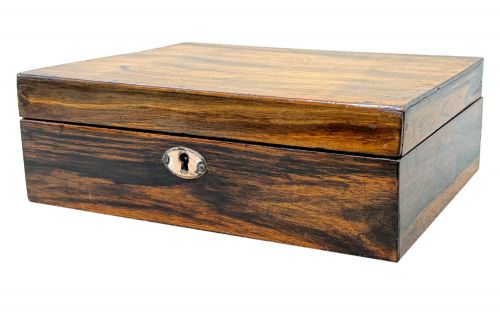


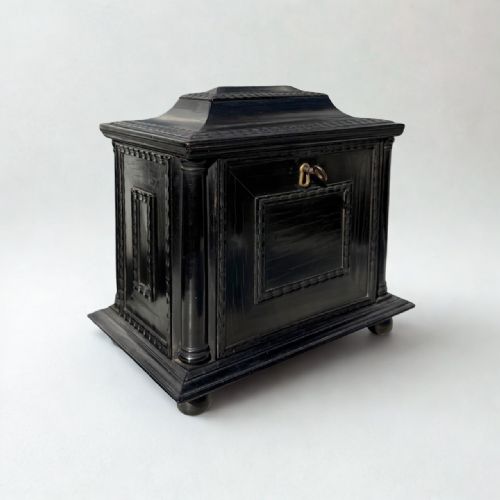


Ebony Jewellery Box
An ebony jewellery box brings dark, polished timber and intricate inlay to the dressing table, offering a sturdy home for small valuables.
Ebony Jewellery Box
When searching for an ebony jewellery box, you encounter pieces spanning from the seventeenth century through to the art deco period, taking the form of compact trinket boxes, larger table cabinets and fitted work boxes. These containers range from solid ebony construction to timber carcasses veneered in the dense dark wood, often paired with contrasting lighter woods and decorative inlays.
The nineteenth century yields many of the available examples, frequently showing Anglo-Indian craftsmanship or European revival styles. Pieces appear alongside related forms such as tea caddies and table caskets, reflecting the varied domestic uses for small decorative wooden boxes over the centuries.
How they were made
Cabinet makers utilised dense tropical hardwoods, working solid ebony or applying fine veneers over secondary woods like walnut and fruitwood. Structural carcass work relied on precise joinery to house heavy timber without warping.
Decoration involved intricate inlay techniques, incorporating bone, brass, mother-of-pearl, kingwood and porcupine quill into the dark wooden surfaces. Specialised parquetry and marquetry patterns created geometric designs or pictorial motifs across the lids and sides.
Recorded styles range from seventeenth-century Flemish Baroque and Italian Renaissance Revival to Victorian and Art Deco forms.
What varies in quality
The standard of an ebony jewellery box depends on the precision of its decorative inlays and the stability of its construction. Finely cut bone, brass or marquetry work set flush into the dark timber distinguishes finer examples from simpler production.
Internal fitting and hardware further separate the grades, with partitioned trays, silk or velvet linings, and original working locks showing the care invested by the maker. The choice of secondary woods and the depth of the exterior polish complete the distinction between standard boxes and masterwork cabinets.
The Ebony Jewellery Box Glossary
- Parquetry
- Geometric wood inlay forming patterned surfaces on box lids and sides. It relies on contrasting timbers arranged in precise repeating shapes.
- Table Casket
- A small, decorative box designed for tabletop display, often featuring substantial locks and feet. These pieces functioned as secure containers for letters or valuables.
- Anglo-Indian
- Furniture and decorative objects made in India for British residents or export during the colonial period. They frequently incorporate porcupine quill and bone inlay.
- Pietra Dura
- The inlay technique of using cut and fitted polished coloured stones to create pictorial designs. In these boxes, stone plaques are mounted directly onto the wooden lid.
- Tunbridge Ware
- Small wooden objects decorated with mosaic patterns made from thousands of tiny tinted wood blocks. The technique creates remarkably detailed pictorial or geometric scenes.
Ebony Jewellery Box: Frequently Asked Questions
How do I care for antique ebony?
Keep wooden boxes away from direct sunlight and sudden temperature changes to prevent the timber and veneers from splitting. Dust gently with a dry cloth and avoid harsh modern polishes that can damage historic finishes.
Apply a minimal amount of microcrystalline wax occasionally if the wood appears dry, buffing it off thoroughly. Ensure the inner linings are kept dry and free from moisture to protect any metal or bone inlays.
Are keys usually included with these boxes?
Many antique boxes survive without their original keys due to centuries of displacement. Specialised locksmiths can sometimes provide replacement keys if the lock mechanism is standard.
When a key is present, test the lock gently without forcing the mechanism. Even without a key, the box remains a decorative and functional tabletop object.
How do I date an ebony box?
Dating relies on examining the construction methods, secondary timbers, hinge types, and interior linings. Style indicators such as art deco geometric patterns or seventeenth-century Flemish carving provide clear chronological markers.
Wear patterns on the base and the type of fasteners used also help place a piece within its correct historical period. Comparing the decorative motifs with dated examples in the archive narrows down the decade of manufacture.
What is porcupine quill work?
Porcupine quill work involves arranging natural quills in geometric bands across the wooden surface, often framed by ebony and bone. This distinctive technique is characteristic of nineteenth-century Anglo-Indian craftsmanship.
The quills provide a textured, striped pattern that contrasts sharply with the dark ebony background. These pieces were popular souvenirs brought back to Britain during the Victorian era.