


Black Inlaid Casket
A black inlaid casket brings together rich dark surfaces and meticulous handwork, offering a striking repository for keepsakes and jewellery.
Black Inlaid Casket
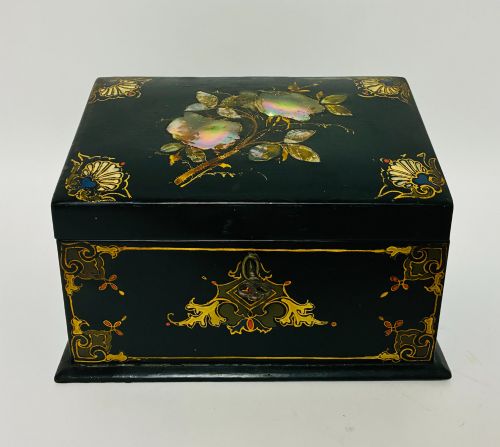
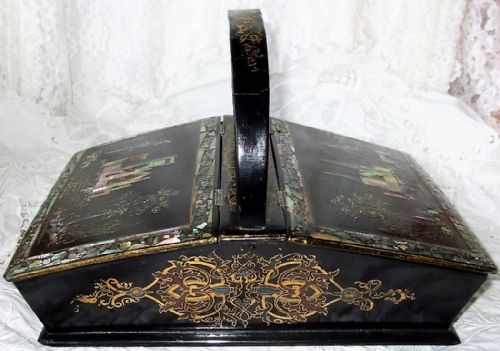
A black inlaid casket is a decorative container designed for keepsakes, stationery, or jewellery, defined by its dark ground and contrasting ornamentation. These pieces range from Victorian papier-mâché and lacquer creations to ebonised wood boxes mounted with hardstones or precious metals.
The versions most commonly encountered on this page date from the nineteenth century, including Victorian examples and earlier Regency forms. Makers employed techniques spanning English papier-mâché work, Italian pietra dura panels, and intricate Anglo-Indian quillwork.
Beyond simple storage, these caskets function as desktop or vanity ornaments, often fitted with internal trays, compartments, or needlework equipment. Their utility matches their decorative appeal, making them enduring focal points for a collector's surface.
Materials and construction
The foundational bodies of these pieces rely on moulded papier-mâché, dense ebonised wood, or ebony, finished with smooth lacquer or polished surfaces. Artisans built structural integrity into each box before applying delicate decorative layers.
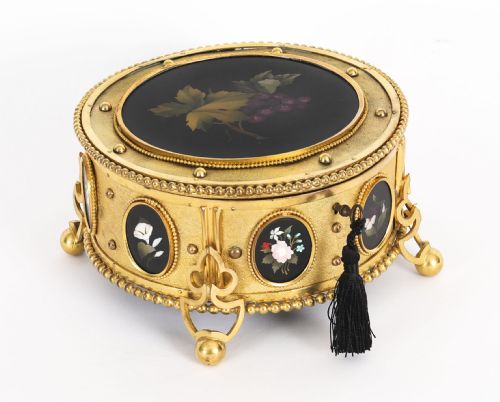
Inlay and mount work required specialist skill, incorporating mother-of-pearl, brass, or fine pietra dura stone plaques set flush into the dark ground. Porcupine quill and coromandel timbers also appear, demonstrating the diverse regional traditions applied to nineteenth-century box making.
Listings feature nineteen-century materials including mother-of-pearl, pietra dura, coromandel, and papier-mâché across English, French, and Italian origins.
Distinctions in quality
Quality rests upon the precision of the inlay work and the integrity of the underlying dark surface, whether lacquer, ebonised wood, or papier-mâché. Superior examples display tight, flush fitting materials with minimal disturbance to the surrounding body.
The sophistication of the secondary materials, such as finely detailed pietra dura panels, intricate brass mounts, or elaborate interior fittings, separates standard containers from exceptional pieces. Preservation of the original surface finish and internal lining further dictates the standing of a given casket.
The Black Inlaid Casket Glossary
- Pietra dura
- A method of inlaying cut and fitted polished coloured stones to create pictorial designs. This technique appears frequently on nineteenth-century Italian boxes.
- Ebonised wood
- Timber treated to resemble ebony through staining or painting. It provides a dense black finish common in Victorian and Regency decorative objects.
- Papier-mâché
- A composite material made of paper pulp or reinforced paper sheets, moulded and lacquered. It formed a primary structural medium for nineteenth-century English caskets.
- Mother-of-pearl
- The iridescent inner layer of certain mollusk shells, sliced thin for decorative inlay. It creates bright, reflective contrasts against dark box surfaces.
- Coromandel
- A dense, heavily variegated timber imported from Asia, valued for its rich dark brown and black grain. It served as a luxury material for nineteenth-century stationery and keepsake cases.
Black Inlaid Casket: Frequently Asked Questions
What were black inlaid caskets used for?
These caskets served primarily as secure, decorative containers for personal valuables, including rings, necklaces, and delicate trinkets. Many were also designed to hold stationery, sewing implements, or keepsakes on a lady's dressing table or a gentleman's desk.
Beyond practical storage, they functioned as display pieces that demonstrated the owner's taste and refinement. Their internal compartments kept organised items safe from dust and light exposure.
How can I tell a Victorian box from a Regency one?
Regency boxes often exhibit clean architectural lines, linear brass stringing, and dense timbers like coromandel or mahogany. Their construction reflects neoclassical restraint popular in the early nineteenth century.
Victorian examples frequently utilise moulded papier-mâché, heavier ornamentation, and mother-of-pearl inlay with floral or mother-of-pearl motifs. The stylistic shift moves from geometric Regency austerity toward more expressive Victorian surface decoration.
What is pietra dura?
Pietra dura translates from the Italian as hard stone, referring to the artisanal practice of assembling cut-and-fitted coloured stones. Craftsmen arranged minerals such as jasper, chalcedony, and marble to form floral or figurative mosaics.
These panels were then set directly into the wooden or ebonised bodies of imported caskets, particularly in nineteenth-century Italy. The result is a smooth, permanent picture panel that resists fading.