


Ebonised Wooden Tea Table
An ebonised wooden tea table brings deep, dark elegance to a room, offering a distinct surface rooted in late-nineteenth and early-twentieth-century design.
Ebonised Wooden Tea Table
When you search for an ebonised wooden tea table, you enter a field defined by dark, polished finishes spanning the Victorian, Edwardian, and Art Deco eras. These pieces take various forms, including coffee tables, centre tables, side tables, and occasional tables designed for display or social gatherings.
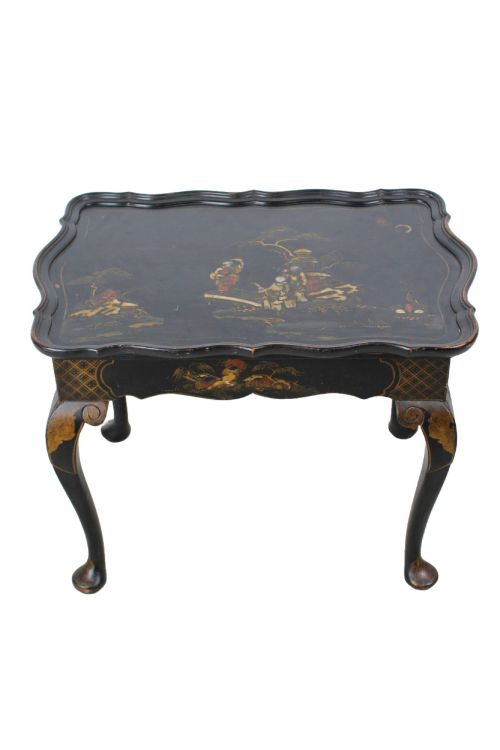
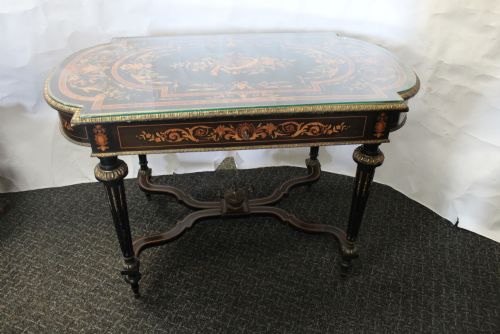
The versions you meet on this page range from Aesthetic Movement and Anglo-Japanese designs to French Napoleon III and Edwardian Chinoiserie interpretations. Makers utilised ebonised timber alongside contrasting materials to create striking visual focal points in a drawing room or parlour.
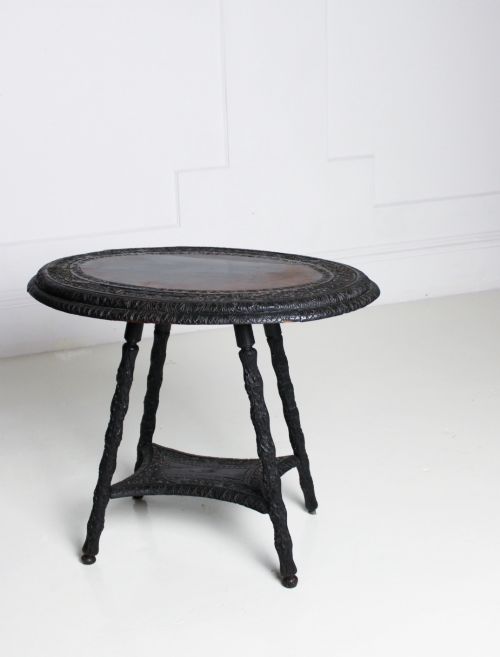
Originating from periods such as the 1880s and the early twentieth century, these tables reflect global influences including Anglo-Indian craftsmanship and Japanese-inspired aesthetics. Each example demonstrates how dark wood finishes were adapted for diverse domestic uses over the decades.
How they were made
Craftsmen achieved the characteristic dark finish by ebonising timber, a process that stained or treated light wood to mimic costly ebony. This technique was frequently paired with rosewood, walnut, alder root, or blonde oak depending on the specific regional workshop and period.
Decoration often involved intricate inlays of brass or gilt highlights to catch the light against the dark surface. Certain pieces incorporate lacquered wood or crossbanded veneers, showing careful attention to surface pattern and structural detail.
Some tables spent a century holding heavy porcelain teapots before retiring to quietly host mobile phones.
What varies in quality
The standard of a piece rests upon the crispness of its ebonised finish and the precision of any inlay work, whether brass or contrasting wood. Tables that retain their original gilt details and retain structural integrity without excessive surface wear stand apart from simpler iterations.
Design ambition dictates the upper tier of the range, where distinct stylistic movements like the Aesthetic Movement or named makers shape the construction. Simpler occasional tables offer utility, while more elaborate centre tables showcase sophisticated joinery and materials.
Liberty & Co.·Carlo Bugatti
The Ebonised Wooden Tea Table Glossary
- Ebonised
- Wood treated with a dark stain or chemical process to imitate solid ebony. This finish was widely adopted during the Victorian and Edwardian eras to achieve a formal, uniform appearance.
- Centre table
- A freestanding piece designed to be viewed from all sides rather than pushed against a wall. These tables often occupied the middle of a Victorian parlour.
- Aesthetic Movement
- A late-nineteenth-century design approach emphasising visual beauty over narrative or moral content. It drew heavily on Japanese art and clean, dark lines.
- Crossbanded
- A method of applying veneer across the grain of the underlying wood around the perimeter of a tabletop. This creates a contrasting border that frames the central panel.
- Occasional table
- A small, portable table brought out for specific uses such as serving tea or holding books. These versatile pieces became popular in various forms throughout the nineteenth and twentieth centuries.
Ebonised Wooden Tea Table: Frequently Asked Questions
Where were these tables placed originally?
These tables served various functions in Victorian and Edwardian homes, often positioned in the centre of a room or beside seating. They held tea services, books, or decorative objects for guests to admire.
Smaller occasional and side tables could be moved easily around the parlour as needed. Centre tables anchored the room and displayed the household's taste.
What defines the Aesthetic Movement style?
The style focuses on visual harmony, flat dark surfaces, and inspiration drawn from Japanese art and design. Ebonised wood formed a key part of this vocabulary, providing a stark canvas for gilt or inlaid decoration.
Tables from this movement often feature geometric forms and understated elegance. They marked a departure from heavier, highly carved Victorian furniture.
How do I tell an Edwardian piece from a Victorian one?
Victorian examples tend to display heavier proportions, deeper carving, and rich inlays associated with formal nineteenth-century entertaining. Ebonisation during this time often mimicked expensive exotic hardwoods.
Edwardian pieces generally exhibit lighter frames and brighter decorative influences like Chinoiserie. The transition reflects shifting domestic habits towards airier, less cluttered interiors.