


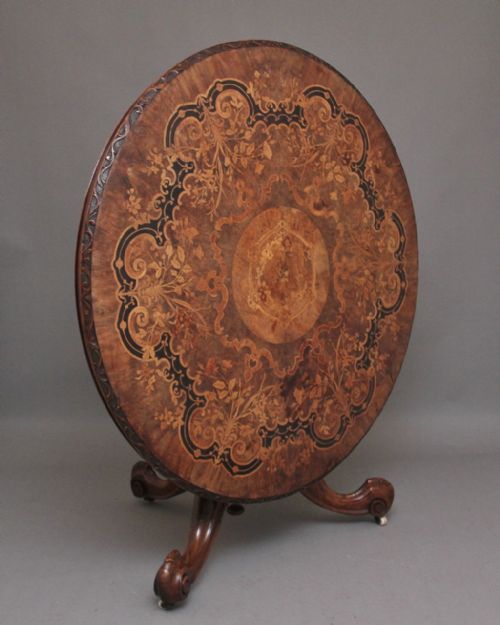

Ebonised Marquetry Centre Table
An ebonised marquetry centre table commands a room with dark surfaces and intricate floral or geometric inlays.
Ebonised Marquetry Centre Table
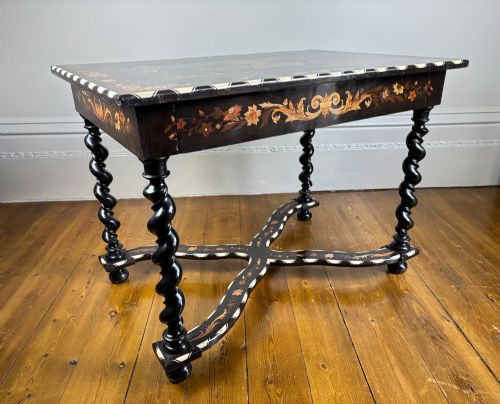
An ebonised marquetry centre table stands as a freestanding focal point designed to be viewed from all sides in the middle of a room. The search for an ebonised marquetry centre table brings up nineteenth-century examples spanning Victorian, Napoleon III, and various revival styles.
Makers shaped these surfaces into occasional, coffee, breakfast, and writing tables, often utilising rounded or shaped tops. You will frequently encounter French and English pieces employing contrasting wood veneers and metal stringing.
The dark, polished finish creates a dramatic ground for floral wood inlay, tortoiseshell, and brass work. These tables served domestic parlours and salons where display and entertaining mattered most.
How they were made
Cabinet makers achieved the dark, dense finish by staining timber, usually fruitwood or beech, to imitate ebony. This ebonised wood provided a sombre, uniform backdrop that made inlaid brass and lighter veneers stand out.
Marquetry involved cutting intricate patterns from thin sheets of walnut, burr walnut, amboyna, and bone, then fitting them meticulously into the surface veneer. Brass and ormolu mounts added structural definition and edge protection to the tops and legs.
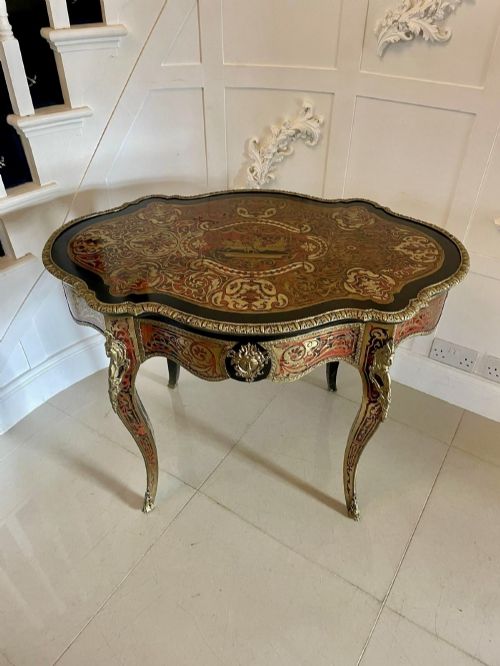
Boulle work appeared on French pieces, combining tortoiseshell and brass cut together in counter-change patterns. Artisans glued these delicate assemblies onto the carcase wood before scraping and polishing the surfaces to a high gloss.
Object types recorded across the site include occasional tables, breakfast tables, and writing desks with bone and brass inlay.
What varies in quality
The precision of the marquetry cutting determines the crispness of the design, where tighter joints between the contrasting woods signal superior workshop output. Inferior examples rely on inked lines to fake the complexity of true multi-timber inlay.
The choice of secondary timbers and the depth of the brass or ormolu mounts mark the distinction between standard commercial items and bespoke commissions. Finer tables feature richly figured burr walnut or amboyna panels alongside finely chased metalwork.
Structural integrity rests on the stability of the central pedestal or leg joints, which must support heavy tops without wobbling. Superior pieces maintain tight veneer adhesion without lifting or extensive bubbling across the expansive surfaces.
Maison Millet·Gillows·Holland and Son
The Ebonised Marquetry Centre Table Glossary
- Ebonised
- Wood stained or painted black to simulate ebony. This finish was widely used in nineteenth-century furniture to create stark contrast with lighter inlays.
- Marquetry
- A decorative technique applying veneer pieces to a structure to form pictorial or geometric patterns. Different coloured woods, bone, and metal create the design.
- Boulle
- A method of marquetry using brass and tortoiseshell, named after the French cabinet maker André-Charles Boulle. It produces a shimmering metallic and dark pattern.
- Ormolu
- Gilt bronze mounts applied to furniture for decoration and edge protection. The technique involves coating bronze with a gold amalgam and heating it.
- Parquetry
- Geometric wood inlay forming repeating patterns such as cubes or chequers. Unlike marquetry, it uses strict geometric shapes rather than pictorial motifs.
Ebonised Marquetry Centre Table: Frequently Asked Questions
What is an ebonised marquetry centre table?
An ebonised marquetry centre table is a freestanding nineteenth-century table featuring a darkened wood finish and intricate inlaid veneer patterns.
These pieces were built to sit in the middle of a room rather than against a wall, displaying decoration on every side.
How do I care for ebonised wood?
Protect ebonised wood surfaces from direct sunlight and excessive moisture to prevent the dark finish from fading or lifting.
Dust gently with a dry, soft cloth and avoid chemical polishes that can degrade the historic polish.
Where did these tables originate?
These tables largely originated in nineteenth-century British and French workshops influenced by revivalist and aesthetic movements.
French cabinet makers specialised in elaborate Boulle work and ormolu mounts, while English makers favoured refined walnut and amboyna.
How do I distinguish French and English styles?
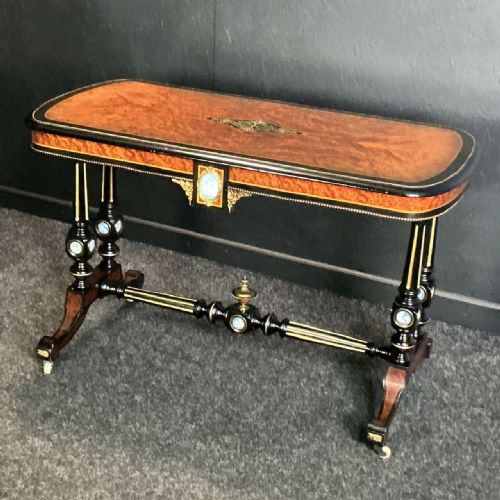
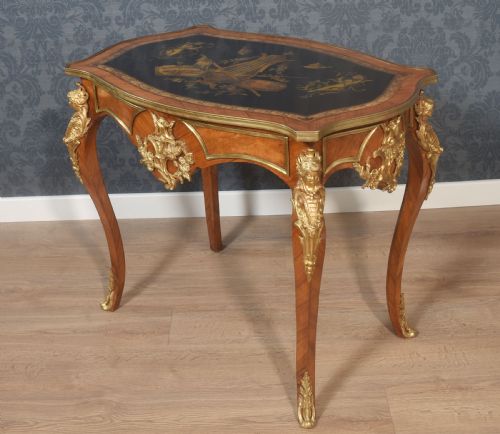
French tables frequently incorporate heavy ormolu mounts, tortoiseshell, and Louis-style curves. English pieces often lean towards rectilinear aesthetic movement designs or subtle walnut and marquetry work.
Examining the construction methods and secondary timbers inside the carcase often confirms the origin.