
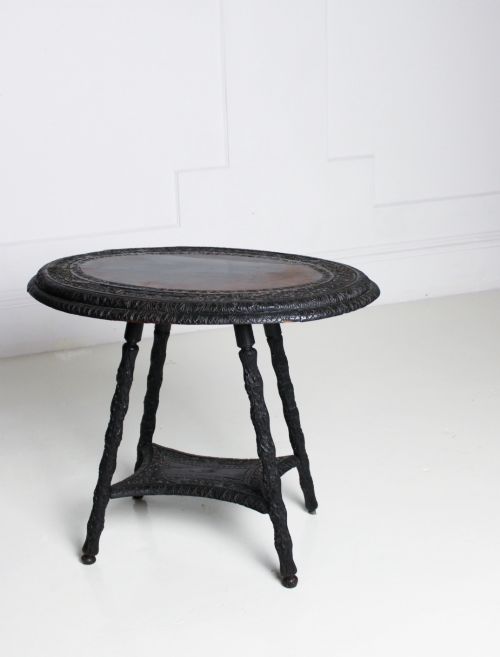


Ebonised Hardwood Table
An ebonised hardwood table brings deep, dark surfaces and intricate carving into a room, drawing the eye instantly.

Ebonised Hardwood Table
When you search for an ebonised hardwood table, you encounter dark-finished timber furniture originating primarily from nineteenth-century export markets and Victorian workshops. The selection centres on plant stands, side tables, and occasional tables that display dense carving and contrasting surfaces.
The pieces on this page lean heavily toward Chinese Export, Anglo-Indian, and Japanese forms, alongside Victorian English interpretations. Buyers frequently meet jardiniere stands, low coffee tables, and marble-inset tables rather than large dining furniture.
Origins range from Far Eastern workshops to British retail firms, uniting exotic hardwoods with the fashionable blacked finishes of the period. Each piece serves as a compact display surface, whether holding a vase, a lamp, or a planter.
Materials and construction
Maker's workshops built these pieces using dense timbers such as rosewood, teak, and various heavy hardwoods, often treating the surface to achieve a deep black ebonised finish. This dark treatment mimics rarer ebony while providing a uniform ground for elaborate hand carving.
Many examples incorporate inset panels of rouge or white marble into the top surface to support heavy planters and resist moisture. Bone inlay and deep relief carving appear frequently, showcasing the technical skill of nineteenth-century artisans across different continents.
Materials recorded across the inventory include hardwood, ebonised wood, marble, rosewood, teak, and bone.
Factors that define quality
Depth and crispness of the hand carving separate standard production pieces from finer workshop creations. Sharp undercut foliage, dragons, and figures indicate skilled labour, whereas shallow or mechanical moulding suggests lower grade output.
The integration of materials also dictates standard, particularly where marble tops fit flush into the hardwood frame without gaps. Solid timber construction throughout, rather than thin veneering over soft secondary woods, ensures lasting structural integrity.
Liberty of London
The Ebonised Hardwood Table Glossary
- Ebonised
- Wood finished to resemble ebony through staining, painting, or chemical treatment. This technique gained immense popularity during the Victorian era for exotic and domestic timbers alike.
- Jardiniere stand
- A tall, slender table designed specifically to elevate potted plants and flower arrangements. These pieces often feature circular marble inserts to protect the wood from dampness.
- Anglo-Indian
- Furniture made in India by local craftsmen using traditional techniques adapted to British colonial tastes. These items frequently combine British furniture forms with intricate Indian floral and animal carving.
- Chinese Export
- Objects manufactured in China specifically for Western markets and trade during the nineteenth century. They merge traditional Chinese motifs with forms useful in European homes.
- Occasional table
- A small, movable table used for specific, temporary purposes such as holding a lamp or books. They dominate the selection of ebonised hardwood items available.
Ebonised Hardwood Table: Frequently Asked Questions
What is an ebonised hardwood table?
An ebonised hardwood table is a small nineteenth-century display surface treated with a dark, polished finish to resemble ebony wood. These pieces frequently feature dense hand carving and diverse cultural motifs.
They serve primarily as plant stands, lamp tables, or low occasional tables rather than large utilitarian furniture. Their compact proportions make them suitable for accenting corners or displaying decorative objects.
How do I use a jardiniere stand?
A jardiniere stand is designed to elevate potted plants, flowers, or heavy ceramic vessels to a comfortable viewing height. The inclusion of marble tops in many examples protects the wood from water damage.
In a modern interior, you can place one in a hallway or living room to hold a trailing plant or a decorative lamp. Their narrow footprints allow them to fit into spaces where larger furniture cannot go.
Are these tables solid wood?
Most of these tables utilise dense hardwoods such as rosewood, teak, or heavy native timbers. The dark ebonised surface is applied directly to the timber substrate during manufacture.
Some examples also incorporate contrasting materials like inset marble panels or bone details. Construction relies on traditional joinery suited to the weight of the dense materials used.
How do I date a Victorian ebonised table?
Dating relies on stylistic clues, material combinations, and the specific origins recorded in the piece. Nineteenth-century examples often combine Victorian proportions with Far Eastern or colonial carving techniques.
Examining the wear patterns, the method of ebonising, and the fit of marble inserts helps establish the manufacturing period. Maker signatures or retailer labels, when present, provide a precise point of origin.