

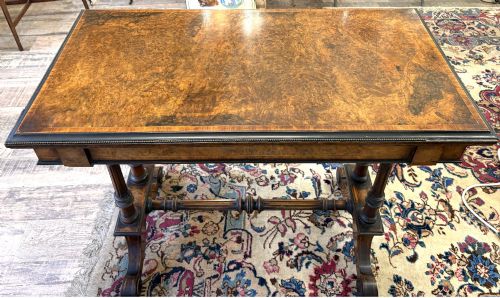
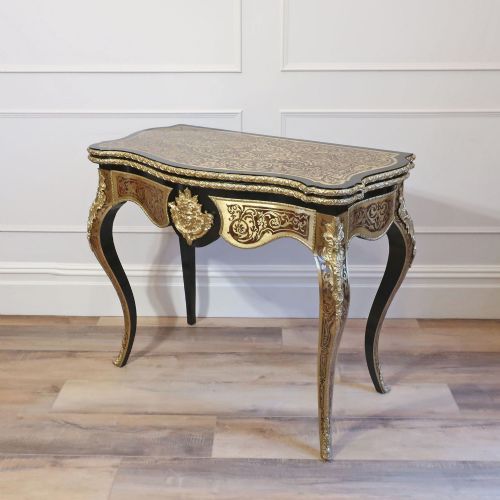
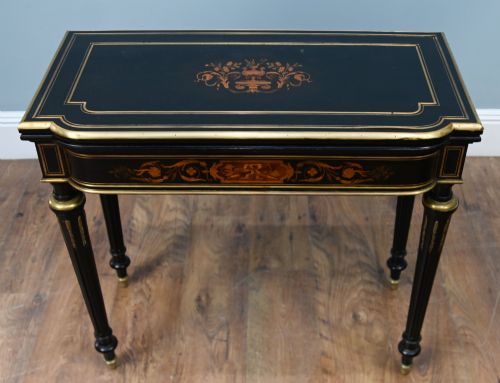
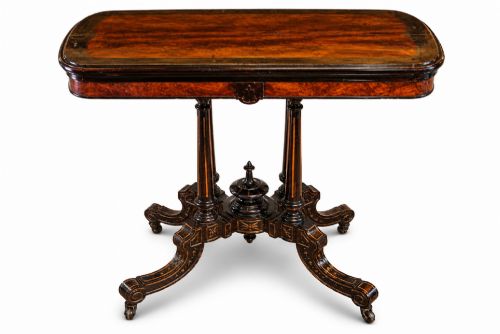
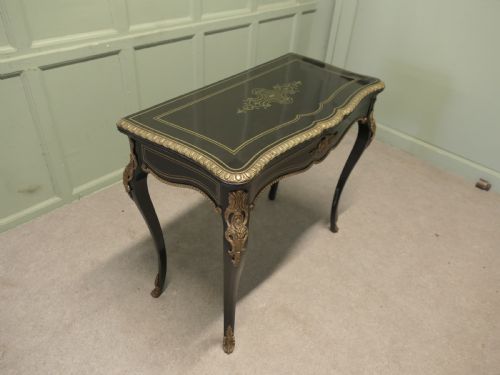


Ebonised Folding Tea Table
These ebonised folding tea table examples bring dark timber and clever folding mechanisms together for practical modern rooms.

Ebonised Folding Tea Table
An ebonised folding tea table is a versatile surface designed for entertaining, appearing most frequently from the nineteenth century in various revival styles. These pieces range from Victorian aesthetic movement designs to French Louis revival forms, adapting easily to modern living spaces.
The inventory on this page shows card tables, games tables, and console tables sharing folding mechanisms and ebonised wood construction. You will encounter walnut, mahogany, and burr walnut frameworks finished to resemble ebony, often accented with brass inlay or gilt.
How they were made
Cabinet makers utilised dense hardwoods like mahogany and walnut, applying dark ebonising stains to achieve a sleek, uniform finish reminiscent of exotic ebony. Surfaces frequently incorporate intricate floral marquetry, parcel gilt details, or contrasting veneers of kingwood and amboyna.
Brass inlay and ormolu mounts punctuate the dark timber surfaces, requiring precise hand-fitting by skilled artisans. The folding and swivelling mechanisms depend on robust interior hinges and pivots hidden within the table frames to support the top leaf.
Ebonised Folding Tea Table Retail Price Guide 2026
Typical asking prices for ebonised folding tea table among the pieces listed under this phrase on Sellingantiques today, from the lower quarter to the upper quarter. They describe what is for sale here now, not the wider market.
Some Victorian card tables hide secret compartments beneath their swivelling tops, designed to swallow stray playing cards and ivory counters whole.
What varies in quality
The distinction between standard production and exceptional craftsmanship lies in the crispness of the carving and the precision of the brass or wood marquetry. Superior examples exhibit seamless joints in the folding mechanism and harmonious timber selection beneath the ebonised finish.
Maker attribution elevates certain pieces significantly, as seen in stamped signatures or paper labels from established cabinet works. The finesse of the parcel gilt and the preservation of the delicate secondary woods like amboyna or kingwood dictate the standing of an individual table.
Jenks & Woods·Lamb of Manchester·S&H Jewell
The Ebonised Folding Tea Table Glossary
- Ebonised wood
- Timber stained or painted to imitate solid ebony, popular during the nineteenth century for a dramatic, dark appearance. This finish appears widely across aesthetic movement and Victorian pieces.
- Marquetry
- Decorative patterns formed from thin veneer pieces applied to a furniture structure, creating floral or geometric designs. Craftsmen often combined exotic woods like kingwood and walnut for contrast.
- Parcel gilt
- The practice of applying gold leaf selectively to specific carved details or highlights on a piece. It contrasts sharply against the dark ebonised background timber.
- Ormolu
- Gilt-bronze mounts applied as decorative ornaments to furniture corners, legs, and aprons. This technique characterises French revival and Louis style pieces.
- Card table
- A specialist folding table featuring a baize-lined interior surface designed for evening games and tea. The hinged top rotates or folds open to reveal a stable playing area.
Ebonised Folding Tea Table: Frequently Asked Questions
What is an ebonised folding tea table used for?
These tables served primarily for social gatherings, offering a compact surface for tea service or card games that could fold flat against a wall when not in use. Their dual functionality made them essential items for nineteenth-century reception rooms.
Today, they function brilliantly as console tables that open out when guests visit or as striking decorative accents in a hallway. The folding top remains fully operational in many surviving examples.
How do I identify the aesthetic movement style?
Aesthetic movement pieces emphasise simplicity, dark ebonised finishes, and Japanese-inspired decorative motifs rather than heavy historic revival ornamentation. They often incorporate subtle gilt highlights and clean structural lines.
Look for restrained geometric inlay and lighter proportions compared to earlier Victorian furniture. The focus rests on artistic design and material harmony.
What is the difference between walnut and ebonised mahogany?
Walnut displays a naturally rich, figured grain pattern that cabinet makers sometimes highlighted alongside ebonised borders. Mahogany offers a denser, heavier foundation that took black stain exceptionally well to mimic ebony.
Both timbers provide the structural stability required for folding table mechanisms. The choice of base wood often reflects the prevailing fashion of a specific decade.
How should I care for ebonised wood surfaces?
Ebonised finishes require gentle dusting with a soft, dry cloth to prevent micro-scratching on the dark pigmented surface. Avoid direct sunlight and excessive moisture, which can fade the dark stain or damage underlying veneers.
Occasional application of appropriate furniture wax helps nourish the timber beneath the finish. Treat brass and gilt highlights with care to preserve their original patination.