
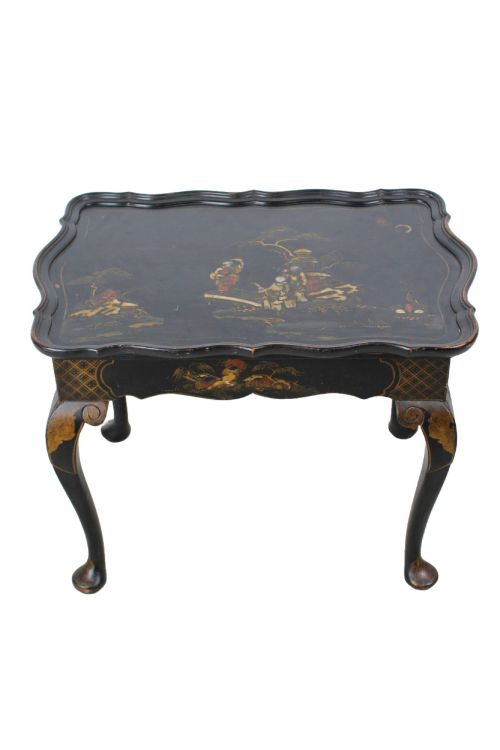
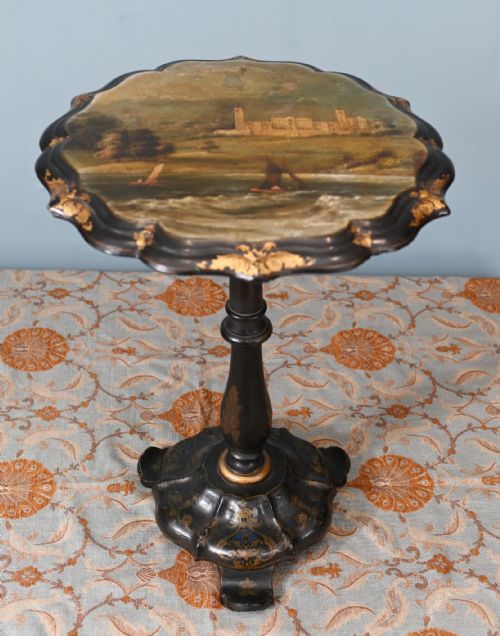
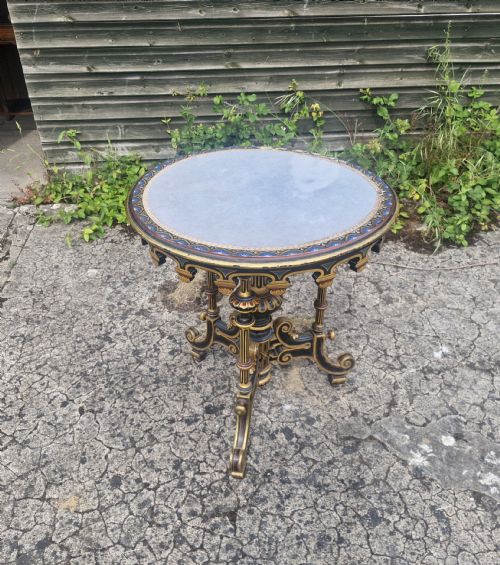
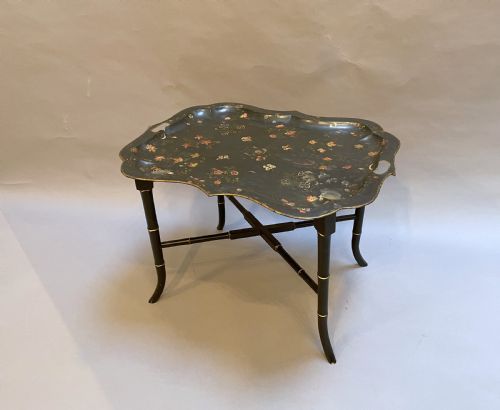


Gilt Ebonised Tea Table
A gilt ebonised tea table brings dark polished surfaces and bright highlights together, offering a striking centrepiece for a sitting room.

Gilt Ebonised Tea Table
When you search for a gilt ebonised tea table, you enter a field dominated by nineteenth-century craftsmanship, including Victorian, Regency, and Edwardian pieces. These tables combine dark ebonised wood or black lacquer with gold leaf decoration, creating a dramatic contrast that defines their visual appeal.
You are most likely to meet papier-mâché tray tables on stands, card tables, and occasional tables spanning the period from eighteen-seventy to nineteen-ten. Many incorporate chinoiserie motifs, floral painting, or aesthetic movement designs.
The form adapts easily to various interior settings, functioning as a serving surface, card table, or decorative centre table. The combination of dark finishes and gilded detail remains consistent across these functional types.
Materials and construction
Maker's workshops built these tables using ebonised wood, mahogany, amboyna, and papier-mâché, applying black paint or lacquer to achieve a dark, uniform ground. Artisans then added intricate detail through hand painting and gold leaf application.
Papier-mâché tray tables utilise moulded paper pulp reinforced for strength, mounted on folding or fixed wooden stands. Card tables often feature hinged tops lined with baize or leather, supported on folding wooden frameworks.
Listings feature nineteen-century Victorian, Regency, and Edwardian examples utilising ebonised wood, papier-mâché, lacquer, and gold leaf.
Evaluating quality and execution
The distinction between standard production and superior work rests on the precision of the gilding and the depth of the ebonised finish. Finer examples display crisp hand-painted Chinoiserie or floral decoration rather than simple stencilling.
Structural integrity in the joints of stands and the smoothness of folding mechanisms on card tables separate better-preserved items from simpler utility pieces. The quality of the underlying wood, such as mahogany or amboyna, also elevates the status of the piece.
Lamb of Manchester
The Gilt Ebonised Tea Table Glossary
- Ebonised
- Wood treated to imitate ebony by staining or painting it a deep black. This finish provides a dark ground that makes gold leaf highlights stand out.
- Chinoiserie
- European artistic style reflecting Chinese motifs and decorative techniques. It appears frequently in the painted scenes on nineteenth-century papier-mâché trays.
- Papier-mâché
- A composite material made from paper pulp mixed with glue and resin, pressed and dried into sturdy forms. It serves as the base for many decorative tray tables.
- Parcel Gilt
- Partial gilding where gold leaf highlights specific carved details, edges, or motifs. This technique draws the eye to particular decorative elements against the dark wood.
Gilt Ebonised Tea Table: Frequently Asked Questions
What is an ebonised tea table?
An ebonised tea table is a dark wood or papier-mâché table finished with black paint or stain, often accented with gold leaf. These pieces date predominantly from the nineteenth century.
They function as decorative side tables, card tables, or serving surfaces, bringing a dramatic dark aesthetic to period interiors.
How do I care for papier-mâché tables?
Papier-mâché tables require gentle dusting with a dry microfibre cloth and protection from direct sunlight and moisture. Avoid placing hot or wet items directly on the painted surface.
Keep them away from rapid temperature changes to prevent cracking in the lacquer and paint layers.
Are these tables sturdy enough for daily use?
Many card tables and centre tables are constructed solidly from mahogany or ebonised wood and handle regular use well. Papier-mâché tray tables are lighter and suit serving or display better than heavy loads.
Check the stability of the stand and joints before using any antique table for active daily tasks.
How do I distinguish Victorian from Regency styles?
Regency pieces often display classical restraint with clean lines, while Victorian and Aesthetic Movement examples embrace more ornate floral or Chinoiserie decoration. Papier-mâché and japanned surfaces became especially popular during the Victorian era.
Examining the construction methods and decorative motifs helps clarify the likely period of manufacture.