
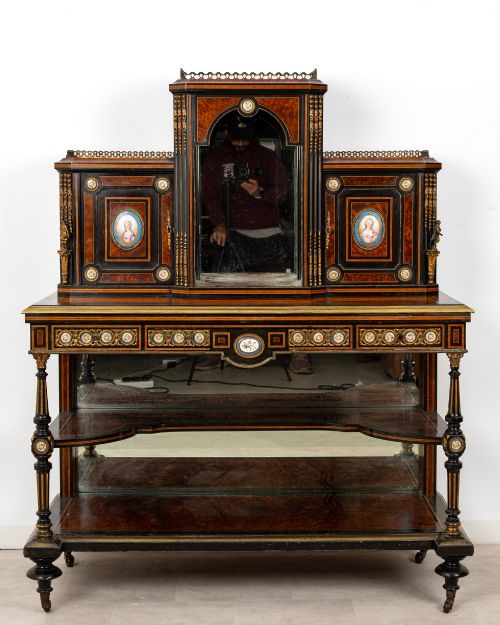

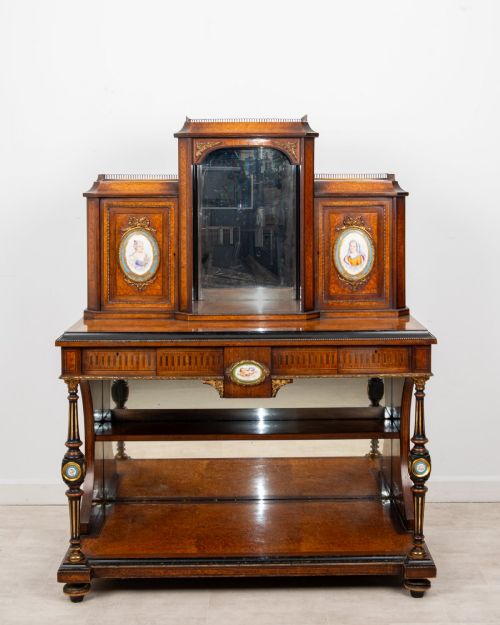
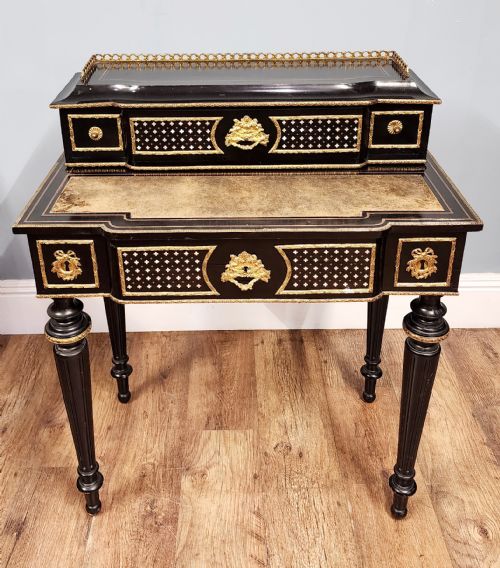
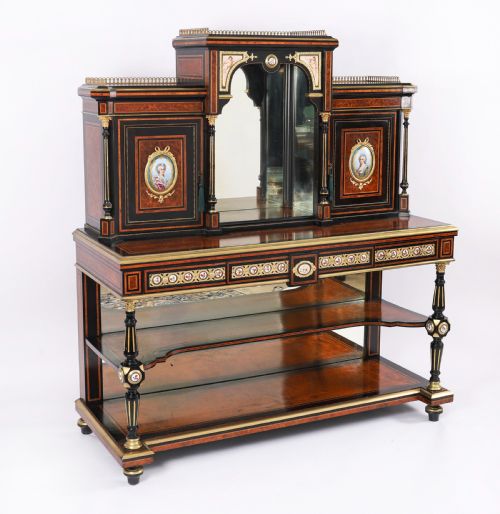


Ebonised Bonheur Du Jour
An ebonised bonheur du jour combines a practical writing surface with compartmentalised storage, offering a compact desk designed for correspondence.
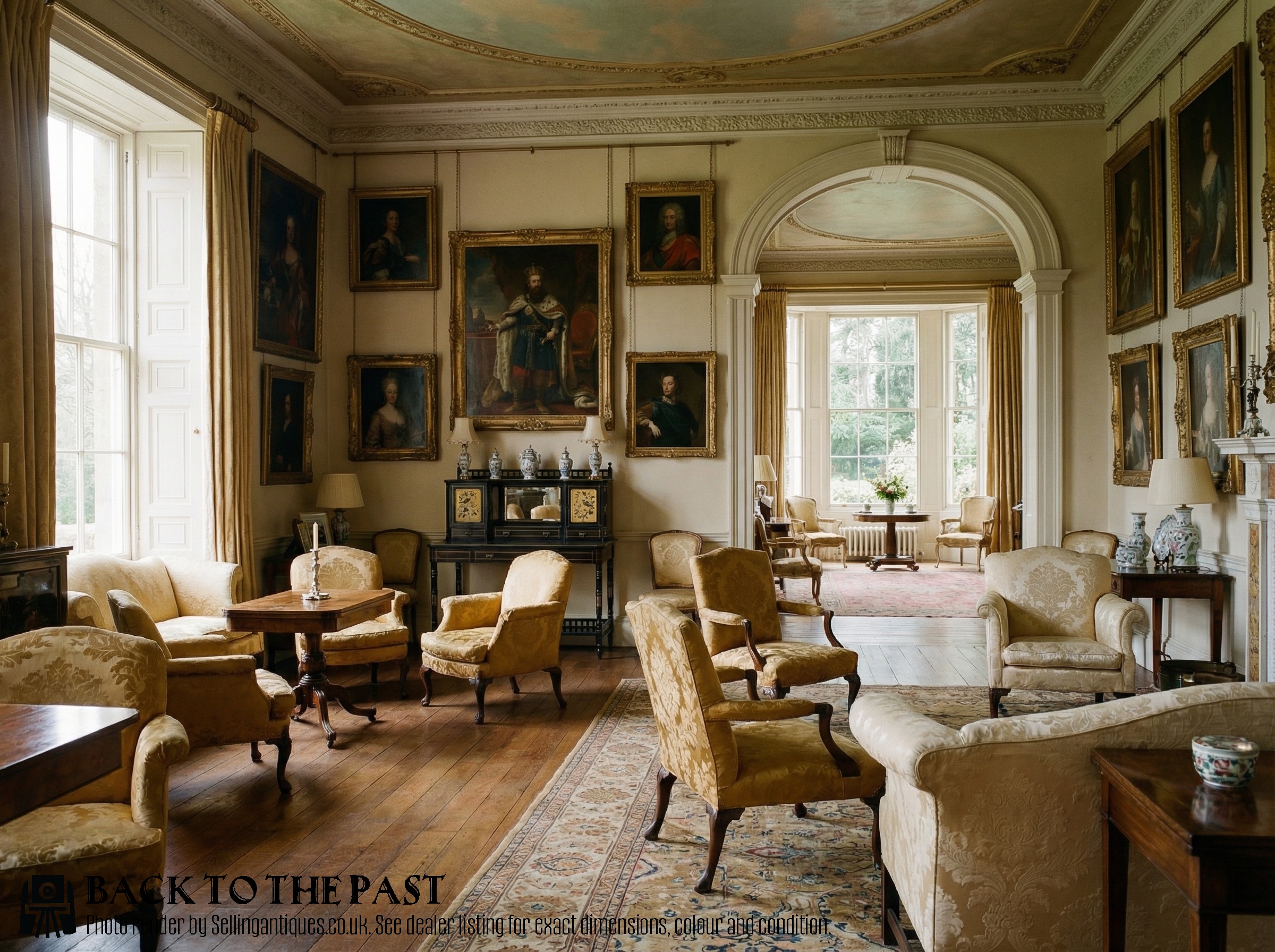
Ebonised Bonheur Du Jour
An ebonised bonheur du jour is a small writing desk equipped with superstructure shelving, drawers, or cabinets above the main writing surface. The form emerged in France and became popular across the nineteenth century, including during the Victorian and Edwardian periods.
The version most commonly encountered on this page pairs ebonised wood with decorative elements such as ormolu mounts, porcelain plaques, or marquetry. These writing desks draw upon French Napoleon III, Victorian Louis XVI Revival, and Aesthetic Movement design styles.
Originating predominantly from French workshops and English makers, these pieces function as both decorative furniture and usable writing desks. The listings demonstrate variety in wood combinations, such as amboyna and burr walnut paired with ebonised finishes.
Materials and construction methods
The foundational structure relies on timber, principally ebonised wood, alongside contrasting veneers like amboyna, burr walnut, and walnut. Ebonising involves treating cheaper or lighter woods to imitate ebony, a technique requiring careful preparation and staining.
Metalwork details form a key part of the construction, utilising ormolu, gilt bronze, and brass for mounts, handles, and gallery rails. Inlaid techniques incorporate pietra dura plaques, porcelain panels, and intricate marquetry to enrich the surfaces.
Ebonised Bonheur Du Jour Retail Price Guide 2026
Typical asking prices for ebonised bonheur du jour among the pieces listed under this phrase on Sellingantiques today, from the lower quarter to the upper quarter. They describe what is for sale here now, not the wider market.
Materials recorded include ebonised wood, ormolu, brass, porcelain, amboyna, glass, burr walnut, and gilt bronze.
Assessing quality in execution
Quality rests upon the precision of the cabinetwork and the integration of decorative elements such as porcelain plaques and ormolu mounts. Finer examples display crisp casting in the metalwork and seamless veneer matching across curved and flat surfaces.
The choice of secondary woods and the depth of the ebonised finish distinguish standard production from superior pieces. Signed maker pieces and those retaining intricate boullework or pietra dura details represent the upper tier of the range.
Paul Sormani·Mathieu Befort·Befort Jeune
The Ebonised Bonheur Du Jour Glossary
- Ebonised
- Wood treated to resemble solid ebony through staining or painting. This finish was widely utilised in nineteenth-century cabinetmaking.
- Bonheur du jour
- A small ladies' writing desk featuring a raised superstructure of compartments. The term translates from French as daylight joy.
- Ormolu
- Gilt bronze mounts applied to furniture for decorative effect. The technique involves a mercury gilding process on bronze.
- Pietra dura
- Inlaid work using cut and fitted polished coloured stones to create pictorial designs. This technique appears on select tabletop surfaces.
- Boulle
- Marquetry style using tortoiseshell and brass inlay developed by André-Charles Boulle. It provides a distinct metallic pattern against a dark background.
Ebonised Bonheur Du Jour: Frequently Asked Questions
What is a bonheur du jour?
A bonheur du jour is a small writing desk featuring a tiered superstructure with small drawers, pigeonholes, or a small cupboard above the main writing surface. These desks were traditionally used for writing letters and keeping stationery.
Originating in France during the eighteenth century, the form continued into the nineteenth century with various revival styles. They provide both a functional workspace and a decorative cabinet display.
Where were these desks made?
These writing desks were produced in both French and English workshops during the nineteenth and early twentieth centuries. French makers often incorporated gilt bronze and porcelain plaques, while English makers adopted similar continental revival styles.
Maker signatures, when present, can pinpoint specific workshops in Paris or London. Many pieces remain unsigned but reflect the prevailing aesthetic tastes of their production centres.
How do you care for ebonised wood?
Ebonised wood requires dusting with a soft, dry cloth to prevent surface scratching. Avoid placing these pieces in direct sunlight or near heat sources to protect the dark finish and underlying veneers.
Applying a specialist wax polish occasionally helps maintain the lustre of the ebonised surface. Care must be taken around ormolu mounts and porcelain plaques during cleaning.