
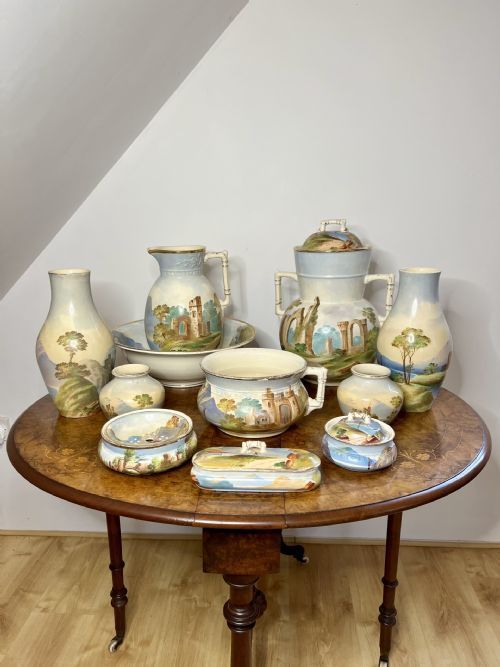


Earthenware Jug and Basin
These earthenware jug and basin sets bring practical bedroom washing into view, offering handsome ceramic design for daily use.
Earthenware Jug and Basin
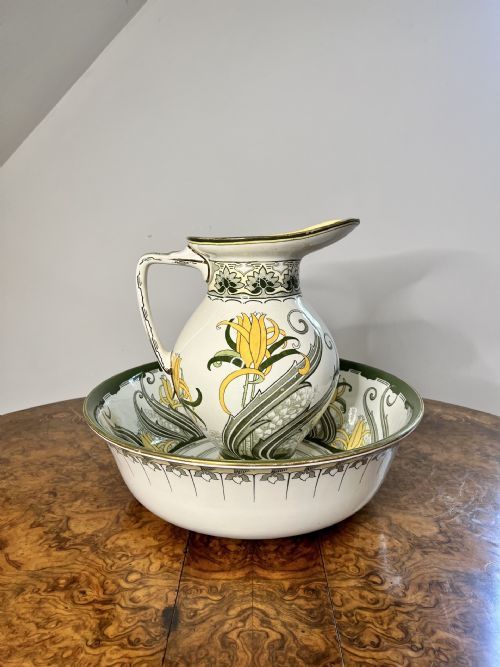
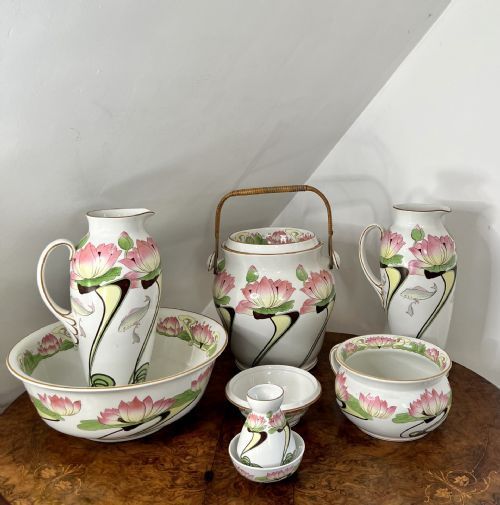
An earthenware jug and basin pair combines a large pitcher with a matching deep bowl, designed primarily for the washstand before plumbed bathrooms became standard. These sets appear across the Victorian, Edwardian, and Art Nouveau periods, taking forms such as wash sets, washstand sets, and bathroom sets.
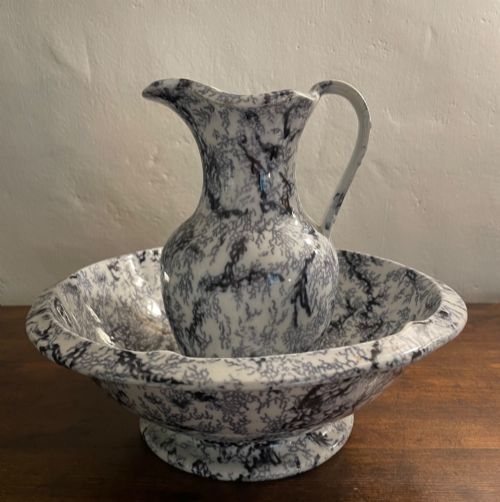
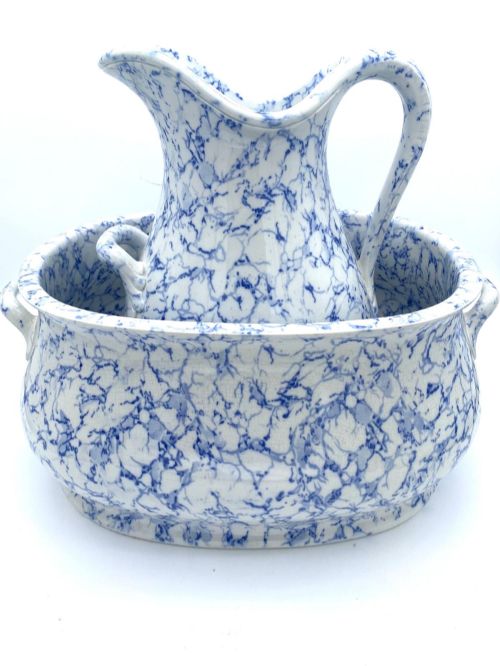
The pieces on this page showcase typical nineteenth-century and early twentieth-century domestic utility, spanning the 1800s, 1880, 1900, and 1910 eras. Makers apply decorative schemes like flow blue, blue and white, and Italian marble patterns to transform everyday ceramic washing vessels into striking bedroom focal points.
How they were made
Potters shape these wares from earthenware clay, applying glazes to seal the porous ceramic body and provide a smooth, cleanable surface for washing. Some examples incorporate enamel decoration or gold leaf details alongside blue and white pigments to enrich the pattern.
Makers fire the clay in kilns before applying transfer-printed designs such as flow blue or marble patterns beneath or over the glaze. This technique ensures the decorative surface withstands frequent contact with water during daily ablutions.
Some nineteenth-century makers decorated wash jugs with faux marble patterns, allowing modest earthenware to pretend it grew inside a grand Italian quarry.
What varies in quality
The distinction between standard domestic utility sets and finer examples lies in the crispness of the transfer printing and the ambition of the pattern. Elaborate surface treatments like Italian marble designs or rich flow blue colouring elevate the visual impact of the earthenware body.
Makers such as Minton and Doulston Burslem introduce refined potting techniques and distinctive decorative motifs that set their output apart from unmarked production. The presence of named factory marks and coherent matching between the jug and the bowl governs the standing of each wash set.
Minton·Doulon Burslem·mark Jones & Sons
The Earthenware Jug and Basin Glossary
- Earthenware
- A porous type of pottery fired at lower temperatures, requiring a glaze to hold water. It forms the structural body for nearly all these wash sets.
- Flow Blue
- A style of cobalt printing where the colour intentionally blurs slightly into the white glaze during firing. This creates a hazy, atmospheric depth on the ceramic surface.
- Wash Set
- A matching collection comprising a large jug and a deep basin, often accompanied by smaller chamber pots or soap dishes. It serves personal hygiene needs on a bedroom washstand.
- Transfer Printing
- A method of applying intricate designs to ceramics by pressing a paper sheet inked from an engraved copper plate onto the clay or glaze. It allows complex pictorial scenes to cover curved jug surfaces.
Earthenware Jug and Basin: Frequently Asked Questions
What is an earthenware jug and basin set?
An earthenware jug and basin set is a paired washing vessel combination made from glazed ceramic. These sets were essential bedroom furnishings before modern indoor plumbing arrived.
Purchasers find them displayed today as decorative interior objects or utilised for holding floral arrangements in hallways and living spaces.
How were these wash sets used?
Households placed the large jug filled with water alongside the deep basin on a wooden washstand for morning washing. Servants carried water up to bedrooms in these pitchers for daily use.
The matching bowl caught the water during washing, while smaller vessels in the set held soap or sponges.
How do I date a jug and bowl set?
Dating relies on stylistic clues like Victorian scrollwork, Edwardian floral motifs, or Art Nouveau linear forms. Maker marks stamped underneath the ceramic base also pinpoint specific potteries and production years.
Material finishes such as flow blue transfer printing or Italian marble patterns further help assign sets to the nineteenth or early twentieth century.
How do I live with an antique wash set?
These large ceramic pieces suit placement on sturdy side tables, low cabinets, or wide floor spaces where their scale remains balanced. Many owners display the jug and bowl together or separate them to hold dried stems.
Care involves gentle cleaning with mild soap and water to protect the historic glaze and any delicate gold leaf or enamel details.