
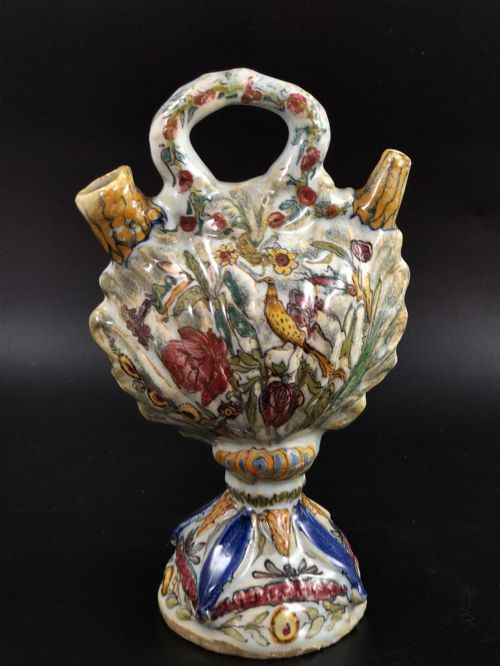
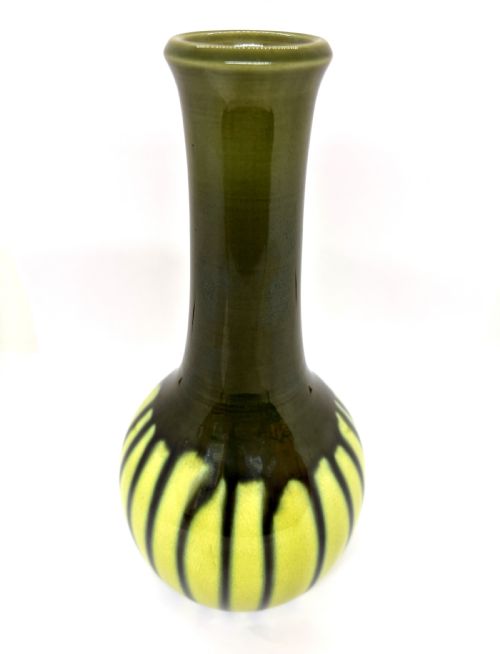


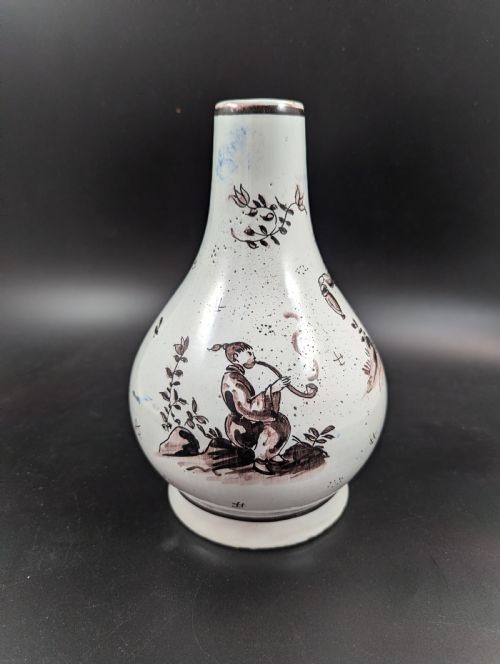


Earthenware Bottle Vase
An earthenware bottle vase brings centuries of painterly tin glaze and rich ceramic form straight to a mantelpiece.
Earthenware Bottle Vase
An earthenware bottle vase combines a narrow neck with a rounded body, produced across several European and Asian traditions. When you search for earthenware bottle vase, you encounter pieces spanning the seventeenth century through to the Victorian era.
The selections range from Dutch Delftware and Italian majolica to British factory work and Japanese Satsuma ware. Many examples show distinct regional styles such as Chinoiserie blue and white decoration or polychrome pigments.
Form and function overlap significantly in this category, encompassing apothecary jars, pilgrim flasks, and cabinet vases. Collectors find both single display bottles and symmetrical pairs among the current listings.
How they were made
Makers shaped these vessels from earthenware clay before applying opaque tin glaze to create a smooth white ground for painting. Painters then worked directly onto the unfired or biscuit-fired glaze using cobalt pigment and enamel colours.
Some pieces incorporate gold leaf highlights or specialised regional glazing techniques, such as the Hispano-Moresque method. Kiln firing fixed the pigments into the surface, sealing the porous ceramic body underneath.
The available selection spans 17th-century Dutch works, 18th-century English delftware, Italian majolica, and 19th-century Japanese Satsuma.
What varies in quality
The crispness of the hand-painted brushwork distinguishes standard workshop production from exceptional masterworks. Fine cobalt blue or polychrome detail requires steady control across curved surfaces.
Glaze coverage and stability determine the visual depth of a vessel, particularly where tin glazes pool around the foot or neck. The precision of the thrown earthenware form dictates the overall elegance of the silhouette.
The Earthenware Bottle Vase Glossary
- Tin Glaze
- A lead glaze rendered opaque by the addition of tin oxide, providing a white background for painted decoration. This technique defines much of traditional European faience and delftware.
- Majolica
- Italian tin-glazed earthenware decorated with colourful pigments. It flourished during the Renaissance and later revival periods.
- Albarello
- A cylindrical earthenware jar originally designed to hold apothecary drugs and dry medicines. These vessels often feature a waisted body for a secure grip.
- Pilgrim Flask
- A flattened bottle shape with side lugs for suspension cords, derived from medieval travel flasks. Potters later rendered these forms purely for decorative display.
- Faience
- European tin-glazed earthenware produced outside of Italy, sharing technical roots with majolica and delftware. The term covers various national traditions.
Earthenware Bottle Vase: Frequently Asked Questions
How do I clean an old earthenware bottle vase?
Dust the surface gently with a soft, dry brush to remove particles without disturbing fragile glaze or pigment. Avoid water immersion, as porous earthenware bodies and historic tin glazes can absorb moisture through tiny hairline cracks.
Keep these vessels away from direct sunlight and areas of high humidity to protect the integrity of the ceramic body. Professional conservation advice should be sought for any piece showing signs of structural instability.
How can I tell Dutch delftware from English pottery?
Dutch delftware often exhibits a particularly thin, refined tin glaze and deep cobalt blue painting influenced by imported Chinese porcelain. English pottery from centres like Lambeth tends to display slightly heavier potting and varied glaze thickness.
Examination of the footring and base frequently reveals clues about workshop origin and firing methods. Comparing the palette and brushwork against documented examples helps confirm regional attribution.
What is the difference between a bottle vase and an apothecary jar?
A bottle vase is shaped for aesthetic display, featuring a narrow neck designed to support single stems or stand alone as sculpture. An albarello or apothecary jar has a straight or slightly waisted cylindrical body created to store dry medical ingredients.
While both share earthenware construction and tin-glazed surfaces, their original domestic and commercial functions shaped their distinct proportions.