
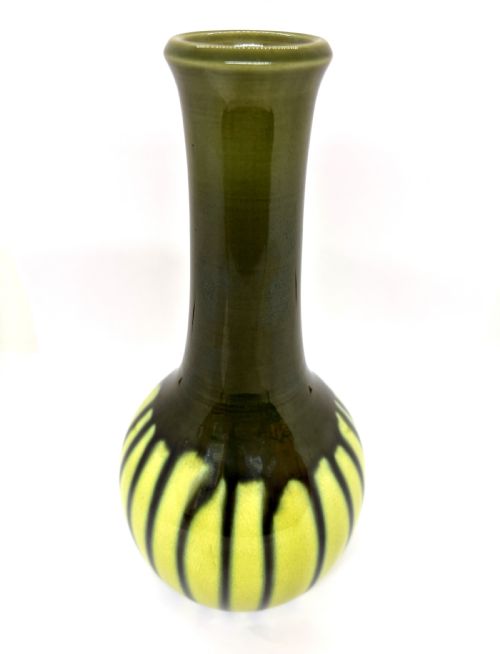
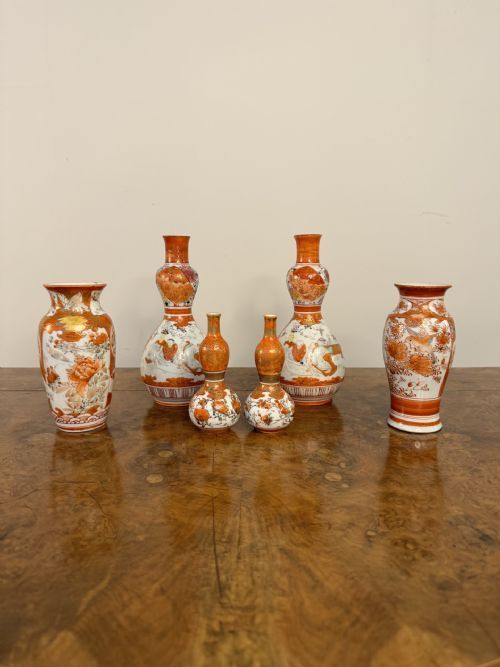


Art Pottery Bottle Vase
An art pottery bottle vase brings tactile weight and rich, fired colour to a room, offering the focused forms collectors seek.
Art Pottery Bottle Vase
When you search for an art pottery bottle vase, you are looking at ceramic vessels defined by narrow necks and rounded bodies, shaped by studio potters and major kilns alike. The examples listed here span from the late nineteenth century through to the middle of the twentieth, encompassing British studio output and Japanese export wares.
You are most likely to encounter earthenware and stoneware creations from English potteries such as Doulton and Burmantofts, often marked by experimental glazes and surface decoration. Alongside these sit Japanese porcelain and ceramic pieces featuring traditional motifs from the Meiji period.
The forms range from compact cabinet vessels to taller, slender neck designs intended to hold a single stem or stand alone as sculptural objects. Each piece represents a specific moment in the evolution of ceramic design, moving from Victorian and Gothic revivals through Arts and Crafts, Art Nouveau, and Art Deco styles.
How they were made
These vessels rely on fundamental ceramic bodies including stoneware, earthenware, and porcelain, shaped on the potter's wheel or cast in moulds before receiving their primary structure. The material choice dictates the weight of the piece and how it responds to the intense heat of the kiln.
Surface finishes involve applied glazes, enamel work, and occasional embellishments such as gold leaf to create distinctive colouration and texture. Potters utilised specialised lustre techniques and faience glazing to achieve the rich metallic sheens and deep tones seen across the period.
Listings span periods from 1880 to 1940, uniting Arts and Crafts, Art Nouveau, and Art Deco aesthetics.
What varies in quality
The distinction between standard production and exceptional work lies in the ambition of the form and the control of the glaze chemistry during firing. Potters who pushed technical boundaries achieved complex crystalline or lustre effects that elevate a simple vessel into a significant work of art.
Hand-painted or incised decoration by named artists carries greater artistic intent than factory-standard repetition, showing a confident hand in the handling of motifs. The crispness of the profile and the depth of the glaze application ultimately determine the standing of each piece.
Burmantoft's Pottery·Emily Stormer·Richard Joyce·Royal Lancastrian·Roger Guerin·Doulton Lambeth
The Art Pottery Bottle Vase Glossary
- Stoneware
- A robust ceramic pottery fired at high temperatures until vitrified, making the body impermeable to liquids even without glaze. It forms the heavy base of many nineteenth-century studio vessels.
- Faience
- Tin-glazed earthenware decorated on an opaque white glaze before firing, popular in British aesthetic design. It allows for vibrant surface patterns and painterly depth.
- Lustre
- A type of ceramic glaze containing metallic elements that produce an iridescent sheen when fired in a reduced oxygen atmosphere. Richard Joyce utilised this technique for Royal Lancastrian.
- Meiji Period
- The era in Japanese history spanning from 1868 to 1912, known for sophisticated export ceramics including Kutani and Imari wares. Pieces from this time often feature intricate enamel and gilt detailing.
- Earthenware
- Porous pottery fired at lower temperatures, requiring a glaze to achieve water resistance. It provides a warm, substantial base for decorative slip and surface carving.
Art Pottery Bottle Vase: Frequently Asked Questions
How do I clean an antique bottle vase?
Dust the surface gently with a soft, dry cloth to protect the glaze and any delicate enamel or gold leaf details.
Avoid submerging older earthenware or porous ceramics in water, as moisture can penetrate unglazed areas or historic repairs.
Can these vases hold water?
Stoneware and porcelain vessels are generally vitrified and will hold water safely for fresh stems.
Earthenware and faience pieces can be porous over time, so it is wiser to use a discreet internal liner if you wish to display fresh flowers.
What is the difference between Imari and Kutani?
Imari wares typically feature a distinct palette of underglaze blue, iron red, and gold, arranged in rich panel designs.
Kutani ceramics often showcase bolder pictorial scenes dominated by green, yellow, red, purple, and blue enamels.
How can I tell Arts and Crafts from Art Nouveau?
Arts and Crafts pieces emphasise visible hand-craftsmanship, structured botanical motifs, and honest, weighty stoneware forms.
Art Nouveau introduces whiplash curves, asymmetrical floral styling, and fluid, iridescent glazes that mimic natural forms.