
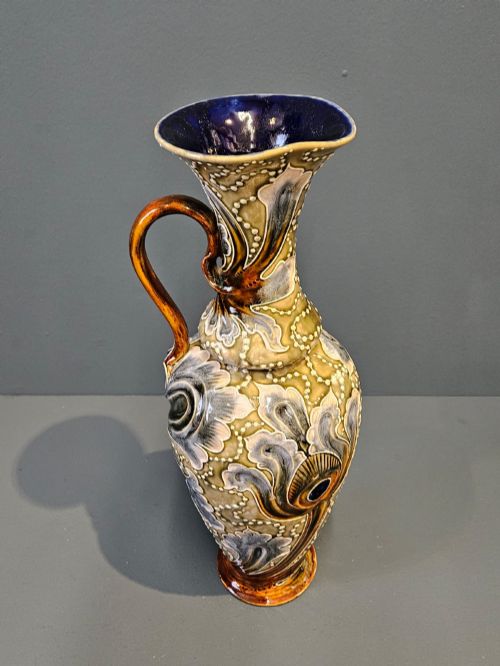


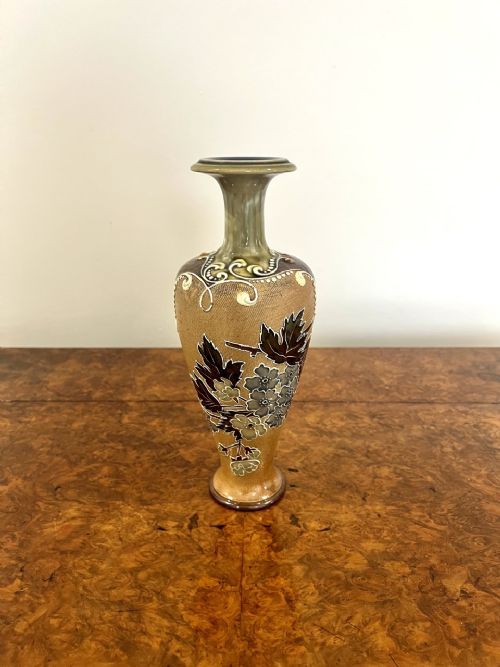


Brown Green Pottery Vase
These brown green pottery vase pieces bring rich earth tones and historic craftsmanship straight into a room.
Brown Green Pottery Vase
When you search for a brown green pottery vase, you are looking at nineteenth-century decorative vessels spanning Victorian, Arts and Crafts, and Art Nouveau styles. The items on this page range from large ewers and bottle vases to umbrella stands and sugar bowls.
You are most likely to meet glazed earthenware and stoneware pieces produced by British potteries such as Doulton Lambeth and Burmantofts, alongside continental Austrian pottery and Japanese earthenware. Forms vary from amphora shapes to tall bottle vases.
The periods represented stretch from the eighteen seventies through to nineteen hundred, capturing a time of immense experimentation in ceramic glazes. These vessels were primarily designed for interior display rather than utilitarian use.
How they were made
Maker workshops utilised earthenware and stoneware bodies, shaping them into bulbous vases, ewers, and tall bottle forms. Techniques relied on throwing or moulding the clay before applying rich glaze mixtures that produced characteristic earth tones.
Makers applied specialised glazes, often combining slip decoration with incised patterns characteristic of the Arts and Crafts movement. Some pieces incorporate enamel details or metal wire elements to enhance the surface texture.
Firing methods achieved deep colour variations across the ceramic body, resulting in the mottled brown and green finishes seen on these vessels. Workshops also employed specialised faience techniques to create distinct surface sheens.
Listings feature items from eighteen seventy to nineteen hundred, incorporating ceramic, stoneware, and glazed earthenware.
What varies in quality
The division between standard production and top tier work rests on the complexity of the glaze run and the depth of the incised or moulded decoration. Superior pieces display deliberate control over the interaction of brown and green pigments during the kiln firing.
Artistry in form and the reputation of the producing pottery significantly elevate an object. Pieces carrying specific maker signatures or originating from celebrated workshops demonstrate greater artistic ambition than anonymous factory output.
Doulton Lambeth·Eliza Simmance·Burmantofts Faience
The Brown Green Pottery Vase Glossary
- Earthenware
- Porous pottery fired at lower temperatures, requiring a glaze to hold liquids. It forms the base for many Victorian and Arts and Crafts vessels.
- Stoneware
- Dense, impermeable pottery fired at higher temperatures until vitrified. This material is durable and forms the body of robust nineteenth-century jugs and vases.
- Faience
- Tin-glazed earthenware decorated with opaque colours. Workshops utilised this technique to achieve vibrant surface finishes on decorative items.
- Ewer
- A large jug with a wide spout and handle, historically used for water or wine. In nineteenth-century ceramics, it served primarily as an ornamental showpiece.
- Amphora
- A two-handled jar with a narrow neck used in antiquity. Victorian and later makers revived this classical shape for decorative pottery.
Brown Green Pottery Vase: Frequently Asked Questions
What periods do these pieces span?
The inventory on this page primarily spans the late nineteenth century, specifically from eighteen seventy to nineteen hundred.
These dates cover the Victorian era alongside the emergence of the Arts and Crafts and Art Nouveau movements.
How were these vases displayed?
These vessels were created primarily for interior decoration on mantelpieces, sideboards, and pedestals.
Larger items like ewers and umbrella stands were positioned in hallways and grand reception rooms to showcase household taste.
Are these items waterproof?
While stoneware bodies are naturally vitrified and hold water securely, earthenware items depend entirely on the integrity of their glaze.
Many pieces function best as dry decorative ornaments rather than containers for fresh cut flowers.
How do I identify Arts and Crafts pottery?
Look for hand-incised foliage patterns, tactile surface textures, and naturalistic earth-toned glazes.
Maker marks and artist monograms scratched into the base often point directly to the individual studio hand.