
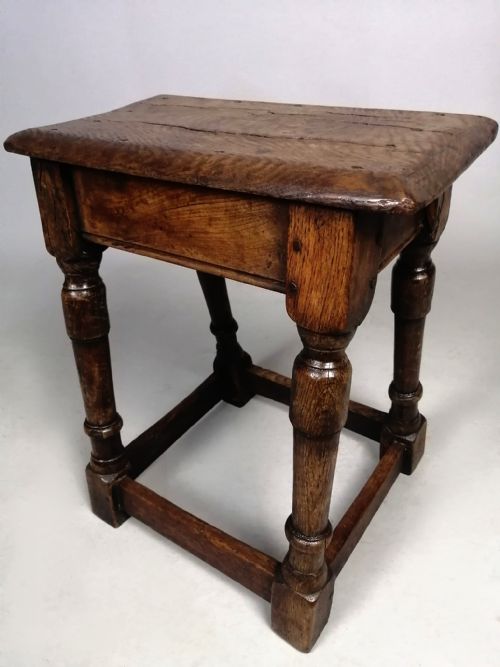


Early Oak Joint Stool
An early oak joint stool brings heavy timber construction and centuries of domestic utility directly into a modern room.
Early Oak Joint Stool
When searching for an early oak joint stool, a buyer looks at sturdy, pegged wooden seating constructed with pegged mortise and tenon joints by traditional carpenters. The most common examples seen here range from seventeenth-century originals to later nineteenth and twentieth-century revivals.
These items primarily function as rigid seating or small side tables, with rectangular tops supported by four vertical turned legs connected by stretchers. Forms vary from simple flat tops to occasional box stools and coffin stools dating across the seventeenth, eighteenth, nineteenth, and twentieth centuries.
The styles span Jacobean, Early Georgian, and English Country vernaculars alongside Arts and Crafts and Jacobean Revival interpretations. Most pieces rely on solid oak timbers, occasionally paired with elm for seats or augmented with secondary hardwoods.
How they were made
Joiners built these stools using green or seasoned oak and elm, shaping the uprights with lathes and cutting square mortise and tenon joints secured by wooden pegs. This rigid frame construction avoided nails or glue, relying on tight timber interlocks to maintain structural strength.
Surfaces received hand-planing and scraping, occasionally incorporating turned bobbin or baluster legs and simple moulded edges along the seat perimeter. Some examples include added leather, upholstery fabric, brass tacks, or metal studs.
Over generations, the timber developed a natural dark wood patina and surface wear through regular handling and beeswax application. Metal fixings appear sparingly, mostly as structural reinforcement or later upholstery attachments.
Materials documented in the archive include brass tacks, upholstery fabric, metal studs, and leather.
What varies in quality
The standard of an early oak joint stool rests primarily on the integrity of the original timber frame and the extent of later replacement parts. Pieces retaining their initial pegged joints and primary oak boards stand apart from examples rebuilt with modern fixings.
Proportion and turning detail also define the upper tier, where crisp mouldings on the legs and stretchers reflect careful benchwork rather than hurried production. The depth of the natural wood colour and the presence of untouched surface textures indicate how well a piece survived centuries of use.
The Early Oak Joint Stool Glossary
- Joint stool
- A rigid wooden stool constructed by a joiner using pegged mortise and tenon framing rather than simple nailed carpentry. These pieces took their name from the jointed timber technique.
- Jacobean
- A seventeenth-century stylistic period spanning the reigns of James I and Charles I, characterised by heavy oak construction and linear turned ornaments. Surviving furniture often displays geometric carving and sturdy proportions.
- Coffin stool
- An alternative regional descriptor for a joint stool, relating to their historical utility in supporting coffins during parish funerals. These share the standard rectangular top and stretchered leg design.
- Stretchers
- The horizontal wooden rails connecting the lower legs of a stool to provide lateral stability and prevent the frame from wobbling. They also served as footrests away from damp floors.
- Patina
- The surface sheen and darkening acquired by exposed wood over decades of handling, cleaning, and light exposure. This accumulation signals genuine age and consistent care.
Early Oak Joint Stool: Frequently Asked Questions
What is a joint stool?
A joint stool is a solid timber seat built with pegged frame construction by traditional joiners rather than basic cabinet makers. The name derives from the precise joints holding the legs and rails together.
These pieces served everyday domestic purposes as movable seating around heavy dining tables or as raised platforms for household tasks.
How old are these stools?
The pieces available span from seventeenth-century originals down to nineteenth and twentieth-century revival interpretations. Carpenters reproduced the seventeenth-century style across the Victorian era and the Arts and Crafts movement.
Materials and construction methods help distinguish period originals from later revival work.
How were they used historically?
Households utilised joint stools primarily for seating at the dining board, where their sturdy frames withstood rough daily handling. Their flat tops also allowed them to function as small side tables or stands.
Records indicate they occasionally supported coffins during rural funeral processions, earning them the alternative name of coffin stools.
Are all these stools made of oak?
While oak forms the primary structural timber across the majority of pieces, makers frequently paired it with elm for seats or used general hardwoods in later revival examples. Secondary materials like leather, metal studs, and upholstery fabric appear on specific variations.
Dark wood finishes and natural grain patterns predominate across the entire selection.
How do I care for an oak stool?
Maintain the timber by applying occasional coats of traditional beeswax to nourish the dry wood and preserve the surface patina. Keep the stool away from direct heat sources and sudden humidity shifts to prevent the oak from splitting.
Avoid harsh liquid cleaners that strip the historic finish.