
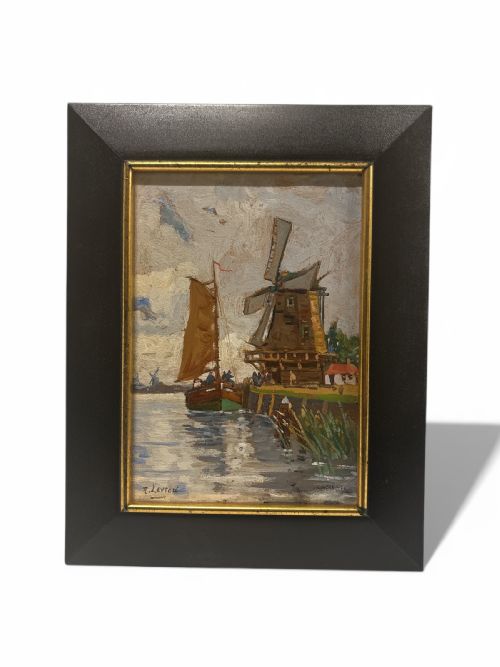
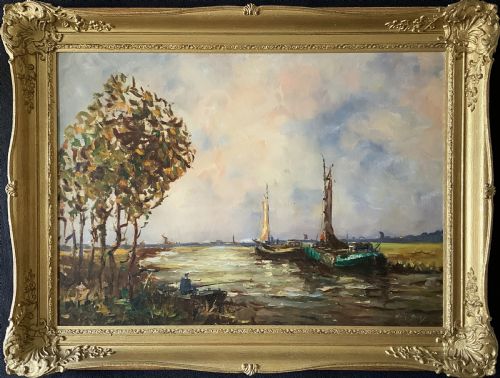


Dutch Impressionist Landscape
A dutch impressionist landscape brings the muted light and quiet water of the Low Countries straight onto your wall.
Dutch Impressionist Landscape
When you search for a dutch impressionist landscape, you encounter oil paintings, watercolours, and panel works depicting canals, rivers, windmills, and grazing sheep. These pieces span from the nineteenth century through the Edwardian era and into the mid-twentieth century, capturing the distinctive atmospheric light of the region.
The works take several distinct forms, ranging from expansive canvas oils to intimate watercolours on paper. Canal scenes with boats and rustic village views dominate the selection, often rendered with loose, expressive brushwork that defines the impressionist and post-impressionist style of the period.
How they were made
Artists painted primarily with oil paint on canvas, wood panels, or canvas boards, building texture with confident strokes. Some works utilise watercolour on paper to capture the soft, hazy light over waterways and fields.
Frames frequently incorporate wood, gesso, and gold leaf, matching the traditional presentation methods of the nineteenth and early twentieth centuries.
Object types include wall art, watercolour paintings, and oil paintings on canvas or panel.
What varies in quality
Quality depends on the surety of the brushwork and the artist's ability to render light and atmosphere convincingly across the canvas. Stronger works display confident handling of pigment that captures the specific mood of a canal or pasture without overworking the details.
The integrity of the surface materials, including the preservation of the original paint layer and any accompanying gesso frame, influences the standing of an individual piece within the range.
Willem Bos·Willem Anton Alexander Knip·Florence Hess·Job de Vogel·John D Walker·Fred Mayor·Hendrik Yan Wolter·Frank Myers Boggs·Anthonij Anton Mauve·David Adolph Constant Artz·Kershaw Schofield·Christiaan Pieter Snyders
The Dutch Impressionist Landscape Glossary
- Canvas
- A heavy woven fabric stretched across a wooden frame to provide the primary surface for oil painting. It allows artists to build rich textures and layers of pigment.
- Gesso
- A plaster mixture applied to wood panels or frames to prepare a smooth surface for painting or gilding. It provides a stable base for the final layers.
- Watercolour
- A paint consisting of pigment suspended in a water-based solution, typically applied to paper. It yields transparent washes that capture delicate atmospheric effects.
- Post-Impressionism
- An art movement extending beyond impressionism that explores emotional response and structural form through bolder colour and brushwork.
Dutch Impressionist Landscape: Frequently Asked Questions
How do I date a dutch impressionist landscape?
Dating relies on the materials used, the framing style, and the recorded active periods of the artists. Canvas types and stretcher construction also offer clues to the era of creation.
Signatures and biographical records help narrow the decade when the artist worked on similar canvas or panel compositions.
Where should I hang a landscape painting?
These works suit dining rooms, studies, or living spaces where natural light complements the subdued tones of the palette. Avoid direct sunlight to protect the oil paint and paper components.
Pairing the piece with a neutral wall allows the atmospheric blues, greens, and earth tones to stand out properly.
What is the difference between oil and watercolour?
Oil paintings utilise slow-drying pigmented oil on canvas or panel, offering rich texture and depth. Watercolours use water-soluble pigments on paper for a lighter, more transparent finish.
Both mediums capture the characteristic light of canal and river scenes but present distinct surface finishes.
Are these paintings original works?
The selection consists of original period paintings and watercolours created by individual artists rather than modern reproductions. Each piece bears the distinct hand of its maker.
Signatures and inscriptions on the reverse often verify the specific hand and period of the work.