
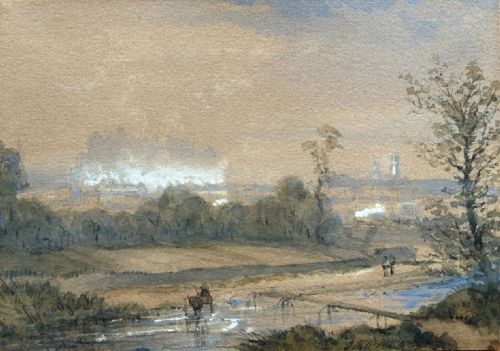
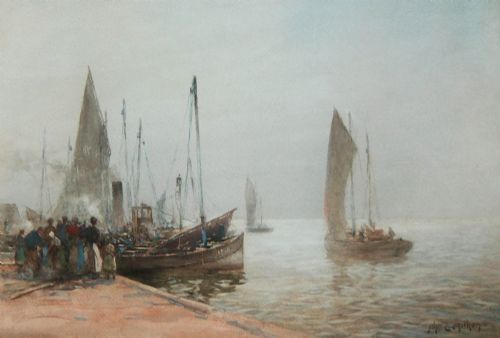


Muted Tone Landscape Painting
When you search for a muted tone landscape painting, you find works that rely on subdued palettes and atmospheric light to capture rural and coastal scenes.
Muted Tone Landscape Painting
A muted tone landscape painting brings together works created across the nineteenth and twentieth centuries, spanning Victorian output through to mid-century modernism. These pieces capture quiet vistas, harbours, and rural views without the glare of bright primaries.
Most examples found in this selection take the form of watercolours on paper or oil paintings on canvas and panel. British and French artists dominate the records, working within regional traditions from Yorkshire to the French Riviera.
How they were made
Makers applied oil paint or watercolour paint onto prepared canvas, wood panels, or heavy paper supports. The handling of pigment allows underlying tones to show through, creating the signature subdued effect.
Framed works often retain their original wooden mounts, which protect the fragile paper or canvas substrates from environmental damage over decades of display.
Listings span periods from the Victorian era through the 1960s, utilising oil paint, watercolour, and mixed media on paper, canvas, and wood.
What varies in quality
The strength of a muted tone landscape painting rests in the handling of atmospheric light and tonal harmony rather than academic finish. Stronger examples demonstrate confident brushwork and a sure sense of spatial depth.
Condition plays a role in valuation, particularly the stability of the paint surface and the absence of heavy foxing on exposed paper watercolours. Works that retain their original frames and clear attribution command closer attention.
John R Prentice·James E Aitken·Gyrth Russell·Ernest Higgins Rigg·Fred Lawson·Florence Hess·Louie Stanley Maurice Prince·Sidney James Beer·Kate E Booth·Henry Charles Fox·Thomas James Lloyd·Stephen John Batchelder·Fred Stead·Thomas Swift Hutton·Irene Lagut·Maurice Asselin·Owen Bowen·Cuthbert Crossley·John D Walker·Augustus William Ennes·Alfred Leyman
The Muted Tone Landscape Painting Glossary
- Watercolour
- A paint consisting of a pigment suspended in a water-soluble vehicle. It is typically applied to paper to achieve transparent washes.
- Oil on Canvas
- A technique where oil paint is applied to a woven fabric stretched across a wooden frame. This medium allows for rich blending and textured impasto.
- Post-Impressionism
- An art movement extending the limits of Impressionism while rejecting its limitations. Artists focused on expressive forms and symbolic use of colour.
- British Impressionism
- A painting style developed in the late nineteenth century focusing on everyday subject matter and natural light. Practitioners adopted looser brushstrokes influenced by French methods.
- Foxing
- Brown spots or patches on paper caused by chemical reactions over time. It frequently appears on older watercolours stored in damp conditions.
Muted Tone Landscape Painting: Frequently Asked Questions
What is a muted tone landscape painting?
These artworks depict scenery using restrained palettes, subtle greys, deep greens, and earthen browns instead of vibrant hues. They focus on atmospheric weather and quiet rural or coastal conditions.
Such pieces date primarily from the nineteenth and twentieth centuries, reflecting the evolving styles of British and European schools across different decades.
How should I hang these paintings?
Keep works away from direct sunlight to prevent the fading of delicate watercolours and oil pigments. Stable indoor humidity protects both canvas and wooden frames.
Pair frames with neutral wall colours that complement the subdued palette of the artwork rather than competing with the tones.
How do I date a landscape painting?
Examine the materials, stretcher bars, framing methods, and any artist signatures or inscriptions on the reverse of the canvas or paper. Stylistic clues also point to specific periods like Victorian academic work or mid-century modernism.
Examine the backboards and labels for gallery stamps or exhibition records that provide a clear historical paper trail.
Are watercolours harder to care for than oils?
Works on paper require glass protection and acid-free mounting to prevent moisture damage and foxing over time. Oil paintings on canvas are generally more robust but still benefit from stable environments.
Both mediums respond well to consistent indoor temperatures and careful handling during seasonal cleaning.