

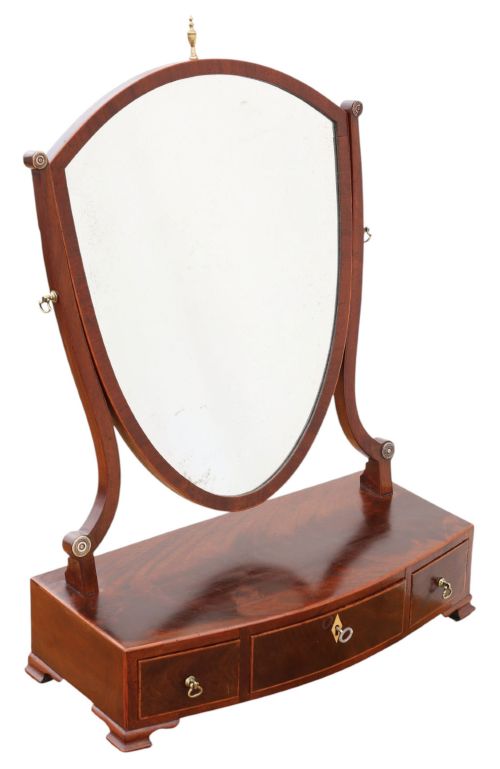
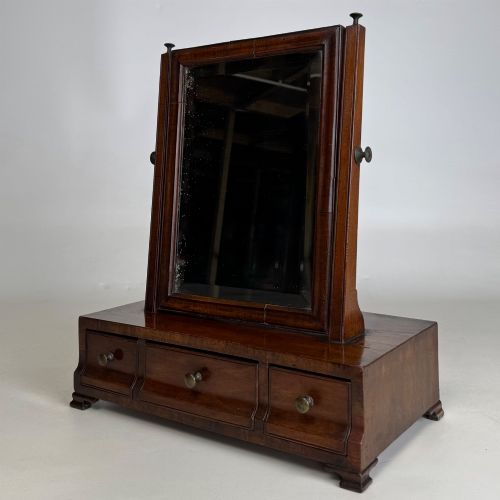


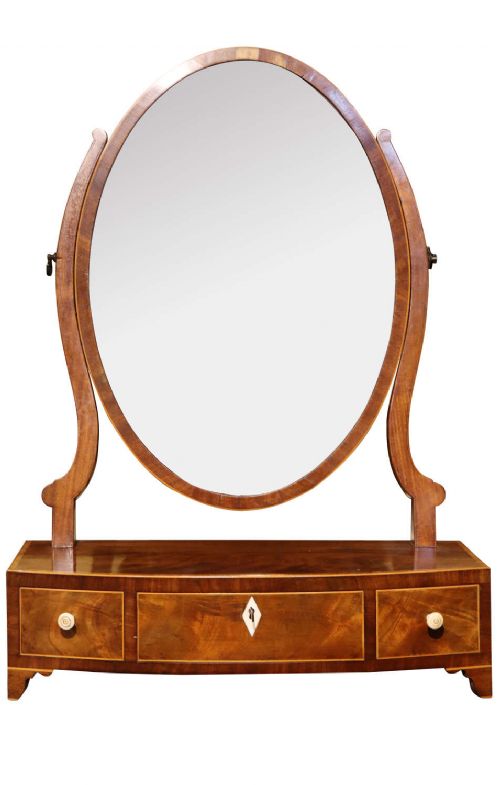


Desktop Vanity Mirror Drawers
Desktop vanity mirror drawers combine a pivoting glass with small compartments for personal items, offering a practical antique dressing piece for a table or chest.
Desktop Vanity Mirror Drawers
Desktop vanity mirror drawers comprise a swinging glass plate mounted in a frame that sits atop a small base fitted with functional storage compartments. These pieces appear across eighteenth-century Georgian, nineteenth-century Victorian, and Edwardian periods in various wood timbers.
The standard version encountered on this page is the mahogany dressing mirror featuring a shield or oval plate above a serpentine or straight box base containing small drawers. Examples range from early Georgian walnut forms to later nineteenth-century swing mirrors and Dutch marquetry pieces.
Originating as essential dressing table accessories for personal grooming, these items provide compact storage for small valuables while adding period character to a modern interior surface. The designs span simple upright boxes to elaborate bureau mirrors with fitted interiors.
What varies in quality
The distinction between standard and superior pieces rests on the choice of timber, the crispness of inlay work, and the subtlety of the base proportions. Pieces displaying serpentine fronts, figured walnut or mahogany veneers, and original brass hardware represent the finer end of the range.
Structural refinement shows in the delicacy of the support arms, the tightness of the dovetail joints in the drawer boxes, and the preservation of the original glass and backboards. Simpler upright boxes with plain mouldings occupy a more utilitarian tier of craftsmanship.
Desktop Vanity Mirror Drawers Retail Price Guide 2026
Typical asking prices for desktop vanity mirror drawers among the pieces listed under this phrase on Sellingantiques today, from the lower quarter to the upper quarter. They describe what is for sale here now, not the wider market.
Listings feature mahogany and walnut as the primary woods, spanning periods from mid-eighteenth-century George II through Victorian and Edwardian revival eras.
The Desktop Vanity Mirror Drawers Glossary
- Swing mirror
- A glass plate hung on pivoting side screws between two upright arms, allowing the user to adjust the angle. This mechanism is central to dressing and toilet mirrors.
- Serpentine
- A curved line with a convex centre flanked by concave sides, frequently seen on the drawer fronts of finer Georgian examples. This shaping requires skilled woodworking.
- Crossbanding
- A narrow strip of veneer laid across the grain of the primary wood around the border of a drawer front or top surface. It provides a neat decorative frame.
- Marquetry
- Elaborate veneer work forming pictorial or floral patterns using various tinted woods. Dutch marquetry examples often feature detailed floral motifs on walnut grounds.
- Escutcheon
- A small plate surrounding the keyhole of a drawer, often made of brass or bone to protect the surrounding wood from wear.
Desktop Vanity Mirror Drawers: Frequently Asked Questions
Where should I place a desktop mirror?
These mirrors suit dressing tables, chests of drawers, or sturdy sideboards where the base sits securely on a flat surface. They require adequate ceiling or wall clearance behind them to permit the glass to tilt fully.
Ensure the furniture beneath is deep enough to support the entire footprint of the drawer base safely without overhang.
How do I clean the glass?
Use a soft, lint-free cloth and a mild glass cleaner applied sparingly to the cloth rather than directly sprayed onto the glass. This prevents moisture from seeping behind the antique mirror plate or damaging the wooden rabbet.
Keep liquids away from the wooden frame and brass hardware to protect the finish and any inlaid stringing.
Are the mirror plates original?
Many antique dressing mirrors retain their original glass, which often exhibits minor foxing, light speckling, or slight distortion characteristic of older manufacturing methods. Replacement glass appears frequently in pieces from the eighteenth and nineteenth centuries.
Original plates add historical value, while clean replacements offer a clearer reflection for daily grooming use.
What is the difference between a toilet mirror and a dressing mirror?
The terms are largely interchangeable in antique listings, historically referring to pieces used during the morning toilet or dressing ritual. Both describe a portable mirror mounted on a drawer base designed for tabletop use.
Specific variations depend on the era, with earlier eighteenth-century examples often termed toilet mirrors and Victorian versions called swing mirrors.
Can I store jewellery inside the drawers?
The small compartments and drawers in these bases were traditionally built for trinkets, cosmetics, and personal documents. They remain suitable for storing lightweight modern items such as rings, earrings, and small watches.
Avoid overloading the shallow drawers, as antique timber bottoms are relatively thin and unsuited to heavy loads.