




Desk Recording Barometer
A desk recording barometer records atmospheric pressure continuously onto paper, offering the serious collector a working piece of Victorian or Edwardian engineering for the study.
Desk Recording Barometer
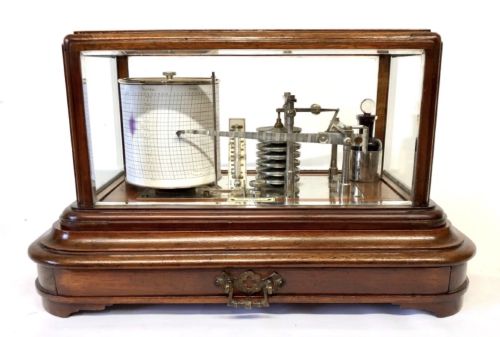
A desk recording barometer, or barograph, is a self-recording meteorological instrument designed to trace barometric pressure over time. When you search for a desk recording barometer, you encounter instruments housed in wooden cases with glass panels that protect the delicate mechanism inside. These scientific instruments come in various configurations, including models combined with a thermometer or barometer dial and drawer.
Most examples found on this page date from the late nineteenth century into the early twentieth century, spanning the Victorian and Edwardian periods. You are most likely to meet mahogany or oak cased versions, alongside occasional walnut and ebonised wood examples. The form follows distinct regional and maker styles, ranging from plain functional enclosures to inlaid Art Nouveau designs.
How they were made
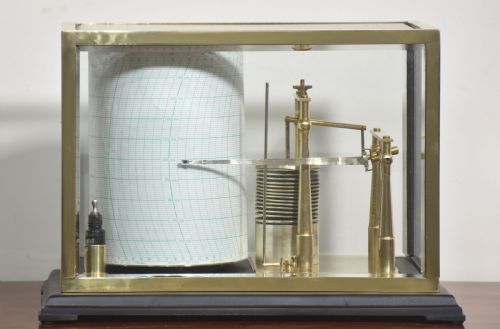
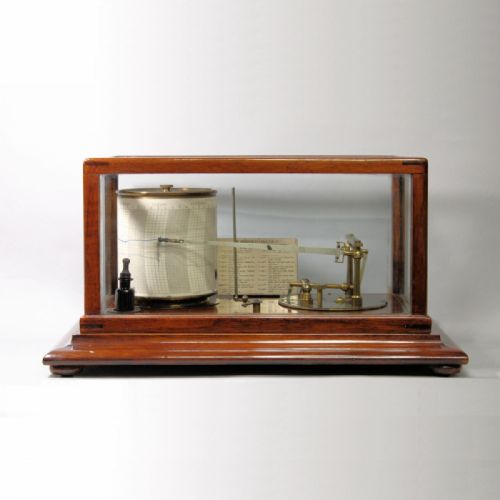
The construction relies on precision metal components combined with polished timber cabinetry. Brass, steel, and metal form the mechanical recording movements and aneroid capsules, while glass panels allow visibility of the rotating drum and moving arm. Cases are constructed from solid and veneered timbers including mahogany, oak, and walnut, frequently fitted with hinged lids.
Recording is achieved through a mechanical linkage where aneroid chambers expand or contract with pressure changes, moving an arm tipped with a nib across a rotating paper chart driven by a clockwork movement. The charts themselves are printed on paper, often secured to cylindrical drums that complete a rotation over a set weekly period.
What varies in quality
Quality in these instruments rests upon the refinement of the movement and the integrity of the housing. Finer examples display crisper castings, superior clockwork mechanisms, and named maker signatures on the bedplate or dial, whereas lesser instruments exhibit simpler noname assemblies.
Cabinetwork creates a further distinction, where thick polished mahogany or figured oak with fine dovetailing and bevelled glass panels separates the high-end production from utilitarian utility pieces.
Short & Mason·R Fuess·Robson of Newcastle·Callaghan & Co·Richard Freres·Gaupp & Co
The Desk Recording Barometer Glossary
- Barograph
- A recording barometer that produces a continuous graphical trace of atmospheric pressure on paper. It uses stacked aneroid diaphragms linked to an inked nib.
- Aneroid
- Operating without liquid. An aneroid barometer uses a flexible sealed metal box to measure pressure changes.
- Chart
- The calibrated paper sheet wrapped around the rotating drum. It receives the ink trace from the recording arm over a specific duration.
- Thermometer
- An instrument for measuring temperature. Some recording barometers incorporate this alongside the barograph mechanism.
- Clockwork
- The mechanical spring-driven movement that rotates the drum. It regulates the speed at which the paper chart moves past the recording arm.
Desk Recording Barometer: Frequently Asked Questions
How do desk recording barometers work?
These instruments operate through stacked metal vacuum chambers that respond to fluctuations in air pressure by expanding or contracting. This physical movement transfers directly to a pivoted arm holding an ink nib which rests against a paper chart.
The paper chart is wrapped around a brass or metal cylinder driven by an internal clockwork mechanism. As the cylinder rotates slowly over the course of a week, the pen draws a continuous line mapping the rise and fall of the weather.
Where should I place a barograph?
A barograph belongs in a stable environment away from direct sunlight, central heating sources, and open draughts. These external factors cause rapid temperature shifts that interfere with the precision of the delicate metal aneroid capsules inside the case.
Most owners place them on a sturdy desk, table, or sideboard where they remain undisturbed. The glass panels allow the movement to be observed safely while protecting the internal mechanism from dust and accidental knocks.
How do I read the paper charts?
The vertical axis on the paper chart shows atmospheric pressure measured in inches or millibars, while the horizontal axis represents time divided into days and hours. An upward curve indicates rising pressure and improving weather, whereas a downward slope signals approaching storms.
By comparing the current trace with historical weather patterns recorded on past sheets, you can interpret local meteorological trends. Fresh charts are wound onto the revolving drum periodically to maintain the recording process.
How do I tell Victorian from Edwardian models?
Victorian instruments tend to feature heavier mahogany or walnut cabinetry with conservative lines and deep polished finishes. Brass fittings on these nineteenth-century pieces often display robust utilitarian casting qualities associated with scientific instrument makers of the era.
Edwardian and later examples frequently incorporate lighter oak timbers, more streamlined proportions, or stylistic flourishes such as Art Nouveau inlay work. The transition in the early twentieth century brought slightly more compact designs suited to domestic writing desks.