

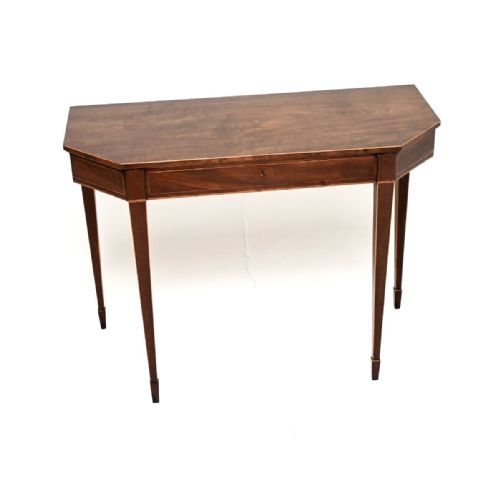
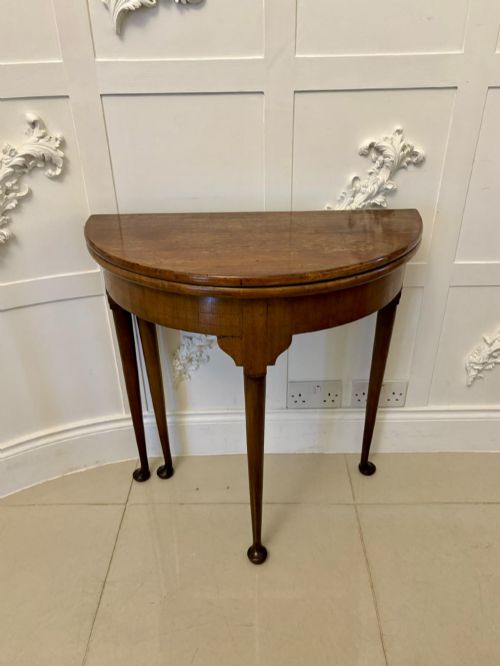
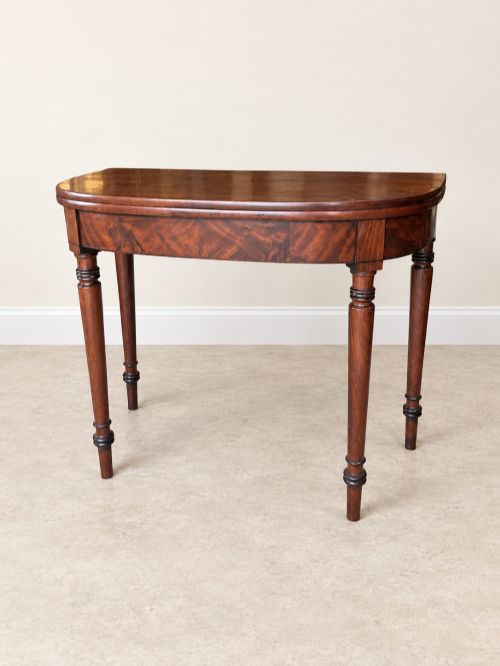
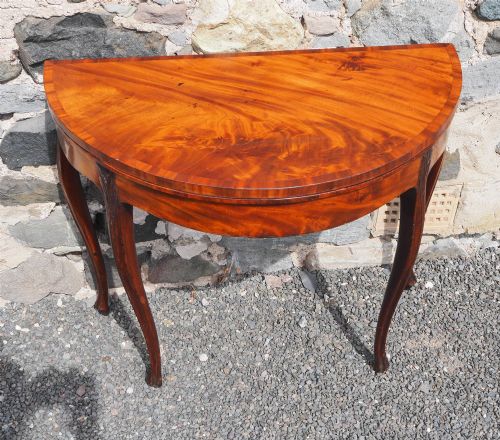

Demilune Folding Card Table
A demilune folding card table offers a semicursal profile that opens to a baize-lined surface, combining formal elegance with practical versatility.
Demilune Folding Card Table
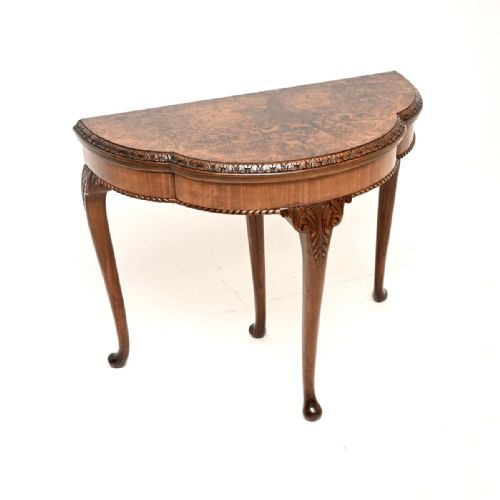
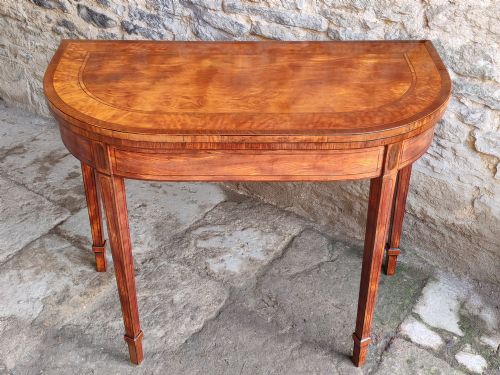
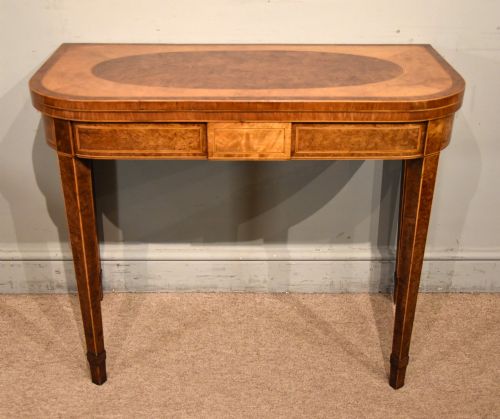
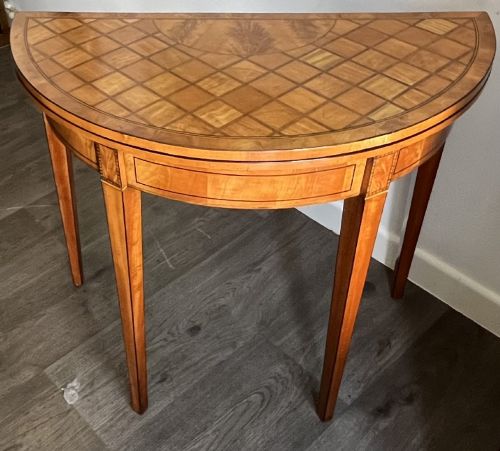
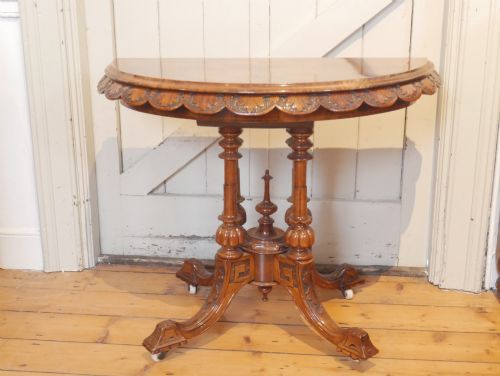
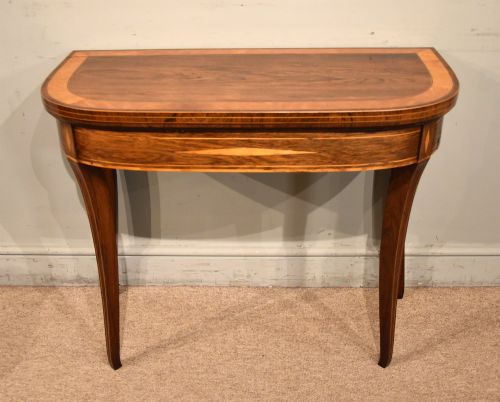
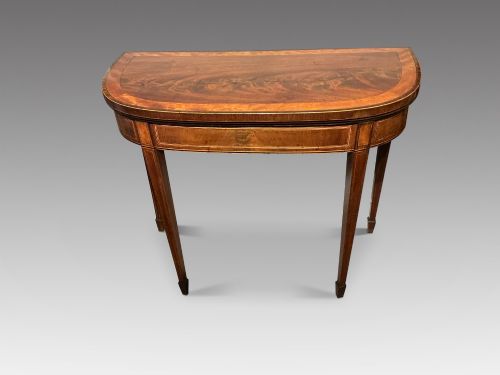
A demilune folding card table is a semicircular piece designed to sit flat against a wall before opening into a full surface for gaming or tea. The examples seen here span from the eighteenth century through the Georgian, Regency, Victorian, and Edwardian periods.
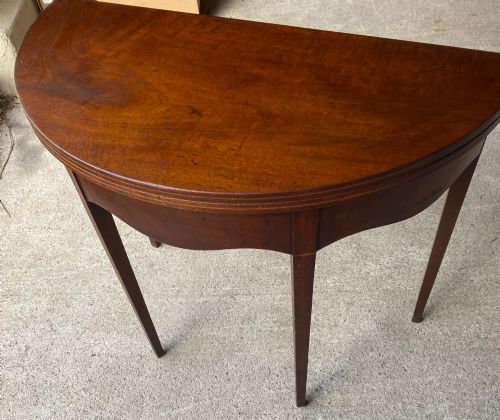
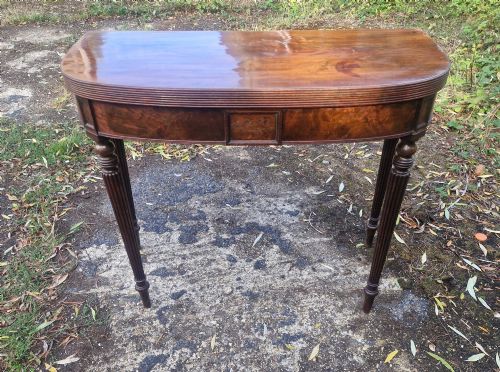
The most frequent form on this page is the mahogany card table, often taking a 'D' shape or half-moon profile. These tables frequently appear alongside related tea tables and console tables from similar eras.
Origin and period styles dictate the presence of specific design elements, ranging from Sheraton and Hepplewhite influences to later Victorian and Edwardian interpretations. Many pieces utilise simple turn-over or fold-over mechanisms to transform the compact console into a functional playing surface.
Materials and Construction
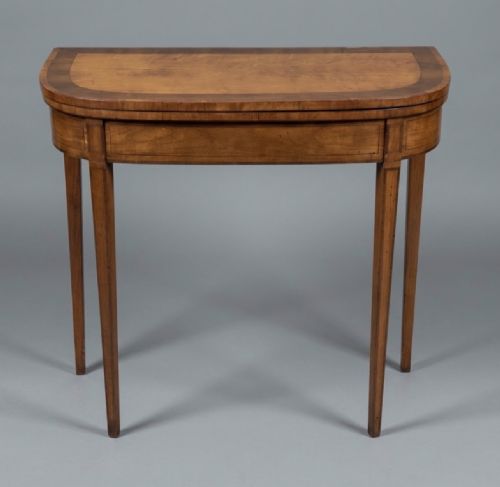
Makers constructed these tables primarily in solid timbers and veneers, selecting mahogany, walnut, burr walnut, and rosewood for their rich grain and durability. Satinwood and boxwood frequently appear as contrasting inlay materials to define borders and panels.
Cabinetmakers applied specialised joinery to accommodate the folding mechanism, balancing the weight of the hinged top against the supporting legs. Brass hinges, brackets, and occasional swing legs support the upper leaf when extended.
Demilune Folding Card Table Retail Price Guide 2026
Typical asking prices for demilune folding card table among the pieces listed under this phrase on Sellingantiques today, from the lower quarter to the upper quarter. They describe what is for sale here now, not the wider market.
Listings feature woods including mahogany, satinwood, burr walnut, and rosewood across Georgian, Regency, and Victorian periods.
Evaluating Quality
Quality rests upon the selection of timber figures, such as the grain patterns in burr yew wood or Honduras mahogany. The precision of satinwood inlay and the crispness of carved details distinguish finer examples from plain production.
Structural integrity of the folding mechanism and the alignment of the hinged top when closed determine the standard of craftsmanship. Tables retaining original brass hardware and stable leg joinery reflect superior workshop execution.
Bruce & Burns of Edinburgh
The Demilune Folding Card Table Glossary
- Demilune
- Half-moon shape. This profile allows the table to stand flush against a wall when closed.
- Fold-over
- A hinged tabletop design. It doubles the surface area when opened for play.
- Veneer
- A thin layer of decorative wood applied to a base timber. It displays figured grains such as burr walnut.
- Inlay
- Contrasting wood or material set flush into the surface. Satinwood and boxwood achieve this decorative effect.
- Triple top
- A table design featuring three nested leaves. It often conceals a storage well or secondary gaming surface beneath.
Demilune Folding Card Table: Frequently Asked Questions
How do I open the table?
Most models use a fold-over or turn-over mechanism where the upper leaf pivots on hinges to rest upon a swing leg or frame extension.
Care must be taken to support the pivoting leaf evenly during the opening process to protect the antique hinges.
Were these used only for cards?
While designed primarily for card games like whist, many examples functioned equally as tea tables or side consoles.
The versatile surface accommodated social gatherings and domestic writing tasks in period drawing rooms.
How do I identify a Georgian piece?
Georgian tables typically display characteristic timber choices like Honduras mahogany alongside restrained neoclassical or Sheraton styling.
Construction details and period secondary woods further help distinguish these eighteenth-century examples from later revival pieces.
Can I place items on the closed top?
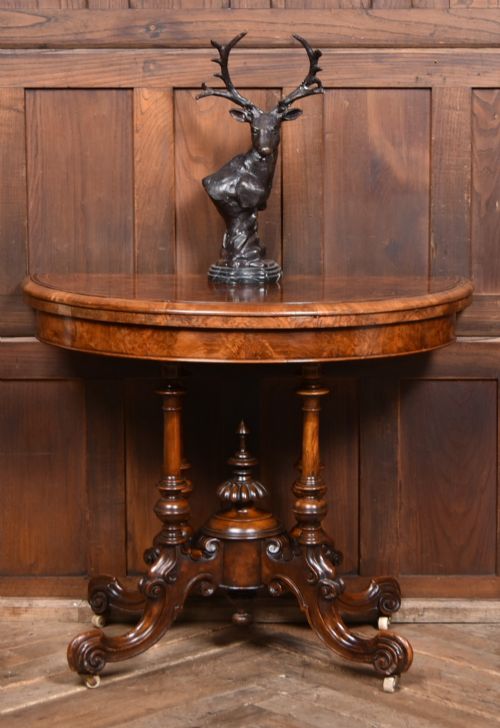
The closed semicircular top serves well for displaying decorative objects, lamps, or small sculptures against a wall.
Ensure weight is distributed evenly to avoid straining the hinge assembly beneath the closed leaves.