



Demi Lune Credenza
These half-round demi lune credenza pieces offer graceful curved fronts and refined storage, bringing timeless elegance to an interior.
Demi Lune Credenza
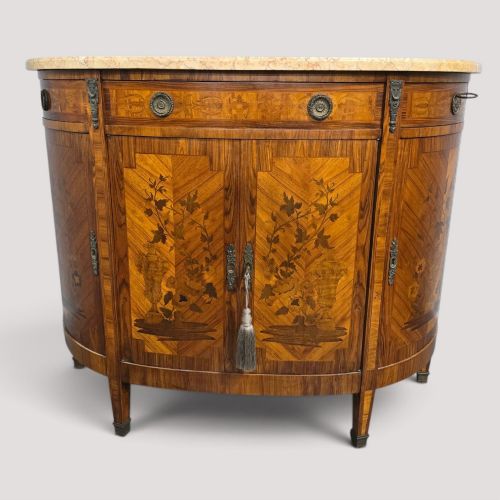
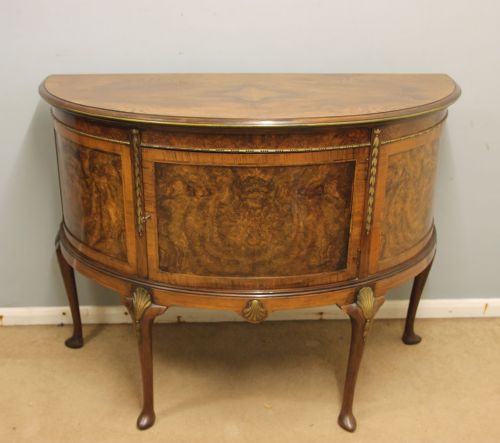
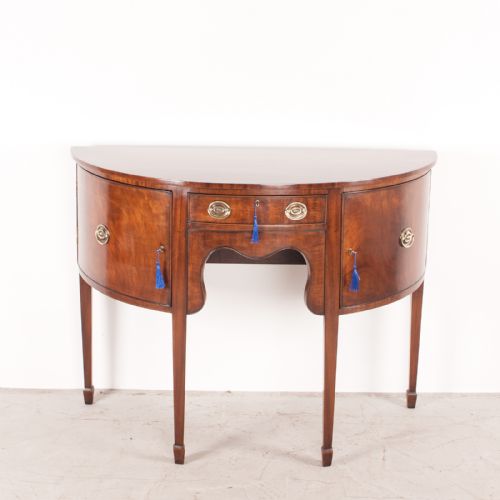
A demi lune credenza presents a distinctive semicircular footprint designed to sit flush against a wall while providing practical surface and cupboard space. These items appear across various historical eras, including the Georgian period, the Edwardian era, and the 1920s.
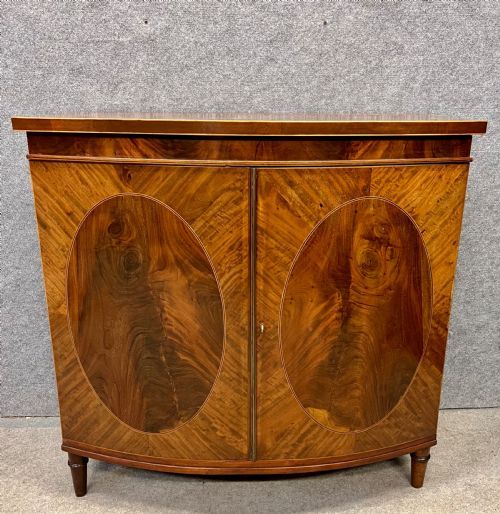
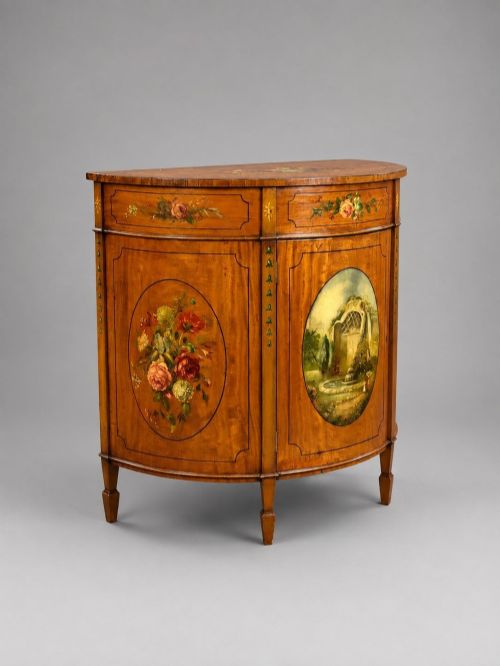
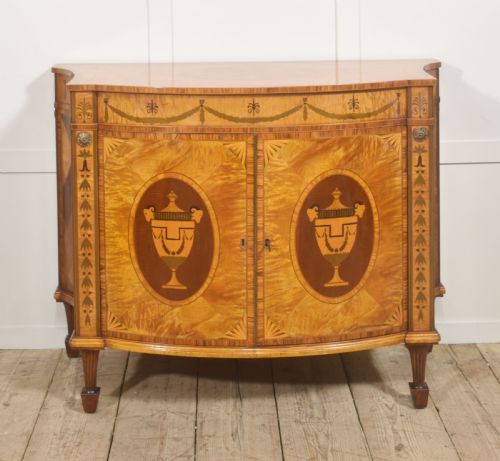
The versions most commonly met on this page include satinwood and mahogany side cabinets executed in the Sheraton Revival style or bearing classical painted panels. These half-round items function effectively as commodes, sideboards, and display cabinets within hallways and reception rooms.
Construction and Materials
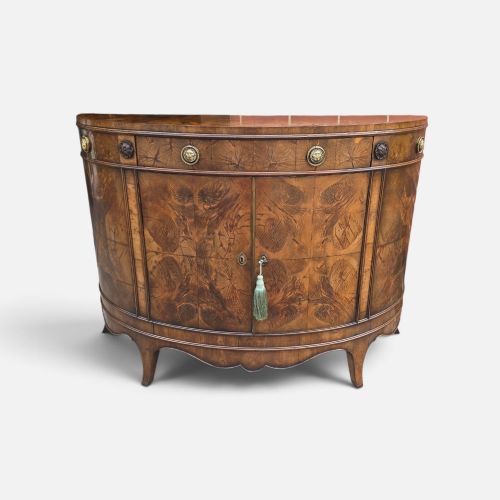
Cabinet makers utilised choice timber veneers such as satinwood, burr yew, walnut, and mahogany over solid secondary woods to achieve the curved front profile. Intricate marquetry and boxwood stringing frequently define the exterior surfaces.
Many examples incorporate decorative elements including hand-painted classical panels, brass mounts, and inset marble tops. These combined techniques demand precise carpentry to bend and fit wood around the semicircular framework.
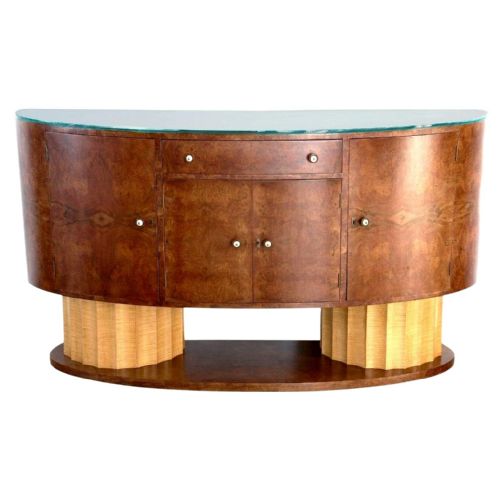
Listings feature items from the Georgian period through to Art Deco, executed in mahogany, satinwood, burr yew, and marble.
Quality and Execution
Superior execution shows in the precision of the timber matching and the intricacy of the marquetry inlay across the curved doors and sides. Finer pieces demonstrate careful hand-painted detail and high-grade cabinet woods such as burr elm and burr yew.
Construction standards distinguish workshop standards, observable in the snug fit of doors, the stability of the marble slabs, and the depth of the finishing polish. Subtler differences lie in the quality of the brass hardware and the crispness of the boxwood stringing.
Hille·Pietro Ferrario
The Demi Lune Credenza Glossary
- Demi-lune
- A half-moon shape characteristic of tables and cabinets with a flat back and a curved front. This profile allows the furniture to occupy minimal depth while offering generous internal capacity.
- Marquetry
- The art of applying pieces of veneer to a structure to form decorative patterns and pictures. Craftsmen use varied woods to create contrasting tonal effects.
- Satinwood
- A durable timber yielding a golden-yellow sheen, frequently used in high-end cabinet making during the eighteenth and nineteenth centuries. It provides an ideal smooth canvas for painted decoration.
- Stringing
- Thin inlaid lines of contrasting wood used to outline panels and drawers. This linear detail defines the edges of geometric and curved designs.
Demi Lune Credenza: Frequently Asked Questions
Where should I place a demi lune credenza?
These semicircular cabinets suit narrow hallways, entrance foyers, and living room walls where standard rectangular furniture projects too far into the floor space. Their shallow depth provides surface area and storage without obstructing foot traffic.
Matching the wood tone to existing interior furnishings helps the piece integrate naturally into the room. Placing a mirror or a lamp above enhances its role as a focal point.
How do I identify a Sheraton Revival piece?
Sheraton Revival items draw inspiration from late eighteenth-century neoclassical designs, typically featuring satinwood surfaces, painted floral swags, and delicate boxwood stringing. These examples often date from the Edwardian period or around nineteen hundred.
Examining the internal construction timber and the ageing of the polish helps distinguish a revival piece from an original eighteenth-century item.
Can these cabinets hold heavy items?
The curved internal shelving accommodates standard household objects, books, and dining porcelain safely. Weight distribution remains important due to the tapering shape towards the back corners.
Marble-topped versions offer robust surfaces for heavy decorative items or lamps, whereas veneered wooden tops benefit from protective coasters.
What is the difference between a commode and a credenza?
A commode traditionally refers to a low cabinet with drawers or cupboards, often used in bedrooms or formal reception spaces. A credenza generally denotes a sideboard or display cabinet associated with dining and living areas.
In practice, terms overlap frequently in antique listings depending on the specific proportions and internal layout of the piece.