


Dark Wood Swivel Stool
These dark wood swivel stool options are height-adjustable music and piano seats that bring practical rotation and period character to a room.
Dark Wood Swivel Stool
When searching for a dark wood swivel stool, buyers encounter nineteenth and early twentieth-century adjustable seats primarily designed for musicians and pianists. The selection on this page centres heavily on Victorian and William IV revolving piano stools and music chairs, alongside industrial workshops examples.
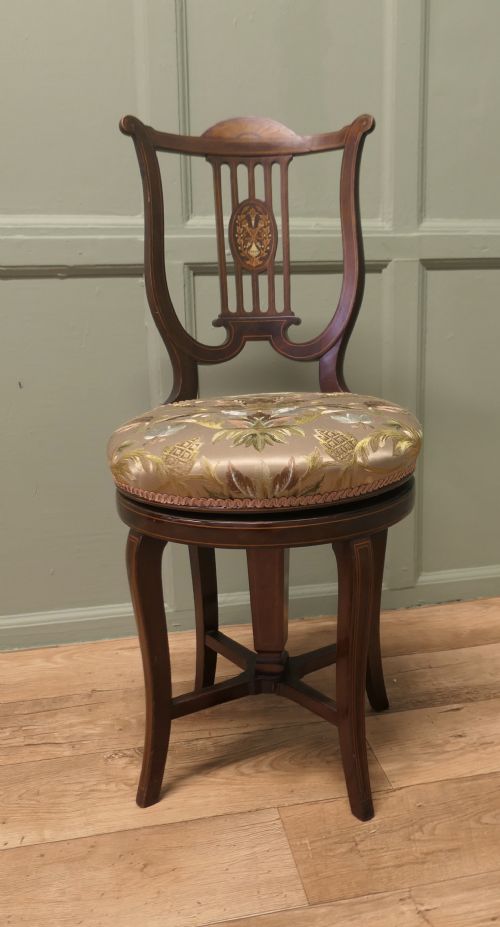
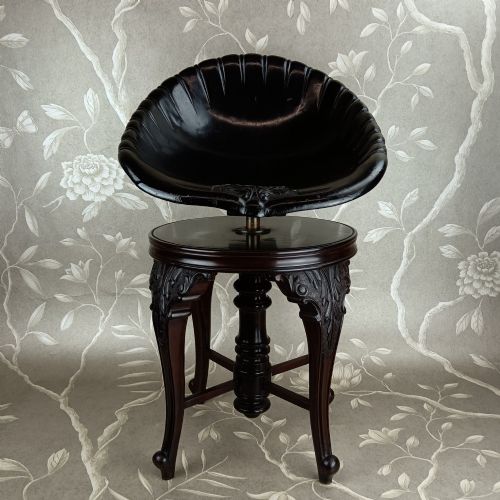
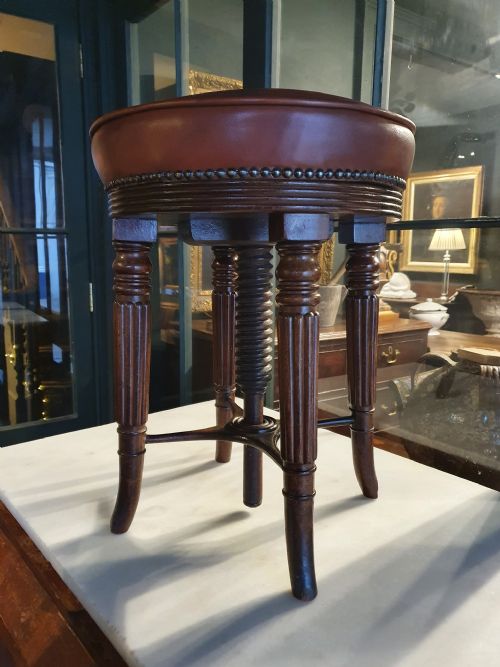
Most pieces combine a rotating top with a threaded wooden spindle or rise and fall mechanism to alter the height. Forms range from simple circular mahogany revolving seats to elaborate lyre-back music chairs and carved walnut grotto stools.
How they were made
Cabinet makers utilised dense timbers such as mahogany, rosewood, walnut and padouk, often shaping the dense grain with carved details. Brass components frequently form part of the internal swivel and height-adjustment screws, while cast iron appears in industrial workshop variants.
Many examples incorporate upholstered seats covered in fabric, velvet or other textiles, secured over padded foundations to provide comfort during long periods of sitting at an instrument.
Listings feature mahogany, rosewood, walnut, and cast iron across Victorian, Regency, and industrial periods.
What varies in quality
The standard of timber selection and the crispness of the carving distinguish finer examples from simpler utilitarian seating. Superior pieces display carefully figured mahogany or rosewood veneers alongside robustly engineered revolving mechanisms that turn smoothly without excessive play.
Maker attribution and refined secondary details, such as elaborate lyre backs or intricate pierced supports, elevate specific piano stools above standard workshop production while retaining their original mechanical function.
Jennens and Bettridge·Gillows·James Shoolbred·H Brooks and Co
The Dark Wood Swivel Stool Glossary
- Revolving
- A seat mechanism that turns fully on a central axis, allowing the sitter to rotate freely while remaining seated.
- Rise and Fall
- An adjustable height mechanism typically operated by turning the seat top to raise or lower the platform along a threaded wooden or metal screw.
- Music Stool
- A specialised seat designed for pianists and harpists, frequently featuring a swivel action and adjustable height to suit different players and instruments.
- Lyre Back
- A chair back designed in the symmetrical shape of a classical lyre, commonly found on nineteenth-century music chairs.
- Padouk
- A heavy, durable exotic hardwood with a reddish hue utilised in colonial and nineteenth-century cabinet making.
Dark Wood Swivel Stool: Frequently Asked Questions
How do I adjust the height on these stools?
Most period music stools operate via a central wooden or metal screw mechanism hidden beneath the seat top. Turning the upper section clockwise or anticlockwise raises or lowers the platform to the desired position.
Some later or industrial variants utilise different levers or pin adjustments, but the threaded spindle remains the standard method found on nineteenth-century revolving piano stools.
Are these stools suitable for daily use?
These pieces were originally built to withstand regular use by musicians in nineteenth-century drawing rooms and parlours. Their solid timber construction and mechanical joints remain sturdy when treated with reasonable care.
Buyers should check that the rotating mechanism operates smoothly and that the central column is stable before using them for extended seating.
How do I tell a Victorian stool from a Georgian one?
Victorian examples often feature heavier carving, rosewood or walnut veneers, and sometimes more complex mechanical adjustment devices. Georgian and Regency pieces typically display cleaner classical lines with simpler mahogany frames and restrained ornamentation.
Stilistic crossover is common because nineteenth-century cabinet makers frequently referenced earlier Georgian design motifs.