


Dark Rosewood Clock
A dark rosewood clock brings rich grain and steady brasswork into a room, offering the dependable mechanics of the nineteenth century.
Dark Rosewood Clock
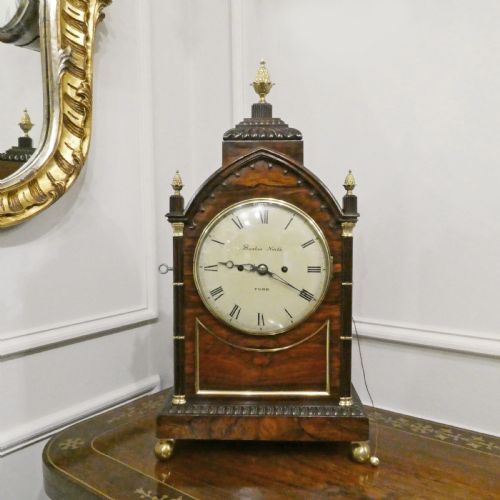
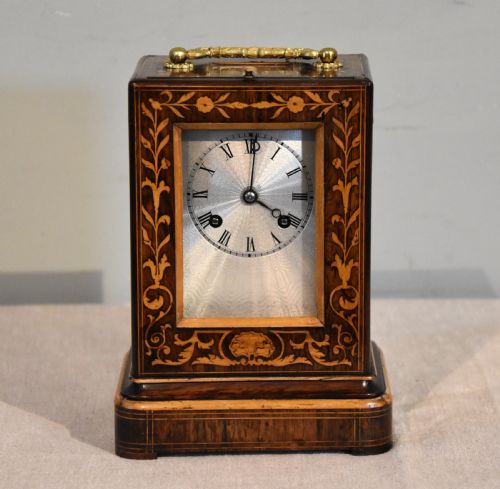
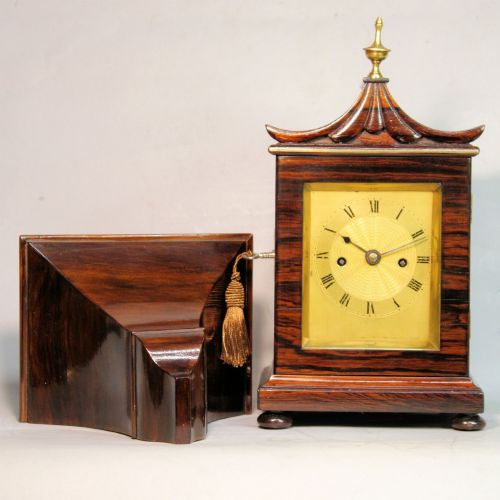
A dark rosewood clock is a timepiece housed in dense, highly figured tropical timber, most commonly appearing on this page as Victorian and Regency drop-dial wall clocks, mantel clocks, and bracket clocks.
The selection ranges from robust English fusee wall clocks to ornate French mantel pieces and delicate library timepieces, spanning the nineteenth century with occasional examples from the Edwardian period.
Buyers seeking this phrase encounter circular dial formats, architectural bracket cases, and octagonal frames that reflect the diverse domestic and public interior styles of the Victorian era.
How they were made
Cabinet makers utilised solid rosewood and applied veneers over secondary timbers, frequently incorporating brass inlay, satinwood stringing, and mother-of-pearl to ornament the cases.
Internal movements relied on fusee or twin fusee mechanisms designed to maintain even tension as the mainspring unwound, driving enamel or silvered metal dials protected by bevelled glass bezels.
Listings feature nineteenth century rosewood clocks alongside Victorian, Regency, and Edwardian examples utilising brass, mother-of-pearl, and glass.
What varies in quality
Quality rests upon the crispness of the brass inlay, the figuration of the rosewood grain, and the precision with which the cabinet joints and dial bezels fit together.
The sophistication of the internal movement, from simple timepieces to quarter-striking twin fusee mechanisms by noted makers, dictates the overall execution and standing of the piece.
Barber and North·Paul Garnier·Henry Marc·Arnold and Frodsham·James Bell
The Dark Rosewood Clock Glossary
- Fusee
- A conical pulley connected to the mainspring by a chain or cord, designed to equalise the torque as the spring unwinds. This mechanism improves timekeeping consistency across the running cycle.
- Bracket clock
- A portable clock originally designed to sit on a wall bracket or table. These cases often feature architectural tops and carrying handles.
- Drop-dial
- A clock design where the circular dial sits above a lower case extension, which usually houses a swinging pendulum. This form became standard for English wall clocks.
- Portico clock
- A mantel clock styled after classical architecture with supporting pillars framing the pendulum. This French style frequently combined rosewood and satinwood.
- Silvered metal
- A brass dial plate treated with a silver solution to create a matte white metallic finish. Numerals and maker signatures are typically engraved and blackened upon this surface.
Dark Rosewood Clock: Frequently Asked Questions
Where should I hang a wall clock?
Mount the clock securely to a solid wall stud using appropriate fixings to support the dense rosewood weight. Avoid placement near direct heat sources or damp environments.
A stable wall ensures the pendulum beats evenly and the movement keeps accurate time.
How do I identify a Regency clock?
Regency pieces typically display restrained classical proportions, elegant brass inlay, and geometric rosewood cases dating from the early nineteenth century. Maker signatures on the dial often confirm this era.
Compare the casework against later Victorian examples, which tend towards heavier carving and varied dial configurations.
What is a twin fusee movement?
A twin fusee movement uses two separate fusee cones to power the timekeeping train and the striking train independently. This setup ensures consistent power delivery to both functions.
Such movements are commonly found in higher quality bracket and table clocks from the nineteenth century.