
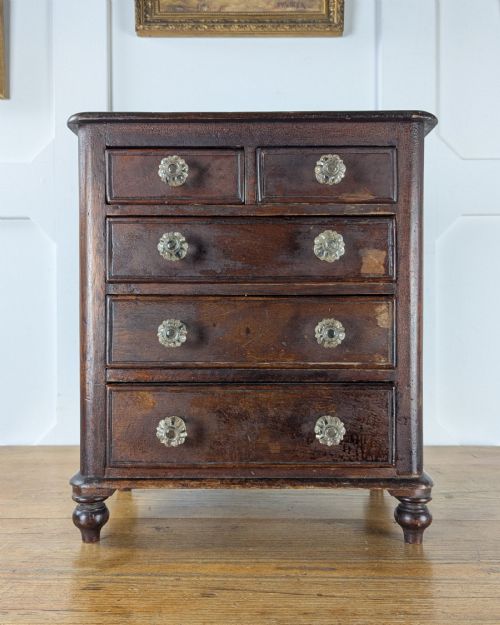
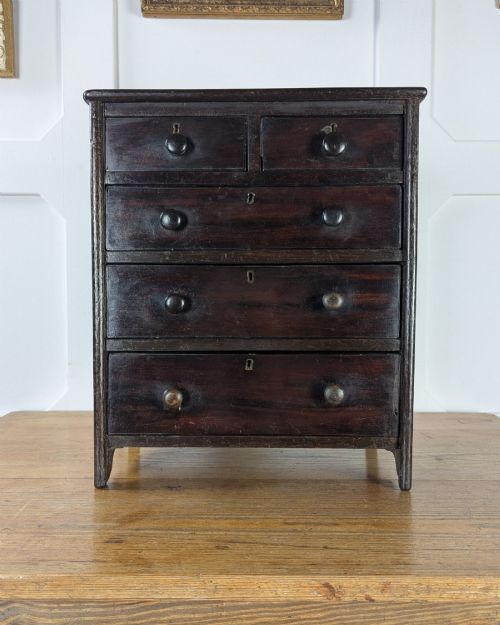
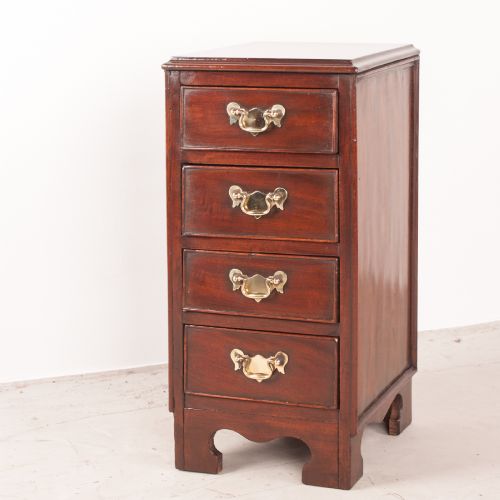
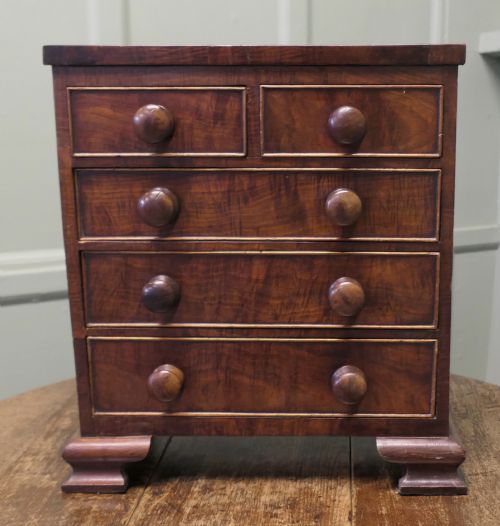



Dark Mahogany Apprentice Chest
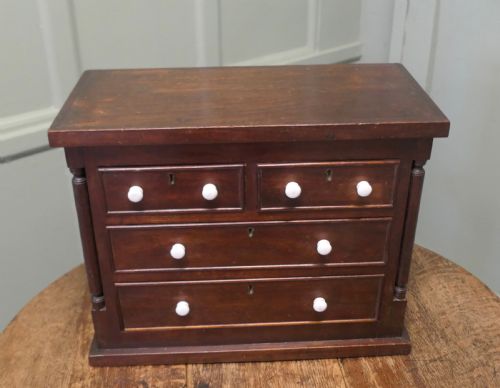
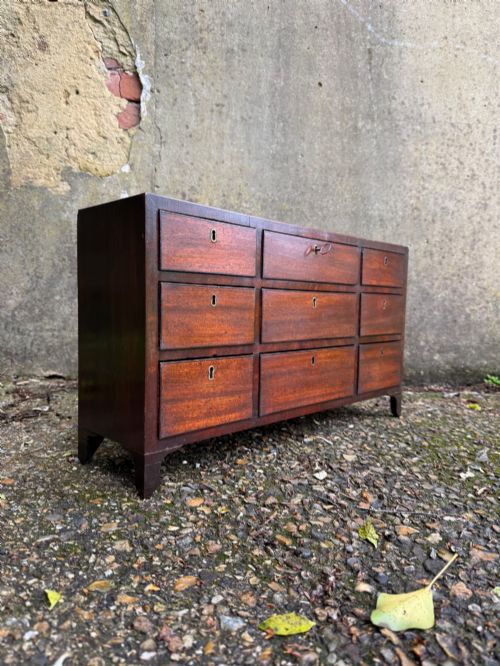
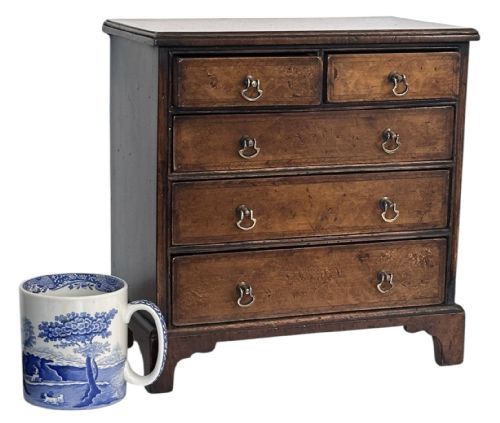
A dark mahogany apprentice chest is a scaled-down piece of cabinetmaking that brings fine proportions and rich timber into compact spaces.
Dark Mahogany Apprentice Chest
When you search for a dark mahogany apprentice chest, you encounter miniature chests of drawers, miniature chests, and table cabinets scaled down from full-sized furniture. These pieces span the Georgian, Regency, and Victorian periods, often taking the form of miniature bow-front chests or small banks of drawers.
The pieces on this page originate predominantly from the 18th and 19th centuries, alongside Edwardian examples. You will frequently find traditional drawer configurations raised on turned feet or fitted with brass drop handles.
Beyond standard chests, the form extends to miniature secretaries, bureaus, and watchmaker cabinets built with the same joinery as domestic furniture. Each item offers functional storage on a miniature scale suitable for tabletops.
Materials and construction
Makers built these pieces primarily using mahogany, frequently reinforced with secondary woods like oak, while incorporating boxwood and wood inlay for decorative contrast. Brass hardware appears as drop handles and escutcheons, and glass occasionally surfaces in related cabinet doors.
The construction mirrors full-scale cabinetmaking of the Georgian and Victorian eras, utilising tight dovetail joints for the drawers and careful jointing for the carcase. Surfaces received polishing to bring out the dark grain of the mahogany, sometimes complemented by fine stringing or inlay.
Listings span the Georgian, Victorian, and Edwardian periods, featuring mahogany, brass, oak, boxwood, bone, and glass.
Distinctions in quality
Quality rests in the precision of the scaling and the fidelity of the proportions to full-sized furniture of the period. Finer examples maintain crisp drawer dovetails and well-figured mahogany timber that displays depth in the grain.
The refinement of the brass handles, the neatness of any wood inlay, and the retention of original turned feet separate standard workshop items from exceptional pieces.
The Dark Mahogany Apprentice Chest Glossary
- Apprentice piece
- A small-scale item demonstrated to a guild to prove a craftsman's skill. These objects replicate full-sized furniture forms.
- Bowfront
- A convex, curved front to a chest of drawers. This shape requires advanced woodworking skill to shape the timber and drawers accurately.
- Dovetail
- A joint formed by interlocking wedge-shaped fingers. It provides strong tensile strength for drawer construction.
- Escutcheon
- A small protective plate surrounding a keyhole. It is typically cast from brass on these pieces.
- Stringing
- Thin inlaid lines of contrasting wood used to outline drawers or panels. Boxwood is frequently utilised for this purpose.
Dark Mahogany Apprentice Chest: Frequently Asked Questions
What is a dark mahogany apprentice chest?
These items are small-scale wooden chests constructed by woodworkers, often as trial pieces or salesmen's samples. They replicate the exact proportions and styles of full-sized Georgian and Victorian furniture.
Cabinetmakers applied the same joinery techniques found in domestic wardrobes and large drawer chests to these miniature versions.
How were these small chests used?
Historically, they functioned as portable storage for small valuables, trinkets, jewellery, or documents. Their compact size allowed them to sit securely on tables or desks.
Today, collectors use them to display small objects or simply place them on tabletops as decorative focal points.
How do I date a miniature chest?
Dating relies on identifying stylistic markers from periods like the Georgian, Regency, or Victorian eras. Details such as bracket feet, bow fronts, and brass drop handle styles correspond directly to the prevailing furniture fashions of their decade of manufacture.
Construction methods, including the hand-cut nature of the drawer dovetails, also indicate whether a piece originates from the 18th or 19th century.
Are these chests made of solid mahogany?
Most examples utilise solid mahogany for the primary exterior surfaces and drawer fronts. Secondary timbers like oak or pine frequently appear in internal drawer linings and backboards.
Finer pieces may incorporate boxwood stringing or wood inlay across the primary mahogany carcase.