
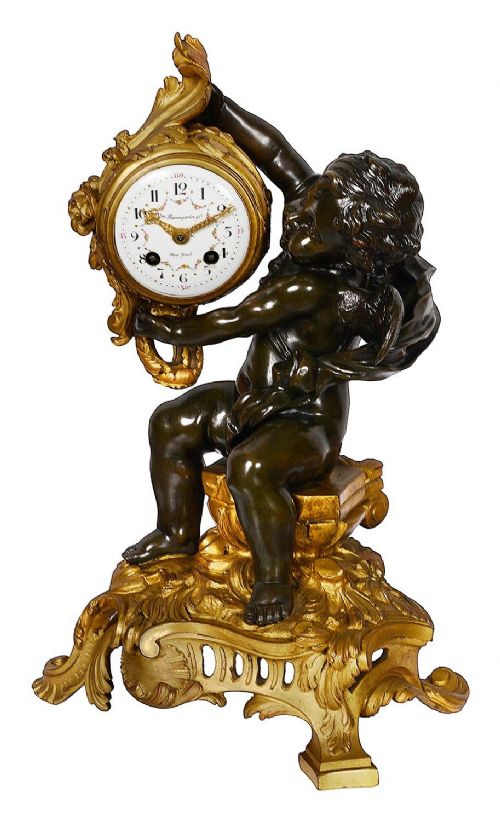


Dark Bronze Mantel Clock
These dark bronze mantel clock examples combine heavy patinated metal with classical figures and architectural cases for the desk or shelf.
Dark Bronze Mantel Clock
When you search for a dark bronze mantel clock, you encounter heavy metal timepieces spanning the nineteenth century, including Victorian and Regency eras. These objects range from single standing clocks to multi-piece clock garnitures incorporating matching side ornaments.
The version most likely to meet you on this page is the French classical or Rococo revival mantel clock, often featuring patinated bronze alongside ormolu highlights and enamel dials. English bracket and carriage clocks also appear among the selection.
Many examples incorporate figurative subjects such as cherubs or literary themes, housed in marble or bronze architectural cases. Makers working in Paris and London produced these striking or time-only domestic clocks.
Materials and construction
The construction relies heavily on cast bronze, patinated bronze, and ormolu, frequently paired with white enamel dials and glass protective covers. Some models integrate marble bases or mahogany portico structures to support the movement.
Internal mechanisms utilise brass gear trains, with twin fusee movements appearing in English bracket and carriage pieces. Exterior surfaces combine dark patination with fire-gilded bronze details and cast figural elements.
Several clocks on this page feature winged cherubs keeping watch over the hours.
Distinctions in quality
Quality separates through the crispness of the bronze casting and the depth of the chasing on figurative elements like cherubs and classical drapery. Superior examples exhibit harmonious balancing between patinated dark bronze and bright ormolu sections.
Maker attribution and movement complexity, such as twin fusee systems or clock garniture sets with matching side pieces, elevate certain pieces above standard domestic timepieces. The integration of marble and silvered dials also marks a higher grade of manufacture.
Japy Freres·Charpentier Paris·James Moore·Lemerle Charpentier·Bellenot Paris
The Dark Bronze Mantel Clock Glossary
- Ormolu
- Gilded bronze produced by applying a mercury-gold amalgam to cast bronze. This technique creates a durable golden finish seen on nineteenth-century clock mounts.
- Clock garniture
- A set comprising a central mantel clock accompanied by matching side ornaments such as urns or candelabra. These matched groupings decorated nineteenth-century mantelpieces.
- Fusee
- A conical pulley used in clock movements to maintain even tension on the chain as the mainspring unwinds. This mechanical device improves timekeeping accuracy.
- Patinated bronze
- Bronze that has been chemically treated to achieve a darkened, aged surface finish. This dark tone provides contrast against gilt metal mounts.
Dark Bronze Mantel Clock: Frequently Asked Questions
How do I wind a dark bronze mantel clock?
Use the provided key to turn the winding squares on the enamel dial gently until resistance is felt. Care must be taken not to overwind the mainspring.
Ensure the clock is standing on a level surface before starting the movement to keep the pendulum beating evenly.
What is a clock garniture set?
A clock garniture is a matched suite consisting of a central mantel clock paired with two side ornaments, such as urns or vases. These sets were designed to create a symmetrical display on a fireplace mantel.
The pieces share identical materials, styles, and casting details from the same period of manufacture.
How do I distinguish Regency from Victorian examples?
Regency pieces often display classical English or early French Empire influences dating from the early nineteenth century. They frequently feature clean architectural lines and restrained use of bronze.
Victorian examples tend towards heavier ornamentation, incorporating Rococo revival scrolls, elaborate figural groups, and rich bronze patination.
Where should I place a heavy bronze clock?
Position the clock on a sturdy mantelpiece, sideboard, or console table capable of supporting significant weight from bronze and marble construction. Keep the piece away from direct heat sources and moisture.
Allow clearance behind the case if the clock incorporates a rear door for pendulum access.