




Dark Blue Caucasian Rug
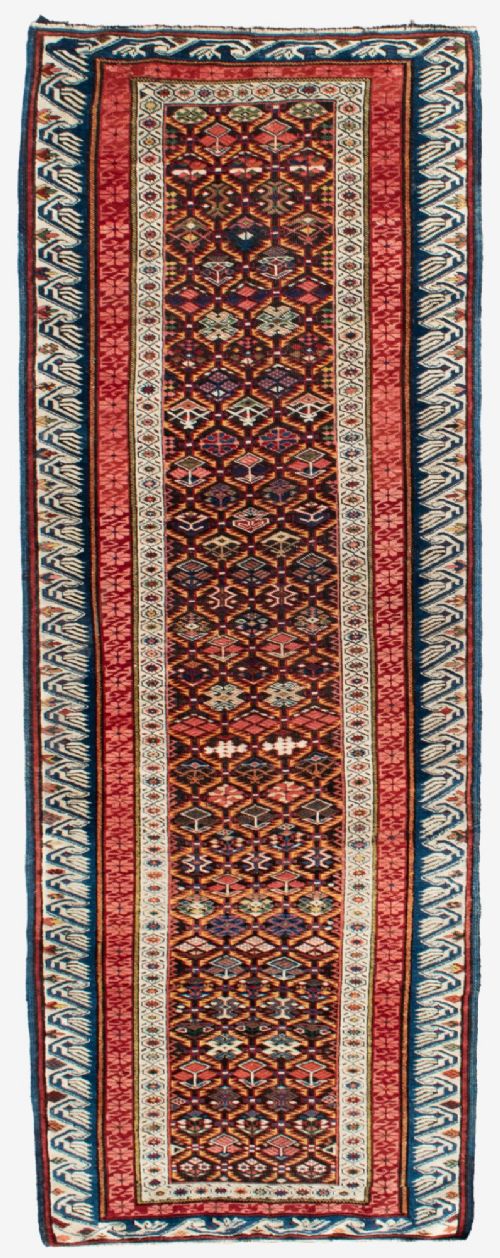
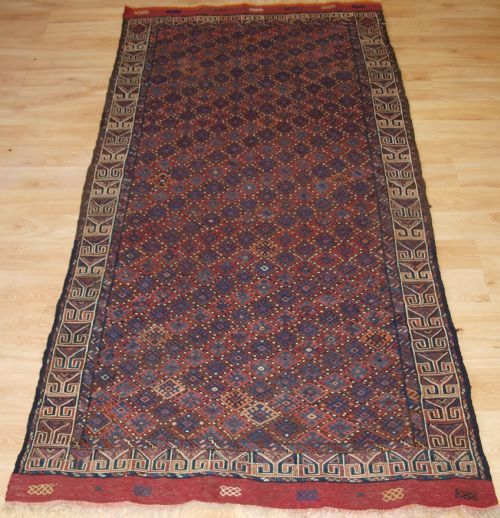
These dark blue caucasian rug examples bring deep indigo tones and geometric village designs straight from nineteenth and early twentieth century looms into modern spaces.
Dark Blue Caucasian Rug
When you search for a dark blue caucasian rug, you are looking at hand-knotted village and tribal floor coverings originating from the Caucasus region. The pieces listed here span from the nineteenth century up to the early twentieth century, taking forms such as standard area rugs, long narrow runners, and specific prayer formats.
Most examples you will meet on this page favour deep indigo fields paired with contrasting geometric motifs, stepped medallions, and stylised animal or plant forms. They cross several distinct regional traditions, including Kurdish, Gendje, Marasali, Seychor, Kuba, and Chi-Chi styles, reflecting the diverse weaving heritage of the area.
How they were made
The makers of these rugs built them using hand-spun wool for the pile, often foundationally supported by cotton warps and wefts. Artisans utilised traditional upright looms to tie dense symmetrical or asymmetrical knots, creating structures robust enough to withstand generations of floor use.
Dyers achieved those characteristic dark blue and indigo shades through natural plant extracts, which were then set alongside madder reds, yellows, and ivories. Flatwoven techniques also appear in specific types, combining supplementary weft-wrapping methods alongside standard pile knots.
Many village weavers tucked tiny hidden amulets or protective motifs into the corners, hoping to ward off the evil eye.
What varies in quality
Quality in these rugs rests on the density of the knotting and the precision of the geometric drawing across the field. Finer weaves allow sharper delineation of intricate borders and complex tribal motifs, whereas coarser pieces display a more rustic, simplified execution.
The integrity of the wool pile and the survival of original outer selvedges and end finishes dictate the structural health of each piece. Superior examples retain rich, saturated dye colours with minimal fading, maintaining the visual punch intended by the original village weaver.
Quchan Kurds·East Caucasus
The Dark Blue Caucasian Rug Glossary
- Pile
- The upright tufts of wool that form the usable soft surface of the rug. This is created by knotting yarn around the warp threads.
- Warp
- The vertical threads stretched tightly on the loom before weaving begins. The fringe of the rug is typically a continuation of these structural threads.
- Weft
- The horizontal strands passed alternately over and under the warp threads to lock the rows of knots in place. In many pieces, these are dyed to a characteristic tone.
- Selvedge
- The bound or reinforced side edges of a rug that prevent the pile and foundation from unravelling. Original selvedges indicate a well-preserved piece.
- Medallion
- A central ornamental design motif placed in the middle of the rug field. Caucasian examples favour geometric, polygonal, or hooked variations.
Dark Blue Caucasian Rug: Frequently Asked Questions
Where were these rugs made?
They were woven in villages and nomadic tribal camps across the Caucasus mountains, a region linking Europe and Asia. Specific groups and districts, such as Gendje, Kuba, and Kurdish settlements, developed distinct local palettes and border patterns.
Production spanned domestic households rather than large urban factories, meaning each weaver introduced subtle variations into traditional regional layouts.
How do I date a dark blue caucasian rug?
Dating relies on assessing the handle of the wool, the structure of the foundation, and the chemical composition of the dyes. Pieces from the nineteenth century often show softer wool texture, hand-spun irregularities, and deeper, more varied abrash in the indigo fields.
Comparisons with documented examples from known periods help narrow down the decade of production, typically ranging from the 1880s through the 1920s.
Are these rugs suitable for hallway runners?
Certain formats are specifically constructed as long narrow runners, designed to handle corridor and hallway traffic. The durable wool pile and tight cotton foundations of these pieces make them well-suited for spaces with regular foot movement.
Using an appropriate underlay helps keep the runner stable on hard flooring and reduces friction against the base fibres over time.