


Dapple Grey Carved Horse
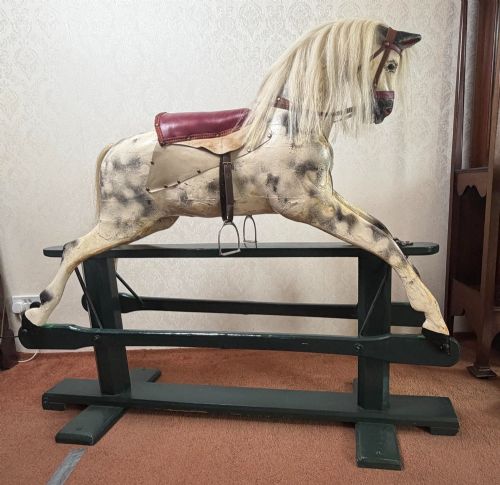
These dapple grey carved horses are traditional wooden rocking horses that bring a classic charm to any nursery or interior space.
Dapple Grey Carved Horse
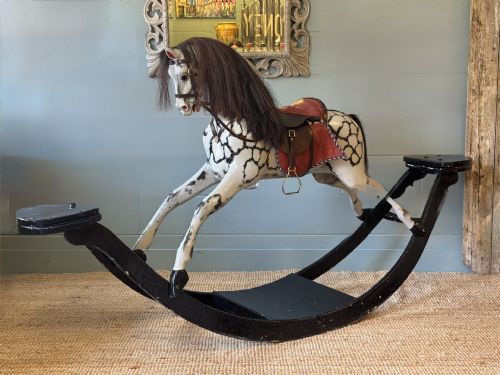
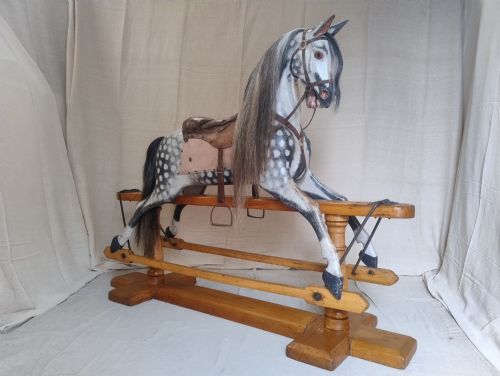
A dapple grey carved horse is fundamentally a rocking horse created from carved wood, typically mounted on either safety stands or traditional curved wooden rockers. These pieces appear across various periods, ranging from the Victorian era through the Edwardian years and into the interwar period.
The most common forms on this page include large antique examples, often displaying the mottled grey paint finish that defines the style. Makers such as F.H. Ayres and G & J Lines produced many of the enduring specimens seen today.
Folk art interpretations also emerge within this category, demonstrating simpler construction methods while retaining the characteristic horse shape. Buyers searching for a dapple grey carved horse generally encounter pieces that show substantial craftsmanship in both the equine carving and the supporting wooden frames.
Materials and construction methods
Makers constructed these figures primarily using carved wood and pine, forming the main body and the supporting frames. Artisans then applied layers of paint to achieve the dapple grey finish, often incorporating glass eyes to enhance realism.
Additional organic materials completed the illusion, utilising real horsehair for the manes and tails, and leather for the tack, saddles, and bridles. Metal and iron components, such as brackets and bolts, secured the rocking mechanism and added structural stability.
Listings on this page span from the Victorian era through the 1950s, utilising wood, metal, leather, and horsehair.
Assessing quality in carved horses
The standard of a dapple grey carved horse rests heavily on the anatomical precision of the wooden carving and the expression captured in the head. Finer examples display detailed musculature, carved ears, and open mouths with carved teeth.
Originality of surface finish and components dictates much of the standing within this category. Surviving original dapple grey paint, genuine horsehair manes, and intact leather tack elevate an item above those with later repaint layers or replacement parts.
G & J Lines·F.H. Ayres·Lines Bros·Collinson·Collinson & Sons
The Dapple Grey Carved Horse Glossary
- Dapple grey
- A coat colour pattern for horses featuring dark grey patches on a lighter grey background, replicated with paint on these carved figures. This finish is the defining visual characteristic of the traditional nursery rocking horse.
- Rocker
- The curved wooden beam upon which the horse mounts to allow a swinging motion. Some nineteenth-century examples sit on bow rockers, while later models use safety stands.
- Glass eyes
- Inset eyes made from blown glass to give the carved animal a lifelike appearance. High-quality examples often feature expressive glass eyes rather than painted wooden substitutes.
- Folk art
- Objects created by self-trained artisans working outside academic traditions. In this context, it describes simpler, less commercial rocking horses with charming individual character.
Dapple Grey Carved Horse: Frequently Asked Questions
How old is my rocking horse?
Dating typically relies on construction traits, mounting styles, and materials. Nineteenth-century models often feature deep bow rockers and separate carved ears, while twentieth-century versions may use safety stands.
Makers' stamps, metal brackets, and the style of the leather tack also offer clues to the decade of manufacture, ranging from the Victorian period through the interwar years.
Are these horses safe for children?
Many antique rocking horses were built sturdily from pine and hardwood to withstand generations of use. However, older pieces may lack modern safety clearances and stable bases found in contemporary toys.
Collectors generally view nineteenth and early twentieth-century examples as decorative display items rather than active playground equipment for young children.
What is a safety stand?
A safety stand is an enclosed wooden frame that keeps the horse within a fixed footprint while it rocks. This design replaced the traditional bow rocker to prevent the horse from tipping over during vigorous play.
Introduced in the late Victorian era, safety stands became common across Edwardian and interwar models produced by major firms.
How should I clean the painted finish?
Preserving the original dapple grey surface requires gentle dusting with a soft, dry cloth. Avoid chemical solvents or abrasive cleaners that can strip the historic paint layers.
Consulting a professional conservator is advisable if the painted surface shows signs of flaking or instability.