


Antique Horsehair Rocking Horse
These antique horsehair rocking horse examples bring traditional playrooms to life with authentic period craftsmanship and genuine character.
Antique Horsehair Rocking Horse
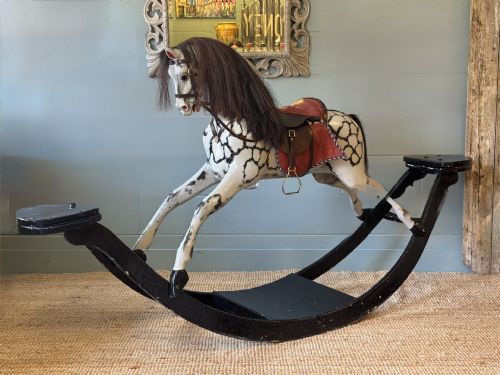
An antique horsehair rocking horse represents a traditional British playroom staple, constructed across several decades from the Victorian era through the mid twentieth century. Buyers seeking this phrase encounter large carved wooden figures mounted either on curved wooden rockers or safety stands.
The pieces listed on this page span styles from Victorian and Edwardian to vintage British interpretations. Makers such as G & J Lines, Collinson, and F.H. Ayres appear among the examples, alongside larger carved and painted horses finished with genuine horsehair manes and tails.
How they were made
Construction relies heavily on carved pine and other timbers, shaped to form the body and head of the animal. Iron, steel, and metal components provide internal reinforcement and support for the swinging mechanism.
Finishing touches incorporate traditional materials including real horsehair for the mane and tail, leather for tack and saddles, and glass eyes to complete the lifelike expression before painting.
Every single horse here has stood firm against generations of imaginary gallops across the nursery floor.
What varies in quality
The standard of carving across the body and head sets the better examples apart, showing careful attention to muscular definition and facial detail. Scale also dictates tier, with extra large models commanding particular attention from collectors.
Makers' attribution influences standing significantly, as branded work from established London workshops carries distinct historical weight compared to uncredited examples from the period.
G & J Lines of London·Collinson·F.H. Ayres
The Antique Horsehair Rocking Horse Glossary
- Curved rockers
- Traditional wooden arcs upon which the horse body pivots for movement. This configuration represents the earlier method of mounting before safety stands gained popularity.
- Glass eyes
- Inset ocular inserts utilised to give the carved head a realistic appearance. Better examples retain their original glass rather than later replacements.
- Playworn
- A descriptive term for surface wear accumulated through active childhood use over decades. It reflects the genuine history of the object rather than deliberate alteration.
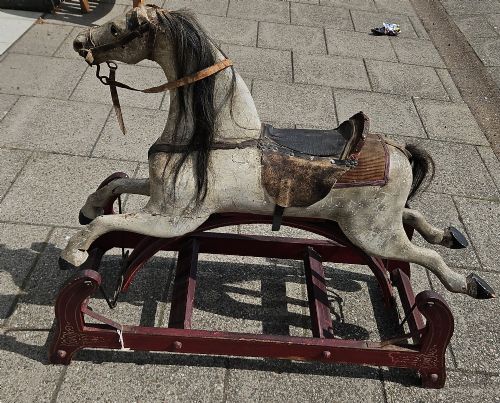
- Safety stand
- A fixed wooden frame that suspends the horse via swing irons, allowing motion without the sliding movement of curved rockers.
Antique Horsehair Rocking Horse: Frequently Asked Questions
How do I date a rocking horse?
Dating relies on construction methods, mounting styles, and maker attribution marks stamped into the wood. Victorian examples often feature curved wooden rockers, while later twentieth century pieces frequently utilise safety stands.
Paint layers and materials like glass eyes or horsehair provide further clues to the decade of manufacture. Comparing the piece against known workshop traits helps narrow down the production period.
What is a safety stand?
A safety stand is a rigid wooden frame that holds the horse steady using swing irons. This design prevented the horse from tipping over during vigorous play.
Introduced in the late nineteenth century, this style gradually replaced traditional curved rockers in many nurseries.
Are original horsehair manes common?
Many surviving pieces retain their original horsehair, though replacement tails and manes occur frequently due to natural shedding and wear. Inspecting the attachment method helps determine originality.
Period workshops utilised genuine horsehair secured firmly into channeled leather strips or directly into drilled neck cavities.
How do I care for carved pine?
Maintaining carved pine requires stable indoor humidity away from direct heat sources to prevent wood splitting. Gentle dusting preserves the painted surface and horsehair elements without causing abrasion.
Harsh chemical cleaners should be avoided to protect original paintwork and patinated metal brackets.