
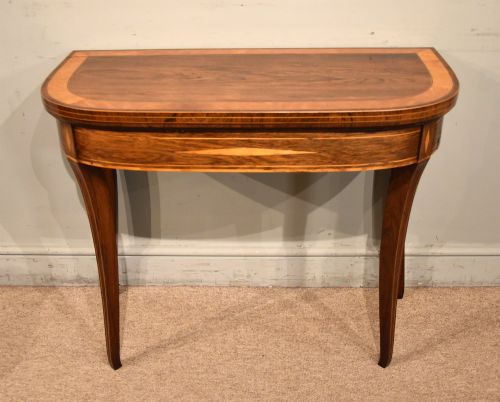


D Shaped Games Table
A d shaped games table brings versatile folding surfaces and rich timber grain to eighteenth and nineteenth century interiors.
D Shaped Games Table
A d shaped games table is typically encountered as a fold over or pivoting top piece designed for card playing or tea. The listings show these tables spanning the eighteenth and nineteenth centuries, including Georgian, Regency and Victorian periods.
Makers produced these forms in mahogany, rosewood and burr walnut, often utilising satinwood or boxwood stringing along the edge. The format frequently doubles as a console or side table when closed against a wall.
Georgian and Regency examples rely on clean architectural lines and rich mahogany surfaces, whilst Victorian pieces often showcase burr walnut veneers and serpentine outlines. The evidence reveals variations from simple folding tops to elaborate pedestal and trumpet supports.
Materials and construction
Cabinet makers built these tables using hardwoods such as mahogany and walnut, frequently applying decorative veneers like burr walnut and rosewood to the top surface. Satinwood and boxwood stringing provided contrasting borders and geometric inlay.
Construction methods centred on folding leaves, revolving mechanisms and stable frame joints to support the weight of the hinged top. Pedestal bases, four-leg configurations and trumpet structures gave stability to the pivoting or folding surfaces.
Some tables include hidden compartments beneath the folding top, originally designed to keep playing cards and counters safe.
Judging the execution
Quality rests in the precision of the timber matching across the fold over top and the crispness of any inlaid satinwood or boxwood stringing. Superior examples maintain tight hinge fittings and smooth pivoting action without looseness in the frame.
The choice of primary timber and veneer figure dictates the visual presence of the piece, from plain mahogany boards to highly figured burr walnut. Better workshops ensured the grain patterns aligned harmoniously when the table opened flat.
William Trotter of Edinburgh
The D Shaped Games Table Glossary
- Demi lune
- Half moon shape. This describes tables with a curved front and a straight back edge designed to sit flat against a wall.
- Fold over
- A hinged top design. The surface opens outward to reveal a larger playing area supported by a swinging leg or pivoting frame.
- Stringing
- Thin inlaid lines of contrasting wood. Craftsmen used satinwood or boxwood to create delicate borders around the edges of table tops.
D Shaped Games Table: Frequently Asked Questions
What is a d shaped games table used for?
These tables served primarily for card playing, social evenings and taking tea in formal reception rooms. When folded shut against the wall, they functioned as console or side tables.
The clever folding mechanism allowed households to expand their surface space only when guests arrived for entertainment or dining.
How do I tell a Georgian table from a Victorian one?
Georgian tables typically display straight legs, clean mahogany surfaces and restrained satinwood inlay reflecting classical proportions. Victorian versions often feature burr walnut veneers, serpentine shapes and heavier pedestal or trumpet bases.
Examining the timber choice and structural silhouette helps distinguish the simpler eighteenth century forms from the more ornate nineteenth century revival styles.
How do folding mechanisms work on these tables?
Most examples use a hinged fold over leaf supported by a swing out rear leg or a pivoting frieze drawer. Some designs feature a revolving top that turns ninety degrees before opening to reveal a hidden compartment beneath.
Careful inspection of the pivot pins and hinge plates shows how the mechanism distributes weight when the leaves open flat.
Where should I place a d shaped games table at home?
The flat straight edge sits flush against a hallway or living room wall, functioning as a console table when closed. Opening the top requires clearance around the piece so guests can gather comfortably for games.
Positioning the table away from direct sunlight protects vulnerable rosewood and burr walnut veneers from fading over time.