


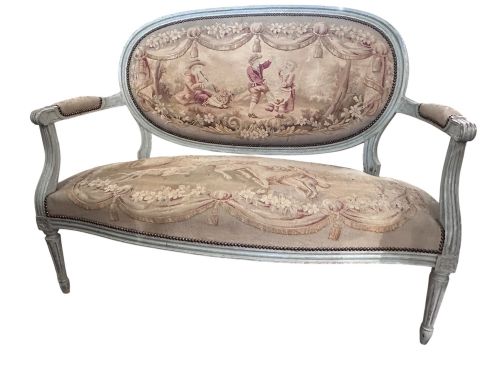


Curved Upholstery Settee
A curved upholstery settee brings a sweeping architectural line to a room, offering generous seating rooted in nineteenth and early twentieth century craftsmanship.
Curved Upholstery Settee
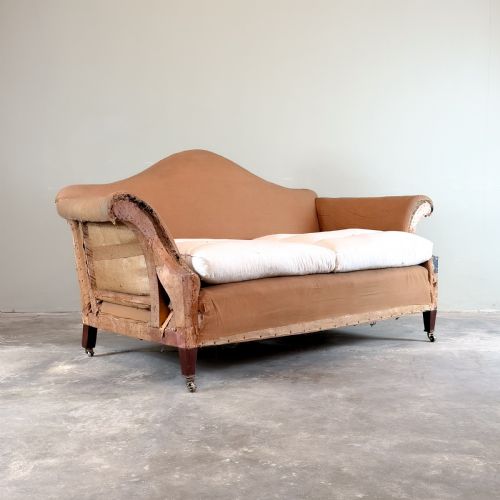
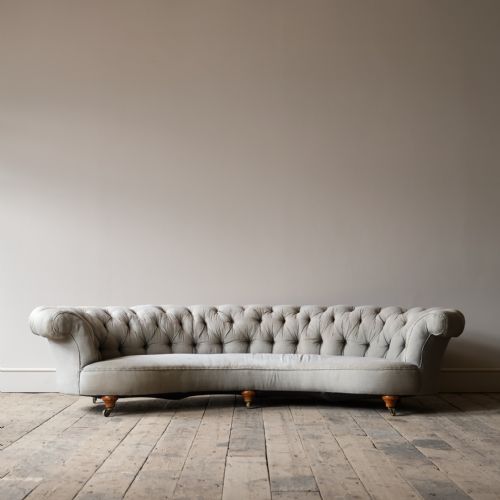
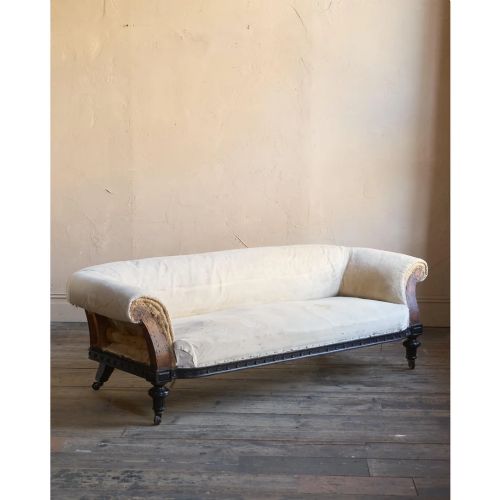
When searching for a curved upholstery settee, buyers encounter generous seating options spanning the nineteenth and early twentieth centuries. These pieces arrive in various configurations, including camel back sofas, crescent chesterfields, canapés, and complete lounge suites.
The versions most commonly met on this page range from Victorian and Edwardian examples to French Louis XVI Revival styles and Art Deco designs. Makers such as Howard & Sons and Hampton & Sons appear alongside French château pieces.
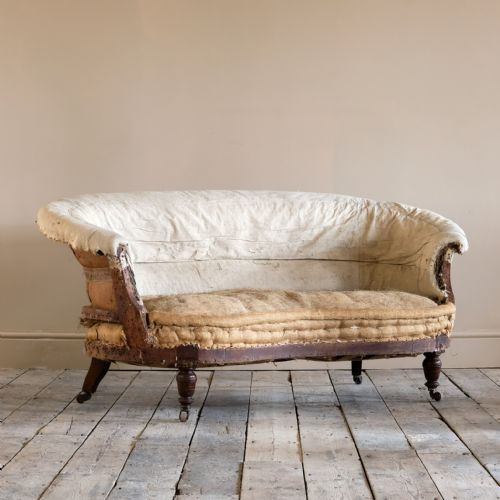
The forms incorporate structural elements like exposed mahogany and walnut frames, caning, and extensive textile coverings. Each settee provides a distinct silhouette defined by its era, whether built for formal reception rooms or relaxed lounging.
How they were made
Makers constructed the foundational frames using hardwoods such as mahogany and walnut, often shaping the timber to follow sweeping, serpentine lines. Brass details sometimes reinforced structural joints or decorated the exterior framework.
Traditional upholstery techniques relied on internal support materials including jute and hessian webbing. Over this foundation, makers applied fabrics like cotton, velvet, and leather to complete the seating surface.
Listings span the nineteenth century through the nineteen-twenties, incorporating hardwoods, brass, and traditional textiles like hessian and jute.
What varies in quality
The standard of a curved upholstery settee rests on the integrity of its wooden frame and the precision of its curved joinery. Superior examples maintain rigid structural stability despite the inherent stress placed on curved timber components.
Distinction also lies in the fidelity of historical revival details, such as hand-carved framework ornamentation and well-executed caning work. The choice of original or sympathetic upholstery materials further elevates the piece's historical coherence.
Howard And Sons·Hampton And Sons
The Curved Upholstery Settee Glossary
- Canapé
- An antique French sofa featuring an upholstered seat and back within a decorative wooden frame. These pieces often display refined carving characteristic of Louis XVI revival styles.
- Chesterfield
- A traditional sofa style distinguished by deep button tufting and rolled arms of equal height to the back. Crescent variations bend the linear form into a gentle curve.
- Camel Back
- A sofa design featuring an undulating, arching top rail that resembles the hump of a camel. This profile creates a graceful focal point across the rear of the settee.
- Hessian
- A coarse woven fabric traditionally used as an internal foundation material for traditional upholstery. It provides durable support beneath top layers of padding and textiles.
- Caning
- A weaving technique utilising rattan strips to create intricate openwork patterns on chair and settee backs. It lightened the visual weight of heavy nineteenth-century wooden furniture.
Curved Upholstery Settee: Frequently Asked Questions
Where should I place a curved settee?
These settees work effectively when floated away from walls to showcase their sweeping rear profiles. They also anchor conversation areas in larger rooms.
Positioning them opposite a fireplace or framing a central rug allows the curved silhouette to define the spatial flow.
How do I identify a French Louis XVI Revival settee?
Look for neoclassical design motifs such as fluted legs, straight lines contrasted with rounded elements, and carved ribbon or floral details. Exposed walnut or giltwood frames are typical.
These pieces often feature Aubusson tapestry or muted velvet coverings that reflect eighteenth-century French interior aesthetics.
What defines an Art Deco settee?
Art Deco pieces emphasise streamlined geometry, bold materials like zebrano wood, and smooth leather upholstery. The designs discard Victorian ornament in favour of sleek, modern curves.
Such suites often incorporate matching armchairs, creating a cohesive seating arrangement typical of the nineteen-twenties.
How do I care for antique upholstery fabrics?
Protect delicate textiles like velvet and cotton from direct sunlight to prevent fading and fibre degradation. Regular gentle dusting preserves the nap of the fabric.
For deeper maintenance, consult professional conservators experienced in handling nineteenth-century stuffing materials like hessian and jute.