




Crystal Champagne Coupes
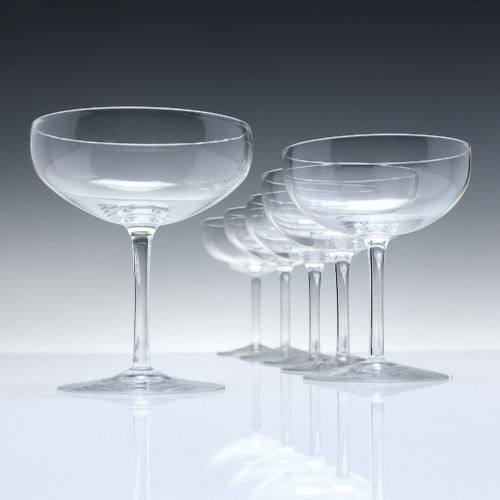
Crystal champagne coupes bring historical elegance to your table, combining broad bowls with sparkling lead crystal for serving sparkling wine.
Crystal Champagne Coupes
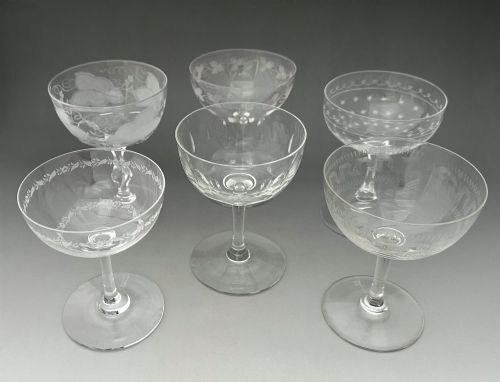
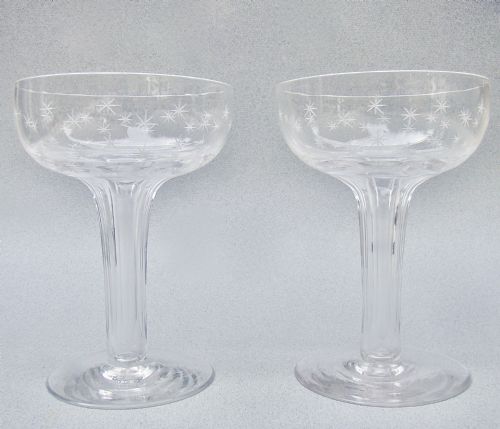
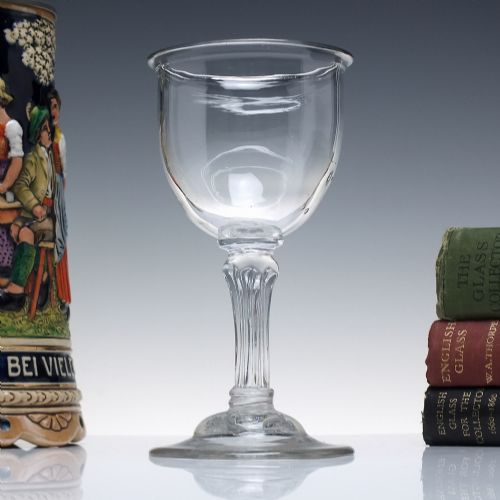
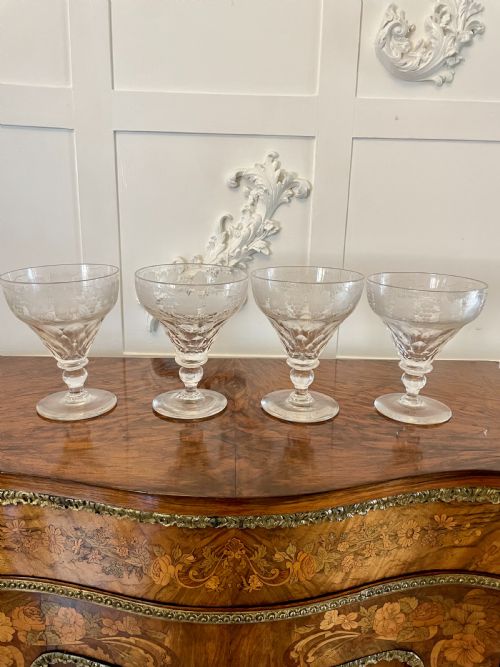
The most common pieces you meet here include matching sets of Edwardian and Victorian glassware, alongside individual pairs dating back to the mid nineteenth century. These vessels often exhibit distinct decorative treatments such as star etching, facet cutting, or coloured overlays on clear glass. Forms range from smaller bowls to larger pedestal stem glasses.
Materials and construction methods
These pieces are manufactured using lead crystal, lead glass, and clear glass, alongside coloured variants like cranberry, green, and red over crystal. The inclusion of lead content gives the material a heavier weight and a clearer ring when struck, which helped artisans achieve brilliant refraction.
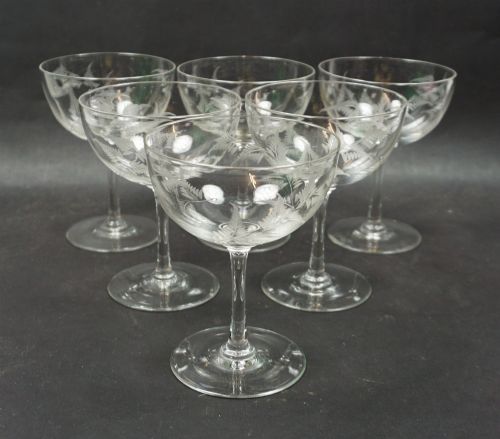
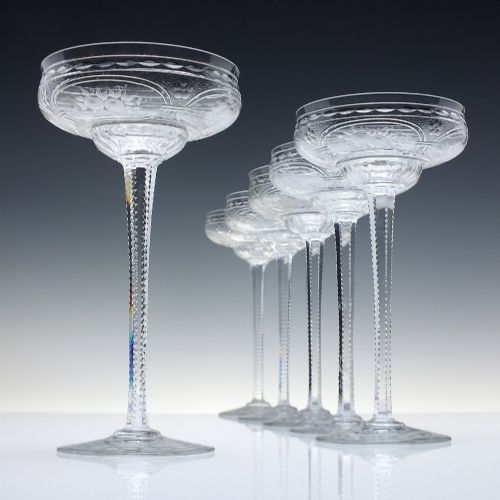
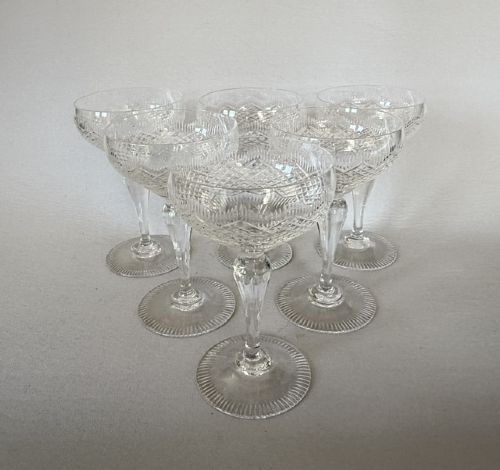
Decoration was achieved through skilled cutting and engraving techniques. Artisans applied wheel-cutting to create geometric facets on stems and bowls, or hand-engraved delicate motifs such as convolvulus and fruiting vines directly onto the glass surface.
Crystal Champagne Coupes Retail Price Guide 2026
Typical asking prices for crystal champagne coupes among the pieces listed under this phrase on Sellingantiques today, from the lower quarter to the upper quarter. They describe what is for sale here now, not the wider market.
Current listings feature glass, lead crystal, and cranberry glass across Victorian, Edwardian, Art Deco, Georgian, and Regency periods.
Assessing quality in antique glassware
Quality in these vessels rests upon the crispness of the cutting and the depth of the hand engraving. Superior pieces display sharply defined facets and smoothly polished surfaces without optical distortion in the glass body.
Consistency across a set dictates the tier of craftsmanship. Matched sets featuring uniform wall thickness, balanced stems, and identical decorative motifs indicate higher workshop standards than mismatched groupings assembled later.
The Crystal Champagne Coupes Glossary
- Champagne coupe
- A stemmed glass featuring a broad, shallow bowl designed for sparkling wine. This shape was popular from the Georgian era through the early twentieth century.
- Lead crystal
- Glass containing a significant proportion of lead oxide, increasing the weight, clarity, and brilliance of the material. It allows for deep, crisp cutting.
- Facet cut
- A decorative technique involving flat polished surfaces ground into the glass. This method enhances light reflection across stems and bowls.
- Overlay
- A technique where a layer of coloured glass is fused over a clear crystal base. Artisans then cut through the coloured layer to reveal the clear crystal beneath.
Crystal Champagne Coupes: Frequently Asked Questions
What periods do these glasses come from?
The pieces span multiple historical eras, starting from Georgian and Regency periods through Victorian and Edwardian times, up to the Art Deco era.
Most items you encounter date from the nineteenth and early twentieth centuries, reflecting the manufacturing styles popular during those decades.
How were coloured coupes made?
Makers utilised an overlay technique, fusing a thin layer of coloured glass, such as cranberry or green, over a clear crystal base.
Engravers then cut through the coloured exterior layer to expose the clear glass underneath, creating striking contrast patterns.
Can I use them for modern dining?
These historical vessels suit special occasions and formal dining settings, offering a tangible connection to past entertaining traditions.
Gentle hand washing preserves the delicate engraving and lead crystal composition during modern use.
What distinguishes bowls from coupes?
The terminology often overlaps in antique glassware descriptions, with both terms referring to shallow vessel forms on stems meant for sparkling wine.
Individual listings may use champagne bowls or champagne glasses interchangeably based on the specific proportions of the bowl.